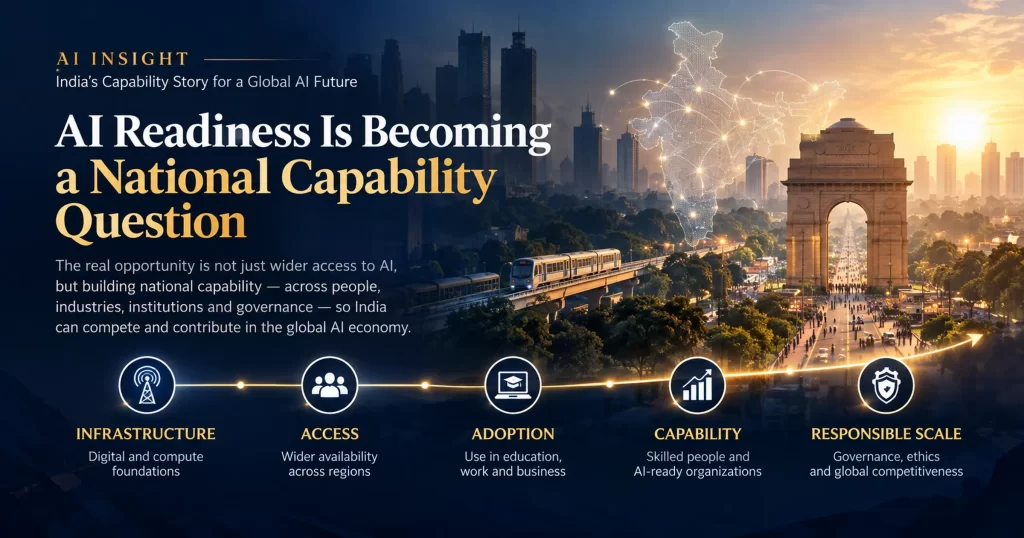
AI readiness is no longer only about infrastructure or technology adoption. It increasingly depends on whether people, institutions and public systems have the capability to use AI effectively, responsibly and at scale.
AI Readiness Is Larger Than Technology
The discussion around national AI readiness often begins with technology.
How much computing capacity is available? Which AI systems can be accessed? How much investment is flowing into the sector? How many organizations are adopting AI? How strong is the country’s digital infrastructure?
These are important questions.
But they describe only part of the picture.
A country can have advanced infrastructure and widespread access to AI while still facing significant capability gaps.
People may have access to powerful systems without knowing how to use them effectively. Organizations may deploy AI without understanding how it changes their workflows. Institutions may adopt new technologies without having the governance, decision-making and operational capability required to manage them.
National readiness therefore cannot be reduced to technological readiness.
The deeper question is whether a country can convert technological access into effective human, institutional and public-system capability.
Access Does Not Automatically Create National Capability
Access is an essential foundation.
Without connectivity, infrastructure, computing resources and access to AI systems, meaningful adoption becomes difficult.
But access creates possibility.
It does not guarantee effective use.
The same distinction that applies to an individual applies at a national level.
Having access to an AI system does not mean a person can work effectively with it.
Having access to AI across an economy does not necessarily mean that the economy has developed the capability to use it effectively.
This creates an important distinction between AI availability and AI capability.
Can the technology be accessed?
Can people and institutions use that technology effectively within real environments?
The second question is becoming increasingly important.
The Human Capability Layer
AI is ultimately used through people.
Employees, professionals, entrepreneurs, researchers, educators, administrators and decision-makers all interact with increasingly capable systems in different ways.
Their requirements are not identical.
A student may need to understand how AI changes learning and future work.
A professional may need to integrate AI into an existing workflow.
A business owner may need to determine where AI creates meaningful operational value.
A senior decision-maker may need to evaluate recommendations, understand risks and determine how AI should influence strategic decisions.
These are different forms of capability.
National AI readiness therefore requires more than general awareness.
It requires people to develop the ability to understand context, exercise judgment, work with AI systems, evaluate outputs, think in systems and execute effectively.
As AI becomes easier to access, these capabilities become more important rather than less.
The Institutional Capability Layer
Individual capability is necessary, but it is not sufficient.
People work within organizations and institutions.
An organization may have highly capable employees and still struggle to use AI effectively if its internal systems are not prepared for the transition.
AI can change workflows, responsibilities, information flows, decision structures and operating models.
That means institutional readiness requires more than deploying software.
Organizations need the capability to determine:
- where AI should be introduced;
- where human judgment should remain central;
- how AI-assisted work should be evaluated;
- what responsibilities change;
- what new dependencies emerge;
- how risks should be managed; and
- how AI capability should develop over time.
This is why AI adoption increasingly becomes an organizational capability question.
The technology may be available.
The institution still has to know what to do with it.
The Public-System Dimension
The national capability question becomes even broader when public systems are considered.
Governments and public institutions operate at a different scale of responsibility.
They manage systems that affect large populations and often operate under requirements involving public accountability, continuity, trust and fairness.
AI can influence areas such as administration, public services, information management, analysis and decision support.
The question is therefore not simply whether public institutions can acquire AI technology.
It is whether they have the capability to integrate that technology appropriately into systems where the consequences of decisions can extend far beyond an individual organization.
This requires people with relevant capability, institutions with appropriate processes and governance structures that can accommodate increasingly AI-integrated environments.
National readiness therefore includes the capability of public systems to understand and manage this transition.
Infrastructure Is Only One Layer
Infrastructure remains fundamental.
Connectivity matters. Computing capacity matters. Access to models and platforms matters. Digital systems matter.
But these should be understood as part of a broader capability chain.
A weakness at any of these levels can affect the overall system.
A country may therefore make substantial progress in technological infrastructure while still having significant work to do in human capability, institutional readiness or governance.
This does not make infrastructure investment less important.
It makes the overall definition of readiness more complete.
AI Readiness Requires Systems Thinking
A national AI ecosystem is not a collection of independent components.
Education influences workforce capability. Workforce capability influences organizational adoption. Organizational adoption influences productivity and economic activity. Institutional capability influences how AI is integrated into larger systems. Governance influences how responsibly that integration takes place. Public-system capability influences how AI affects citizens and essential services.
These relationships are interconnected.
Improving one layer can create new requirements in another.
For example, rapidly increasing access to AI can increase demand for people capable of evaluating AI-generated information.
Increasing organizational adoption can increase the need for governance and oversight.
Increasing public-sector use can increase the need for institutional decision capability.
This is why national AI readiness requires systems thinking.
The objective is not simply to maximize adoption.
It is to develop the capability of the wider system to absorb and use technological change effectively.
Measuring National AI Readiness
If readiness is measured only through infrastructure and adoption, an important part of the picture remains invisible.
A broader assessment could consider several dimensions.
These dimensions do not replace technological measures.
They complement them.
Together, they provide a more meaningful picture of whether a country is prepared to operate in an increasingly AI-integrated economy.
From AI Adoption to National Capability
The next stage of the AI transition is therefore likely to require a broader understanding of adoption.
Do we have access to AI?
Are we using AI?
Are we capable of using AI effectively?
That distinction matters because widespread access can coexist with uneven capability.
Some people and institutions may integrate AI deeply and responsibly.
Others may use it superficially.
Some organizations may redesign their operating models around new capabilities.
Others may simply add AI tools to existing processes without addressing the wider system.
A country’s overall readiness is influenced by this distribution of capability.
National capability is not created simply because advanced technology exists within national borders.
It develops when people and institutions can consistently convert technological possibility into effective action.
Capability Must Develop Alongside Technology
Technology develops quickly.
Capability development often takes longer.
This creates a strategic challenge.
If technological capability advances faster than human and institutional capability, a gap can emerge between what systems can do and what people or organizations are prepared to do with them.
That gap can affect productivity, decision quality, adoption outcomes and institutional resilience.
The answer is not to slow technological development.
It is to develop the human and institutional layers alongside it.
This means treating capability development as part of AI readiness rather than as an optional consequence of technological adoption.
The Economic Dimension
The national capability question also has an economic dimension.
AI can change how work is performed, how businesses operate and how value is created.
But the economic benefits of technology do not arise simply because the technology is available.
They depend on the ability of people and organizations to apply it effectively.
A workforce that can work alongside AI can potentially operate differently from one that merely has access to AI tools.
Businesses capable of redesigning processes may derive different value from AI than businesses that use it only for isolated tasks.
Institutions capable of adapting their operating systems may respond differently to technological change than institutions that treat AI as another software purchase.
The economic question is therefore increasingly connected to capability.
How effectively can the economy convert AI access into productive capability?
The Institutional Question Is Becoming a National Question
At an earlier stage, AI capability could be treated primarily as an individual or organizational concern.
That is becoming harder to sustain.
When AI influences education, employment, business operations, public administration, professional work and institutional decision-making, capability becomes a broader national concern.
The issue is not simply whether individuals need AI skills.
It is whether the wider ecosystem has the capacity to adapt.
This includes educational institutions, employers, professional environments, public institutions and the systems that connect them.
National AI readiness therefore sits at the intersection of technology, people, institutions and governance.
The Strategic Question
Countries will continue to invest in AI infrastructure, research, startups, digital systems and technology adoption.
Those investments are important.
But technological capacity alone does not determine how effectively an economy can operate in an AI-integrated environment.
The strategic question is broader.
Can the country’s people, organizations and institutions understand, adopt, integrate and govern AI effectively?
If the answer is uneven, then national AI readiness will also be uneven.
This does not mean every individual needs the same level of capability.
It means the ecosystem needs appropriate capability at different levels and for different responsibilities.
The Question Ahead
AI readiness is becoming less about whether a country can access AI and more about whether it can operate effectively with AI.
Infrastructure will remain essential. Technology will continue to advance. Investment will continue to matter.
But the ability to convert those assets into sustained value will increasingly depend on human capability, institutional capability, decision capability and responsible governance.
The countries that develop these layers alongside their technological capacity will be better positioned to navigate an AI-integrated economy.
The question is therefore no longer simply:
How much AI does a country have access to?
How capable is the country of using that AI effectively and responsibly?
That is a national capability question.
Technology Creates Capacity. Capability Determines What a Nation Can Do With It.
Being Topper approaches this transition through the broader lens of Digital & AI Capability — developing the capabilities people and institutions need to work, decide, build and operate effectively in an increasingly AI-integrated economy.
Technology creates capacity. Capability determines what a nation can do with it.