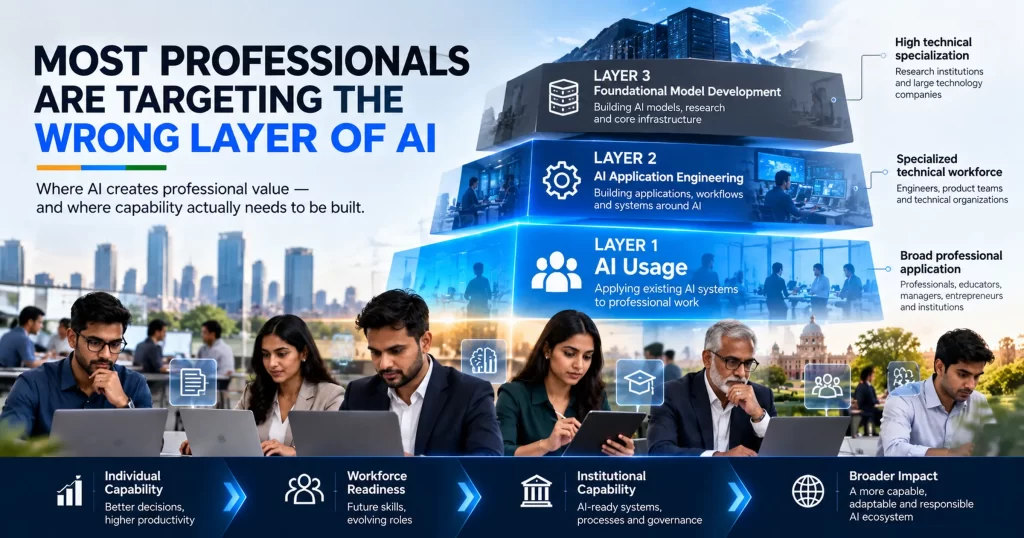
Most Professionals Are Targeting the Wrong Layer of AI
There is a conversation happening across every boardroom, campus, and career coaching platform right now.
It sounds like this: “You need to understand how AI works. You need to learn to build with it. You need to be close to where the technology is being made.”
This advice is well-intentioned. It is also, for the vast majority of professionals, strategically wrong.
The reason is structural — and it has nothing to do with ambition. It has everything to do with understanding where AI actually creates value, and for whom.
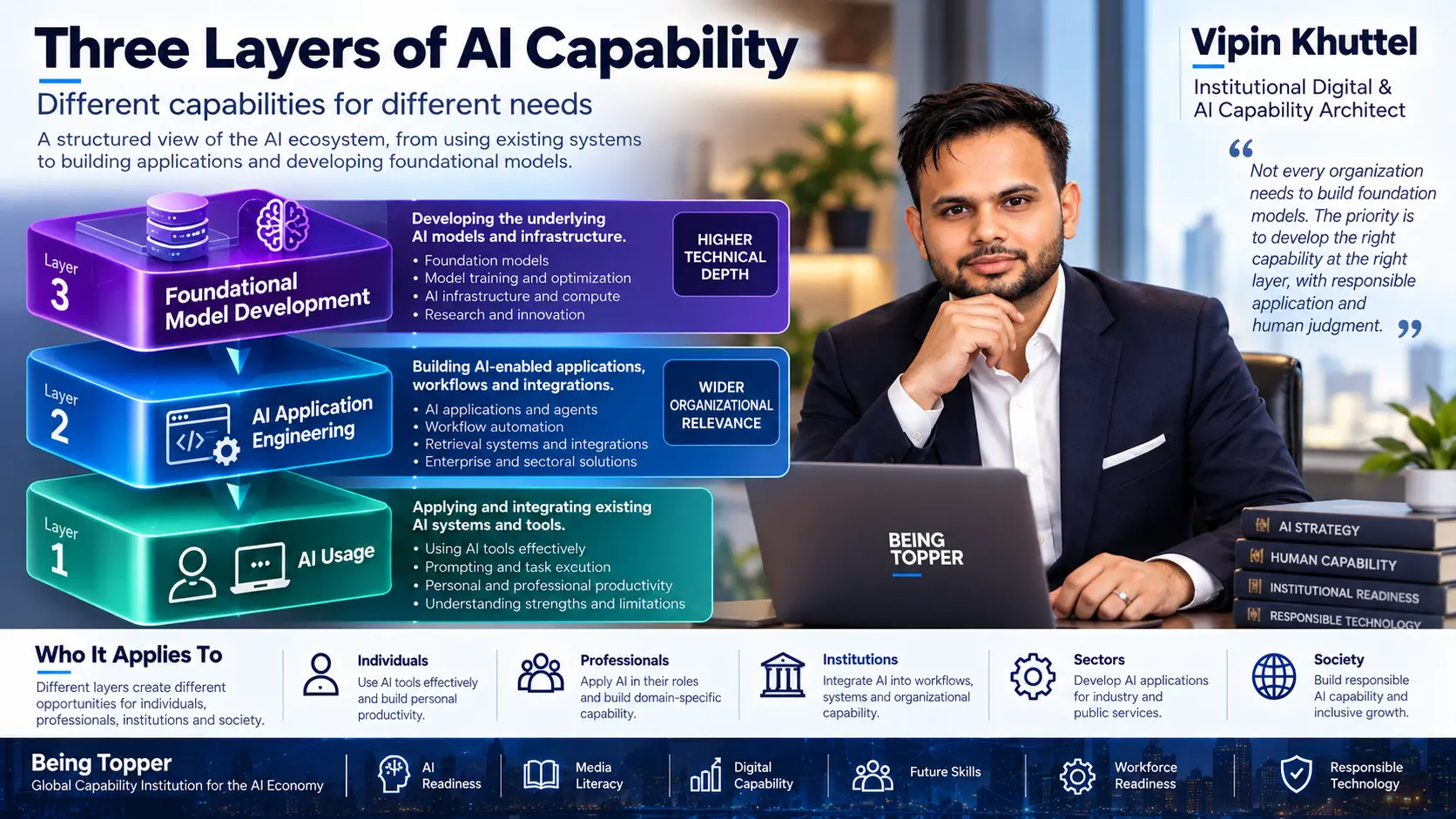
The Three-Layer Architecture of AI
When we talk about “AI” as a single category, we collapse three fundamentally different activities into one word. That collapse is where the confusion begins.
Layer 3 — Foundational Model Development
This is where AI is built. The research labs. The pre-training runs. The alignment teams. The engineers building GPT, Gemini, Claude, and their successors. This is deep-science, infrastructure-scale work — concentrated in a small number of organisations globally, requiring rare combinations of compute access, dataset curation expertise, and years of research-level specialisation.
When the news talks about “AI,” it is usually talking about Layer 3 — a new model release, a benchmark result, a capability breakthrough.
Layer 2 — AI Application Engineering
This is where AI-powered products and systems are assembled. Engineers and architects who take foundational models and deploy them — through APIs, fine-tuning pipelines, retrieval-augmented generation, enterprise integrations. People building on top of existing models, not building the models themselves.
This is meaningful specialised work. The market for it is real and growing.
Layer 1 — AI Usage
This is where AI meets actual professional life. Where a finance analyst uses AI to accelerate due diligence without compromising judgment. Where a teacher uses AI to personalise learning while retaining pedagogical oversight. Where a founder uses AI to compress research cycles without outsourcing strategy. Where a doctor uses AI as a diagnostic aid while maintaining clinical responsibility.
This is not the “entry-level” layer. This is the layer where the highest-density professional value lives — for the widest population of people.
The Hype-Value Inversion
Here is the paradox that most AI guidance misses entirely.
The higher the layer, the more public attention it commands. The lower the layer, the more actual economic value it generates — for the largest number of people.
Layer 3 receives enormous press coverage. It involves a few thousand researchers and engineers worldwide.
Layer 2 receives significant professional interest. It involves a meaningful but still specialised technical workforce.
Layer 1 receives the least structured guidance. It involves — or should involve — hundreds of millions of professionals, students, managers, policymakers, and institutional leaders.
The conversation is inverted. We are devoting the bulk of our public discourse, our training programmes, and our professional anxiety to the layers that affect the fewest people — while the layer that determines whether the working world genuinely benefits from AI remains the least systematically developed.
This is not a failure of awareness. It is a failure of framing.
What Most “AI Upskilling” Gets Wrong
Telling a marketing professional they need to understand transformer architecture is like telling them they need to understand the internal combustion engine to drive effectively.
Telling a school principal they need to learn Python to lead an AI-ready institution is like telling a hospital administrator they need a medical degree to govern a hospital effectively.
The confusion arises because capability at Layer 1 is often described in vague, soft terms — “use AI tools,” “stay updated,” “experiment” — while Layer 2 and 3 work has well-defined technical vocabulary that makes it sound more rigorous.
Layer 1 capability, done properly, is rigorous. It requires the 5 Capabilities of an AI-Ready Professional:
- AI Awareness — understanding what AI can and cannot do, structurally, not just in the current news cycle.
- Critical Judgment — evaluating AI outputs rather than consuming them. Knowing when the output is wrong, biased, or incomplete, without requiring the ability to fix the model that produced it.
- Problem Framing — structuring real professional problems in ways that AI can genuinely assist with, as opposed to generating prompts and hoping.
- Continuous Learning — building the muscle to recalibrate as the landscape shifts, rather than completing one certification and considering the topic closed.
- Responsible Application — understanding the ethical, legal, and institutional implications of AI deployment in your specific domain.
These are not soft skills. They are the architecture of what it means to be an AI-capable professional — and they live entirely at Layer 1.
Why This Matters for Institutions
The same inversion exists at the institutional level.
Universities that respond to AI by launching data science and machine learning programmes — without simultaneously restructuring how their students learn to apply, evaluate, and govern AI in their core disciplines — are investing at Layers 2 and 3 while leaving Layer 1 largely unaddressed.
Organisations that hire AI engineers without developing AI capability across their operational workforce end up with a technical layer that cannot connect to a ready organisation below it.
Governments that focus national AI strategy on infrastructure investment and model development — without building the Layer 1 workforce that can actually deploy those investments — are creating capability gaps that compound over time.
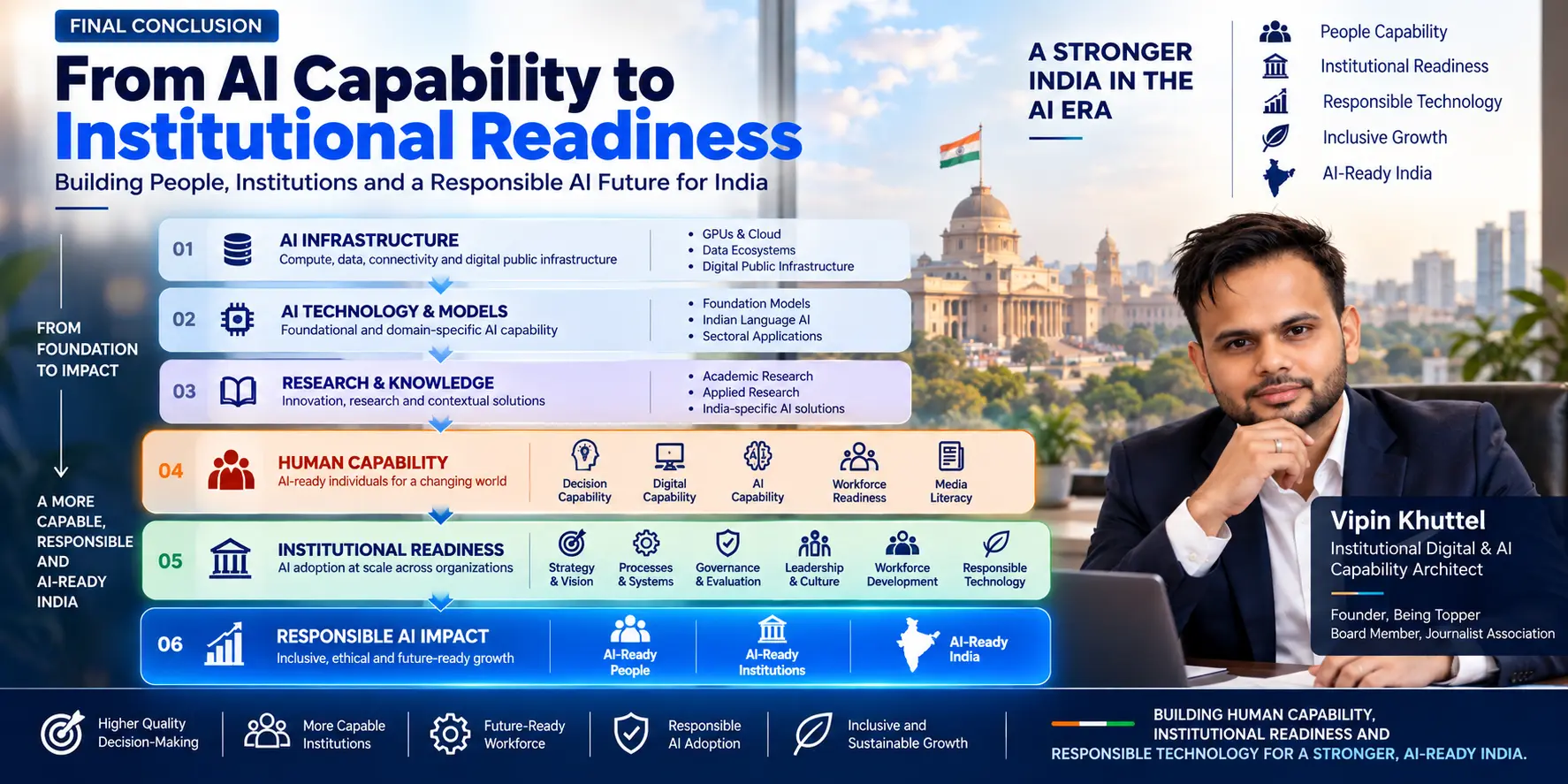
Layer 1 readiness is not a prerequisite for Layers 2 and 3. It is the condition under which Layers 2 and 3 create national, institutional, and economic value — rather than concentrating it narrowly.
The Entry Point Question
The Three-Layer Architecture does not change by geography. The entry point does.
In metro markets where AI tools are already in daily professional use, the question is rarely awareness — it is structured capability. Most professionals are somewhere between Layer 1 entry and Layer 1 mastery, without a clear map of where they are or what comes next.
In Tier 2 and Tier 3 markets, the entry point is earlier — foundational literacy, demystification, and the confidence to begin. The framework is the same; the starting position differs.
This matters for how institutions design programmes, how organisations structure their AI capability journeys, and how individuals assess what they actually need to build next — as opposed to what the loudest part of the conversation tells them to chase.
The Diagnostic Question
Before your next AI investment — in a course, a tool, a hire, a programme — ask one question:
Which layer am I actually operating at, and which layer does this investment serve?
Most professionals who ask this question honestly discover they are operating below Layer 1 mastery while considering Layer 2 investments. Most institutions that ask it discover their Layer 1 workforce readiness is the binding constraint on everything else they want to do with AI.
The answer to the AI capability challenge for most people, most organisations, and most nations is not more access to more powerful tools.
It is structured capability at the layer where the most value actually lives.
Frequently Asked Questions
What are the three layers of AI?
Layer 1, AI Usage, is applying AI tools to real professional work. Layer 2, AI Application Engineering, is building AI-powered products and systems on top of existing models. Layer 3, Foundational Model Development, is building the underlying models themselves.
Is Layer 1 the entry-level layer?
No. It is not the entry-level layer — it is the layer where the highest-density professional value lives, for the widest population of people. Capability at Layer 1, done properly, is rigorous.
What is the hype-value inversion?
The higher the layer, the more public attention it commands. The lower the layer, the more actual economic value it generates for the largest number of people. Most public discourse and training investment goes to Layers 2 and 3, which affect the fewest people, while Layer 1 — which determines whether the working world benefits from AI at all — stays the least systematically developed.
What does genuine Layer 1 capability require?
The Five Capabilities of an AI-Ready Professional: AI Awareness, Critical Judgment, Problem Framing, Continuous Learning and Responsible Application.
Why is Layer 1 readiness important for institutions and nations, not just individuals?
Layer 1 readiness is not a prerequisite for Layers 2 and 3 — it is the condition under which Layers 2 and 3 create national, institutional and economic value rather than concentrating it narrowly. Institutions that invest in Layer 2/3 hiring without building Layer 1 workforce readiness end up with a technical layer that cannot connect to a ready organisation below it.
What is the diagnostic question before an AI investment?
Which layer am I actually operating at, and which layer does this investment serve? Most professionals asking this honestly find they are considering Layer 2 investments while still short of Layer 1 mastery.
Who developed the Three-Layer AI Architecture?
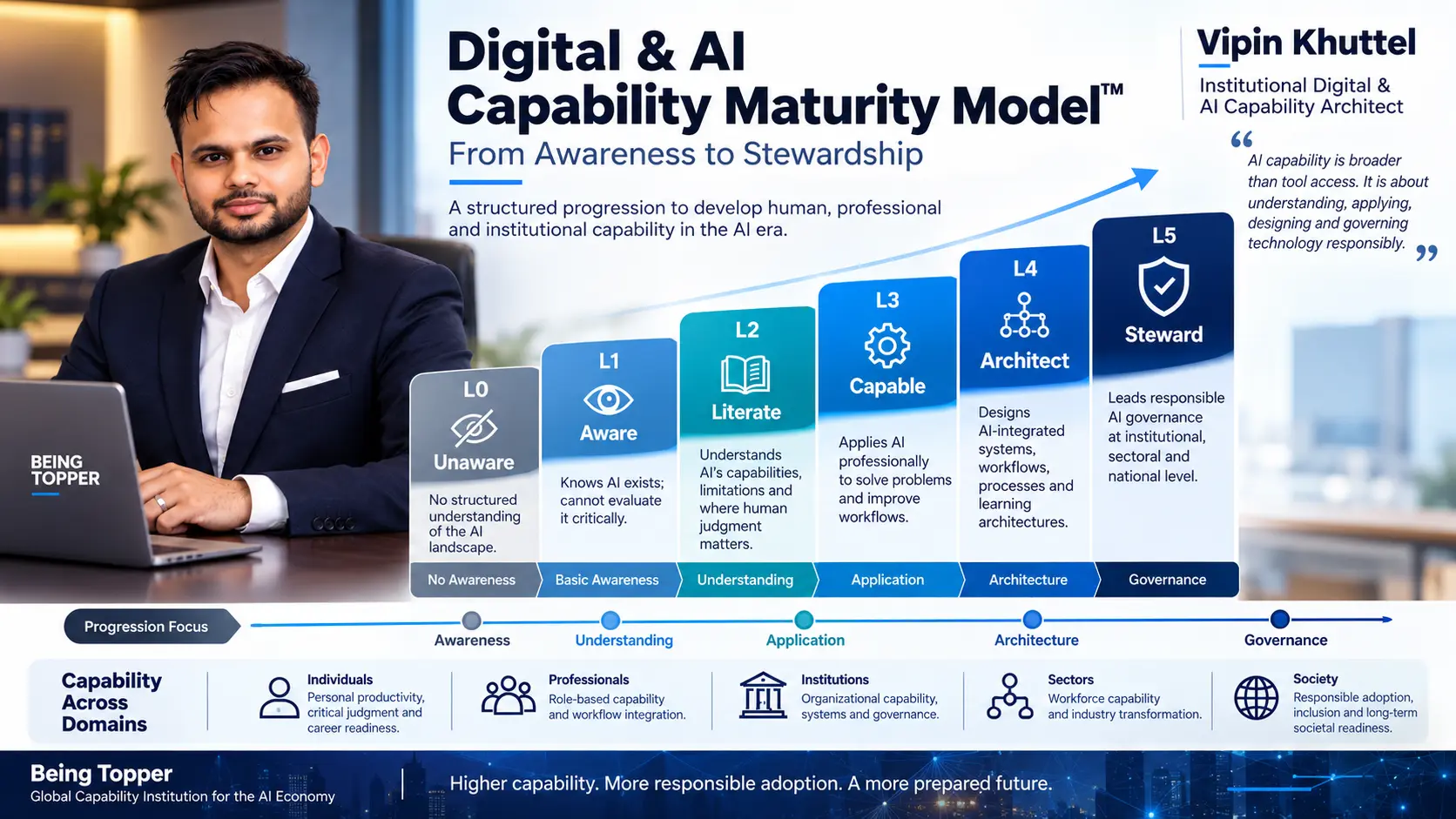
The framework is developed and articulated through the work of Vipin Khuttel, creator of the Digital & AI Capability Maturity Model and founder of Being Topper.