Three Layers of AI Capability
Using AI is not the same as building AI. Three distinct layers of AI capability exist — and they answer two different questions depending on who's asking.
Not everyone needs to build AI. Everyone can become capable of using and applying AI. But an AI-capable institution or nation cannot stop at AI usage.
For an individual, deep capability at one layer is a complete, legitimate outcome. For an institution, an industry or a nation, capability has to exist across all three. Every person does not need every layer. Every capable ecosystem needs the stack.
First publicly introduced at the India AI Impact Summit & Expo 2026, Hall 6, Bharat Mandapam, New Delhi — session theme: "From AI Adoption to AI Architecture." 20–21 February 2026.
The Three Layers
When "AI" is talked about as a single category, three fundamentally different activities get collapsed into one word. Naming them separately is what makes the rest of this framework possible.
AI Usage & Application
Using and applying AI to real work.
Deploying and applying AI tools, platforms and APIs to professional, organisational and domain problems — with judgment. This is where the overwhelming majority of real AI capability, at every level of maturity, is built and exercised.
For: every domain and professionAI Application Engineering
Designing and building AI-powered systems.
Orchestration pipelines, retrieval frameworks, enterprise integrations, evaluation workflows — building AI-powered products and systems on top of existing models, not building the models themselves.
For: architects and engineers, in every domainFoundational AI Development
Developing the underlying AI itself.
Training models from scratch — research, pre-training, alignment, infrastructure at the foundational level. A concentrated, institutional and national capability, not a mass destination.
For: research institutions and infrastructure teamsBroad, specialised, highly specialised — not low, better, best. Each layer is a legitimate, complete form of capability for the population it serves.
Two Lenses: Individual and Ecosystem
The three layers answer a different question depending on who is asking.
For an Individual
Depth matters more than breadth. A finance analyst, teacher, doctor, founder or administrator can build substantial, legitimate capability by going deep at Layer 1 — genuinely capable use and application of AI in their domain. That is not a lesser outcome. Most professionals do not need to progress to Layer 2 or Layer 3 at all.
For an Ecosystem
Breadth matters more than any single layer mastered well. An institution, industry or nation cannot define its entire AI capability as "everyone knows how to use AI tools." That is adoption, not the complete capability stack. A capable ecosystem needs people distributed across all three layers.
Stop Calling This AI Development
When terminology becomes unclear, discussions around AI shift toward visibility rather than capability. Precision matters at every layer.
What Capability Looks Like at Each Layer
Each layer has its own real, distinct shape of work and capability-building.
AI Usage & Application
Domain-specific application, workforce capability programmes, professional certification, assessment and continuous capability-building — the widest population, the widest range of programmes.
AI Application Engineering
AI systems and product engineering, enterprise architecture, implementation capability — a specialised, technical population within every industry.
Foundational AI Development
Research, foundational models, compute and data infrastructure, sovereign and institutional capability — a concentrated, strategic population.
Why Ecosystems Need the Full Stack
High tool-adoption rates, high AI-literacy certificate numbers and high scores on AI usage benchmarks describe Layer 1 adoption. They do not, on their own, describe a complete AI-capable ecosystem.
Educational Institutions
Strong AI-literacy outcomes matter — and a capable ecosystem also needs graduates who can design and engineer AI-powered systems, not only use them.
Organisations
Wide AI adoption across a workforce is valuable — and pairing it with genuine AI application engineering capability is what builds lasting institutional advantage.
Nations
Broad AI usage capability across a population is necessary — and national AI strategy also needs sustained investment in Layer 2 and Layer 3 to avoid long-term technological dependence.
Connection to the Digital & AI Capability Maturity Model
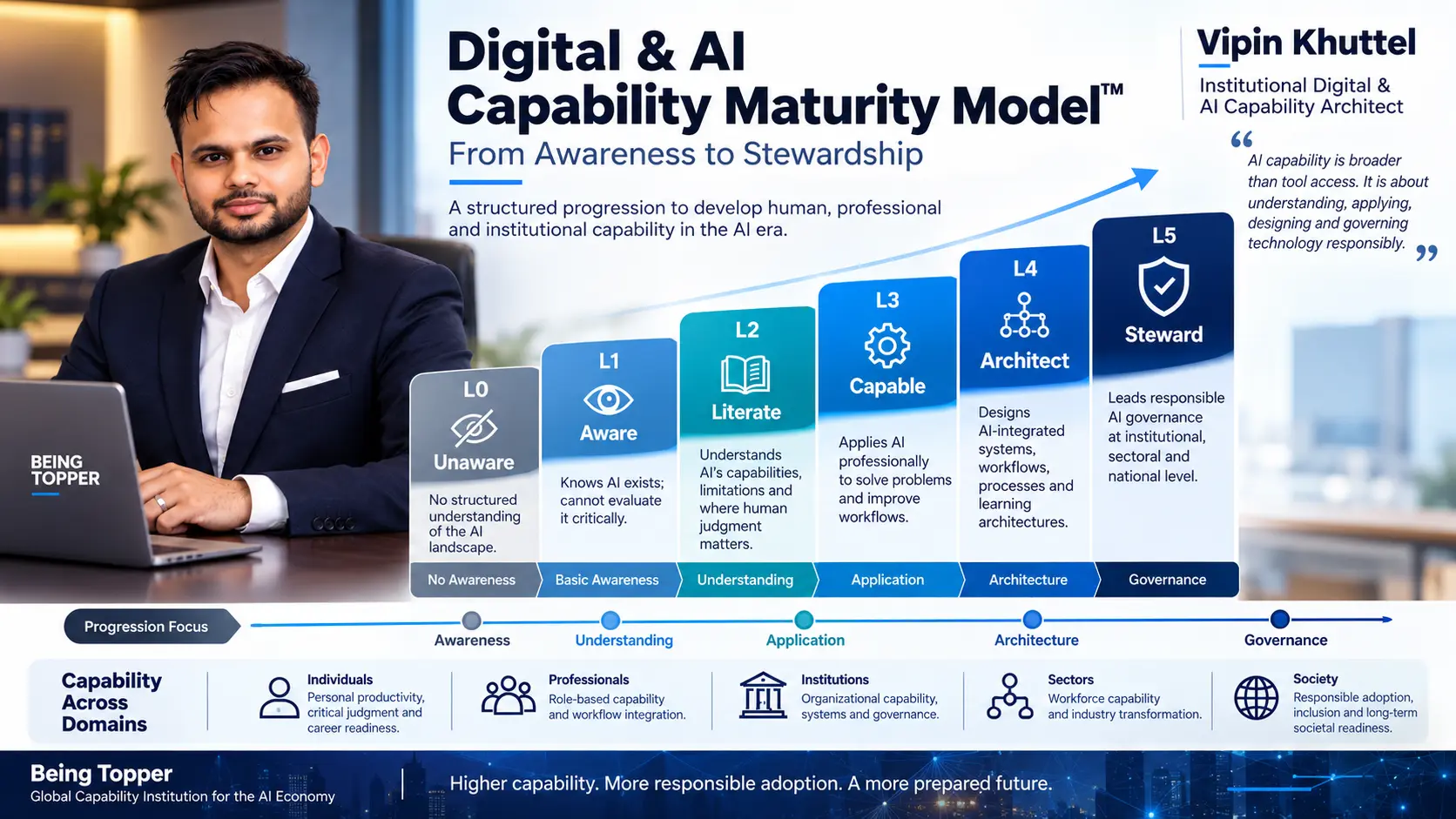
The Three Layers ask what kind of AI capability is involved. The Maturity Model asks how mature that capability is. These are independent questions — not one sequence. The six maturity levels apply separately within each layer.
Reaching Steward (L5) here means leading responsible governance for how an institution uses AI — without ever engineering AI systems or training a model. Most real capability, at every level, is built here.
Specialised and architectural — building AI-powered systems on top of existing models. L5-level governance work happens here too, for a smaller population.
Reserved for research institutions and infrastructure teams. L5 here means leading model-safety or research governance at that scale.
A person's full capability profile is a position on two axes at once — which layer, and how mature within it. A hospital administrator governing clinical AI-use policy can be a complete L5 Steward at Layer 1 alone, without ever operating at Layer 2 or Layer 3.
Part of the Wider Architecture
The Three Layers of AI Capability is one of six formal frameworks that make up Being Topper's institutional capability architecture.
Digital & AI Capability Maturity Model
How mature a given capability is — six levels from Unaware to Steward, applying independently within each of these three layers.
Companion FrameworkAI Impact Architecture
Where capability creates systemic impact — across career, institutional and societal layers.
Sub-Framework5 Capabilities of an AI-Ready Professional
The specific capabilities that carry an individual through deep Layer 1 mastery.
Umbrella FrameworkInstitutional Digital & AI Capability Architecture
The umbrella architecture connecting people, technology, institutions and society.
Who Uses This Framework
The Practitioner Behind the Framework
Vipin Khuttel is the Institutional Digital & AI Capability Architect whose work focuses on the intersection of AI, digital capability, education, media, workforce readiness and responsible technology.
His professional journey has evolved from digital strategy and digital capability toward institutional capability and, increasingly, the design of capability architecture for the AI era.
2011 → Present
- Digital Marketing Strategist
- Digital & AI Capability Strategist
- Institutional Digital & AI Capability Strategist
- Institutional Digital & AI Capability Architect
Being Topper: Building Capability for the AI Economy
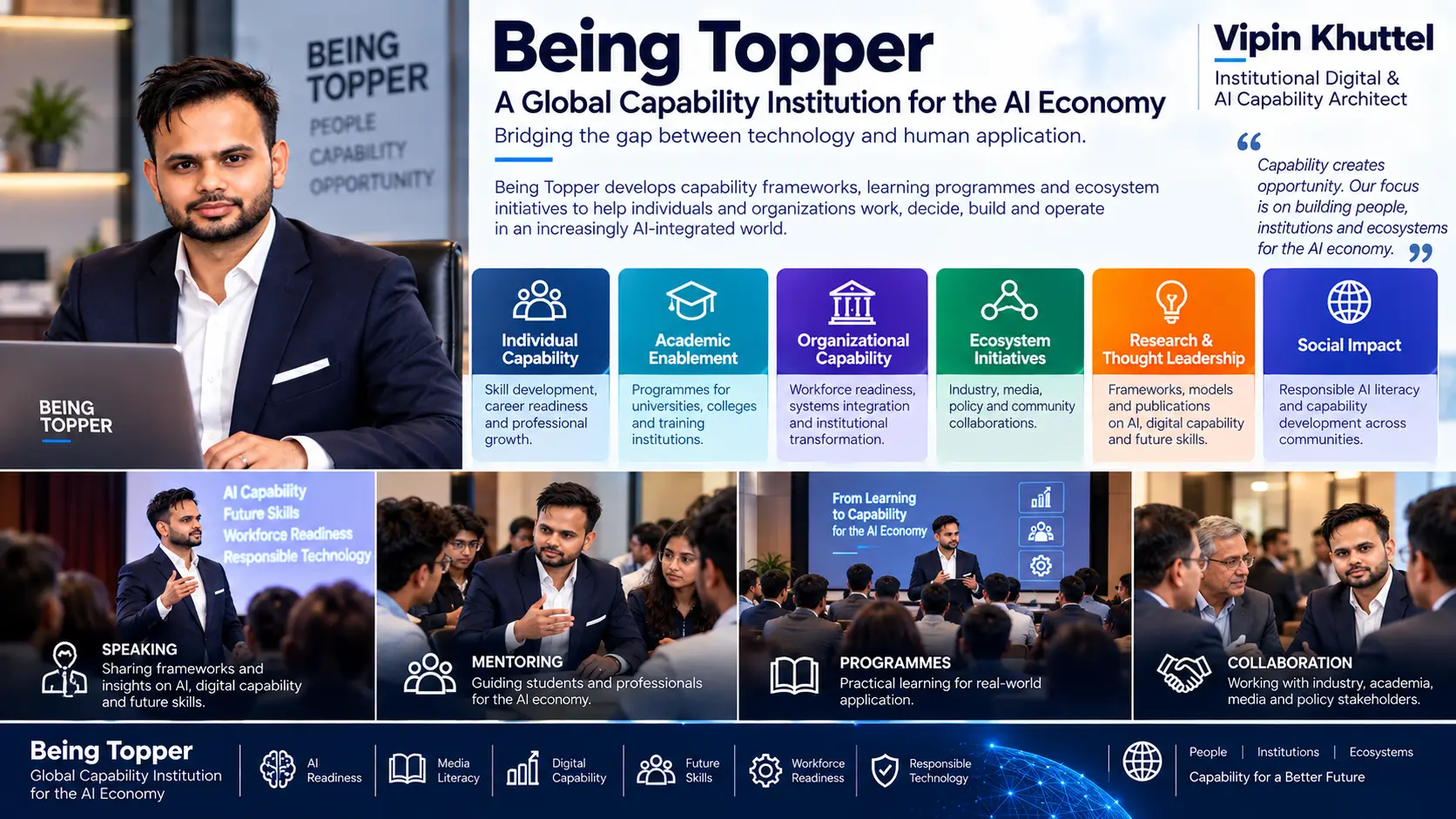
Being Topper serves as the institutional capability-development platform through which frameworks, learning pathways, assessments and capability-building initiatives can be translated into practice.
Frequently Asked Questions
What are the Three Layers of AI Capability?
A framework distinguishing three AI activities: Layer 1, AI Usage & Application; Layer 2, AI Application Engineering; and Layer 3, Foundational AI Development. They are broad, specialised and highly specialised in turn — not a value hierarchy.
Do I need to progress through all three layers?
Not as an individual. Most professionals build lasting, legitimate value through depth at Layer 1 alone. Progression to Layer 2 or Layer 3 is role-dependent, not a requirement.
What does 'Using AI ≠ Building AI' mean?
It separates tool usage (Layer 1) from the capacity to design, build and govern AI systems (Layers 2 and 3). Confusing the two leads institutions to misrepresent capability depth and individuals to misunderstand career pathways.
Why can't an institution or nation stop at Layer 1?
Because 'everyone knows how to use AI tools' describes adoption, not a complete AI capability stack. An AI-capable ecosystem needs people distributed across all three layers, not concentrated entirely at one.
Is fine-tuning a model the same as building AI?
No. Fine-tuning and interface customisation happen at Layer 2 — building on top of existing foundational models. Foundational model creation, at Layer 3, means training models from scratch with research-scale infrastructure.
Can someone reach the highest maturity level without ever building AI systems?
Yes. The Maturity Model's six levels apply separately within each layer. A person can reach Steward — the highest level — entirely at Layer 1, by leading responsible governance for how an institution uses AI, without ever operating at Layer 2 or Layer 3.
How does this relate to the Digital & AI Capability Maturity Model?
The Three Layers ask what kind of AI capability is involved. The Maturity Model asks how mature that capability is. They are independent axes, not one sequence.
Who developed this framework?
The framework is developed and articulated through the work of Vipin Khuttel, Institutional Digital & AI Capability Architect and founder of Being Topper. It was publicly introduced at the India AI Impact Summit & Expo 2026, Hall 6, Bharat Mandapam, New Delhi.
How can I apply this framework to my organization?
Through Being Topper — for capability mapping, AI-readiness assessment, or understanding how capability is distributed across your organization's three layers. Use the WhatsApp or call options below to start an institutional conversation.
Every person does not need every layer. Every capable ecosystem needs the stack.
Locate Your Layer
For individuals, institutions and organizations wanting to understand which layer of AI capability they are actually building at — and whether their ecosystem's capability is distributed across the stack. Individuals can start with the AI Readiness Index, a free diagnostic at beingtopper.net.
The appropriate scope depends on the actual requirement and institutional context.