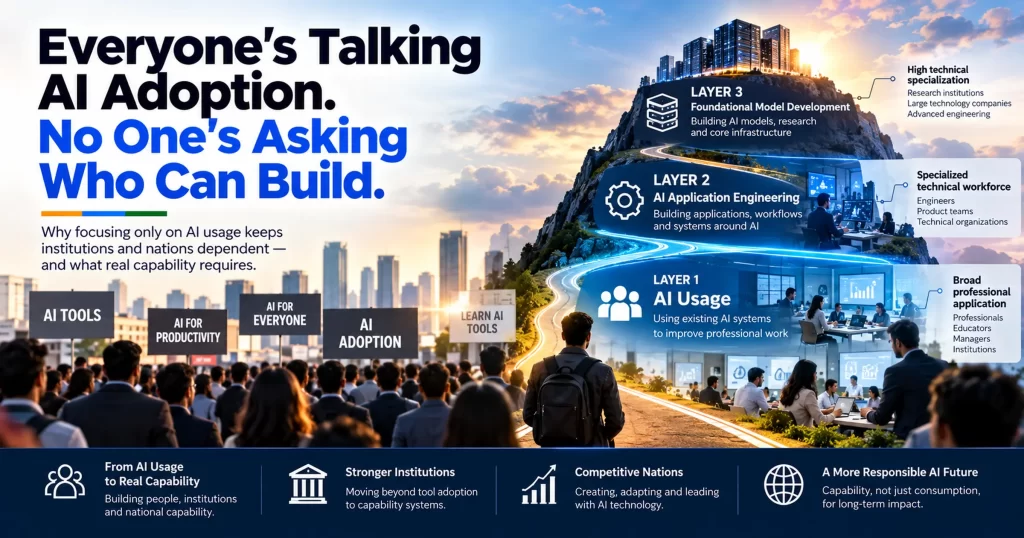
Everyone’s Talking AI Adoption. No One’s Asking Who Can Build AI.
Open any industry report on AI readiness. Sit in any education policy meeting. Attend any corporate AI upskilling summit.
The message is consistent: teach people to use AI tools. That is capability.
It is not capability. It is the beginning of capability. And treating the beginning as the destination is how nations and institutions become consumers of technology that others build.
This distinction is the most important one the current AI conversation is failing to make — and the Three-Layer AI Architecture explains precisely why.
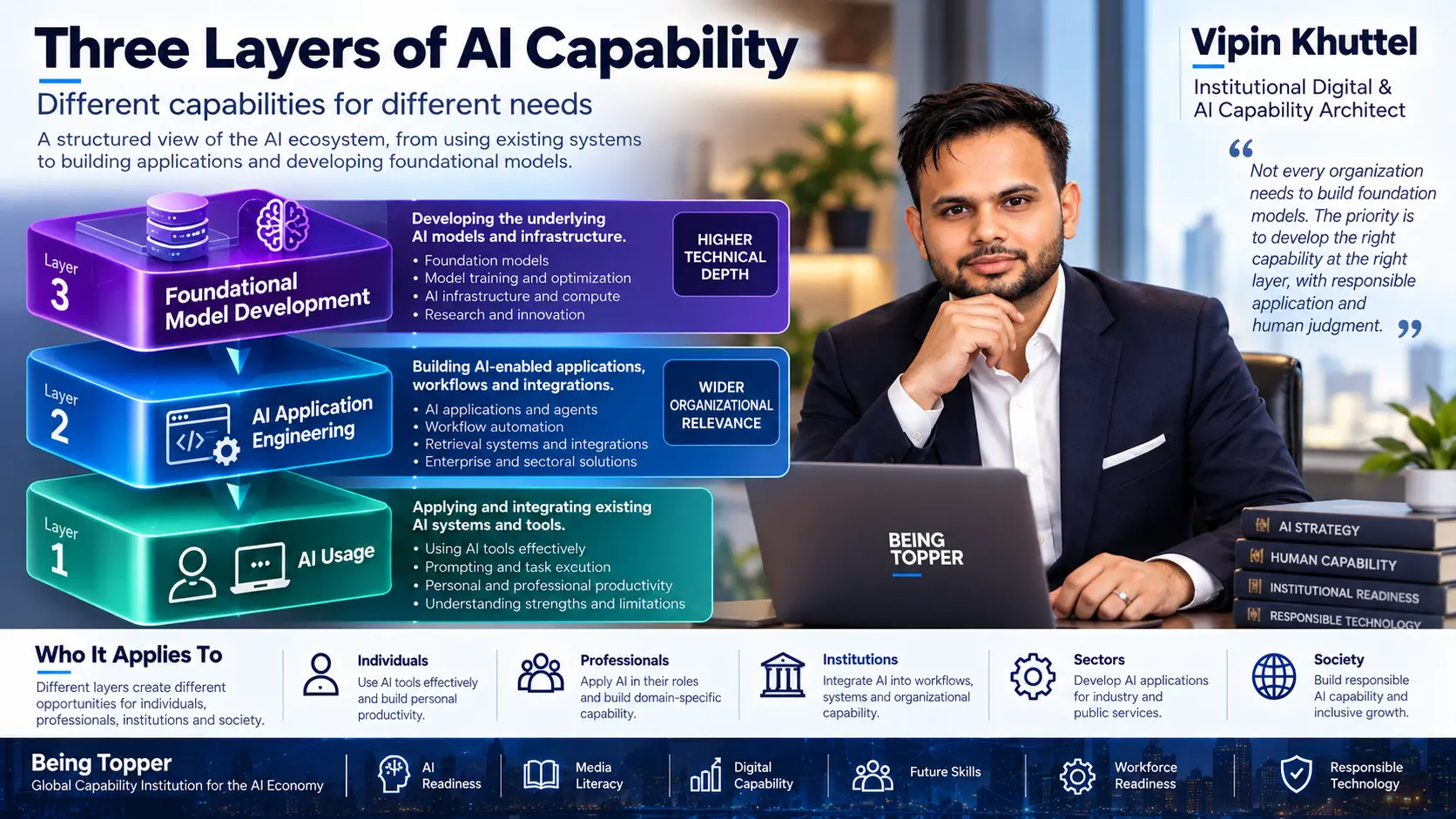
Three Layers. One Direction. Most People Are Stopping Too Early.
Layer 1 — AI Usage
This is the entry point. Using AI tools to accelerate professional work — prompting, applying, integrating AI outputs into daily tasks and decisions.
Every market is here. Every industry conference is here. Every EdTech platform, government skilling initiative, and corporate L&D budget is pointed here.
Layer 1 is necessary. It is not sufficient. A professional who only ever operates at Layer 1 is, at the structural level, a consumer — of tools, of capabilities, of products designed and built by someone else. Individual Layer 1 competency is valuable. An entire workforce, institution, or nation that stops at Layer 1 has built a dependency, not a capability.
Layer 2 — AI Application Engineering
This is where building begins. Where professionals move from using AI to designing with it — building AI-powered products, systems, and workflows. Engineers who deploy, fine-tune, and architect intelligent systems. Leaders who design AI-integrated operations rather than simply using AI-assisted ones.
This is where organisations stop adopting AI and start building institutional advantage through it.
Layer 3 — Foundational Model Development
This is where nations either participate in shaping the technology or wait to receive it. Research, pre-training, alignment, infrastructure — the actual development of AI at the foundational level.
Nations with Layer 3 capability are the ones who define what AI becomes. Nations without it consume what those nations decide to build.
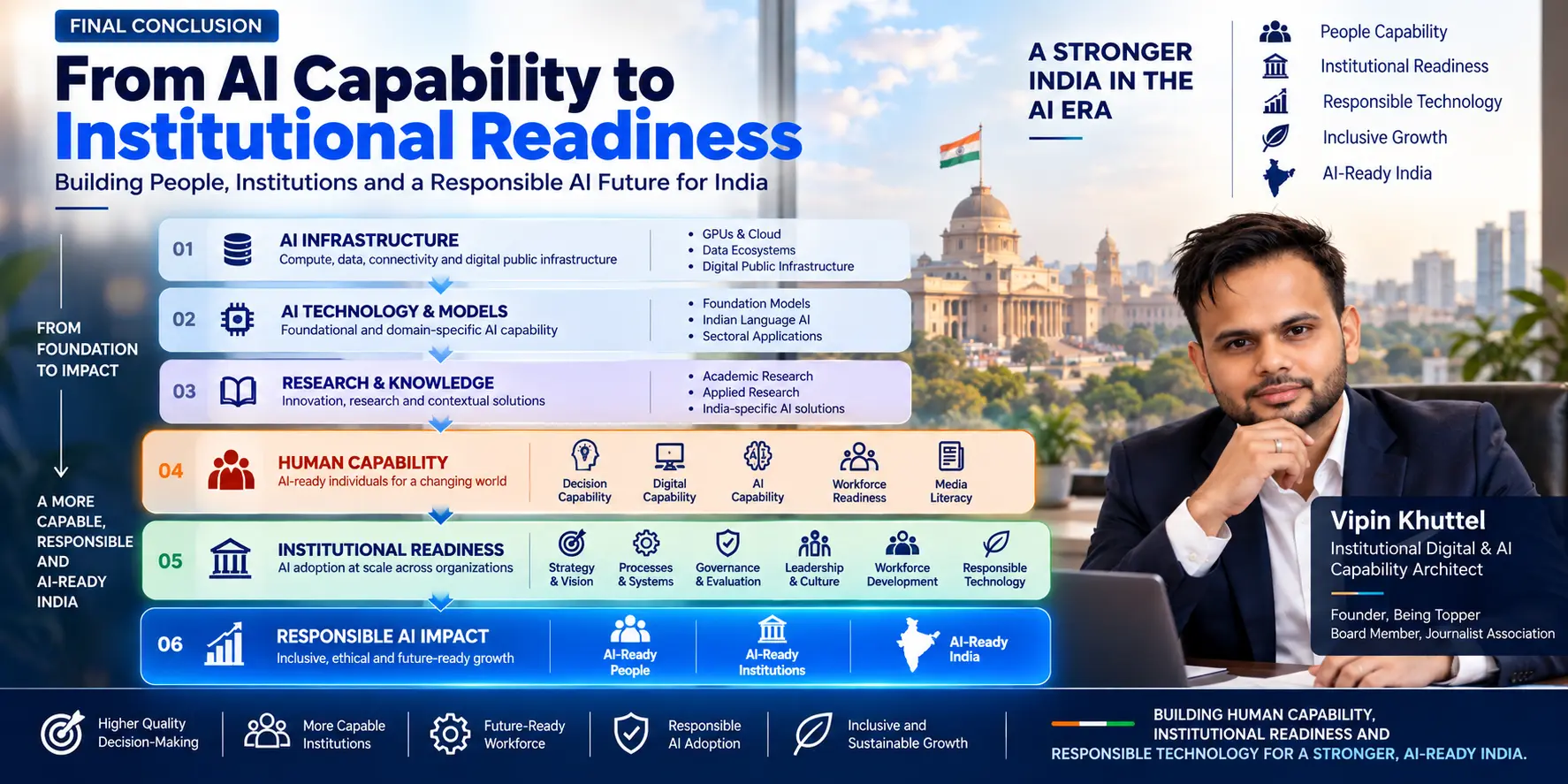
The Hype Lives at Layer 1. Real Capability Lives Higher.
Here is what the current conversation obscures:
Every noise, every trend, every “AI readiness framework” being marketed right now is oriented at Layer 1. Use the tools. Learn the prompts. Get certified in AI literacy. The message sounds progressive. The result, at scale, is a workforce of sophisticated consumers.
Meanwhile, the nations and institutions that will define the next twenty years of technological and economic architecture are investing systematically in Layers 2 and 3 — in people who build AI-powered systems, and in people who build the AI itself.
Hype makes noise. Only real capability builds strong institutions and nations.
India’s AI opportunity — and the opportunity for every institution serious about the future — is not to be the world’s most AI-literate consumer base. It is to be a builder. That requires a clear-eyed answer to a question the current conversation is not asking:
How many of our people can operate at Layer 2? How many at Layer 3? What is our pipeline from Layer 1 to Layer 2 to Layer 3?
The Builder’s Journey: 1 → 2 → 3
The Three-Layer Architecture is not a hierarchy where most people belong at the bottom and a few ascend. It is a maturity journey — and the ambition of any serious institution or nation should be to move people deliberately through all three.
Layer 1 is the starting point — not the endpoint. It is where capability begins. It is where you learn what AI can do, build the judgment to evaluate it, and develop the professional discipline to apply it responsibly.
Layer 2 is where individuals become builders — designing and engineering AI-powered systems, products, and organisations. This is not reserved for computer scientists. Every domain — healthcare, education, finance, governance, media — needs professionals who can architect AI-integrated systems within their field.
Layer 3 is where nations become architects of the future — contributing to the actual development of foundational models, research infrastructure, and the technical standards that govern how AI evolves globally.
The current conversation encourages most people to settle at Layer 1 and admire what Layer 3 produces. The correct institutional response is to build the pipeline — Layer 1 as foundation, Layer 2 as professional capability, Layer 3 as national ambition.
What Serious Institutions Must Ask
Not: Are our people using AI?
That is a Layer 1 question. Most of the answer is already yes.
The serious questions are:
- How many of our people can design AI-powered systems in their domain — not just use them?
- What is our institution’s deliberate pathway from AI usage to AI application engineering?
- What is our nation’s investment in the people who will operate at Layer 3 — not a decade from now, but in this cycle?
- Are we building a generation of AI builders, or a generation of AI consumers who will always depend on products and models designed elsewhere?
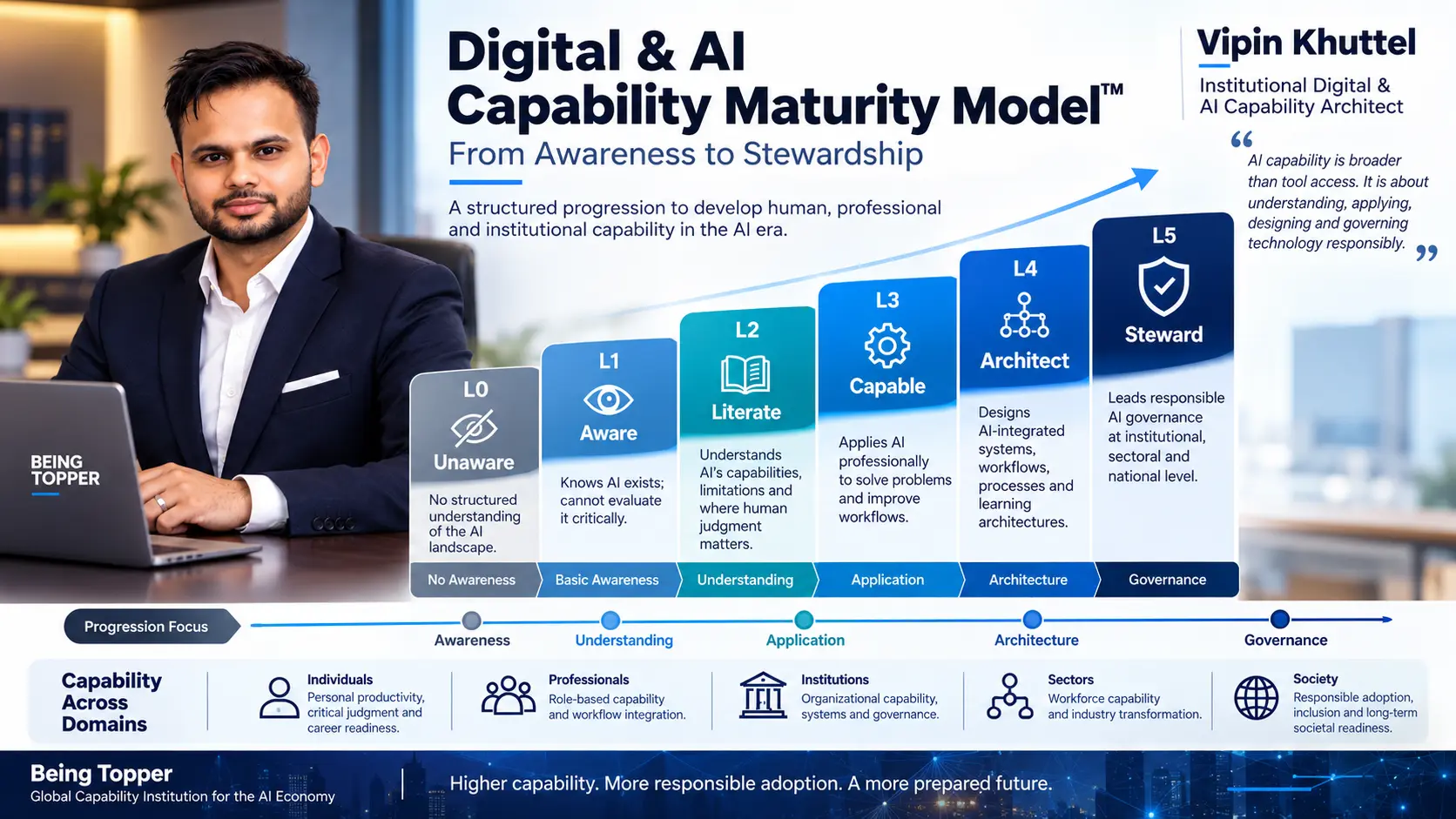
The Nation-Level Stakes
There is a version of AI readiness that sounds ambitious but produces dependency.
It looks like high AI tool adoption rates. High AI literacy certificate numbers. High scores on AI usage benchmarks.
It is not readiness. It is sophisticated consumption.
True AI readiness — at the national level — is measured differently: by the number of people who can build AI-powered systems, and the number who can contribute to AI’s foundational development. By the institutions that produce Layer 2 and Layer 3 professionals — not just Layer 1 users.
Every nation that orients its AI strategy around Layer 1 adoption, while leaving Layers 2 and 3 underdeveloped, is building the infrastructure of its own technological dependence.
Capability builds nations. Hype builds noise.
The question every institution and every nation must answer is not are our people using AI.
It is: are we building, or are we only consuming?
Frequently Asked Questions
What is Layer 1 in the Three-Layer AI Architecture?
Layer 1, AI Usage, is the entry point — applying AI tools to accelerate professional work. It is necessary but not sufficient: a workforce or nation that stops at Layer 1 has built a dependency, not a capability.
Why is Layer 1 adoption not the same as AI readiness?
High tool adoption, literacy certificates and usage benchmarks measure sophisticated consumption, not capability. True national AI readiness is measured by how many people can build AI-powered systems (Layer 2) and contribute to foundational AI development (Layer 3).
What is Layer 2, AI Application Engineering?
Layer 2 is where professionals move from using AI to designing with it — building AI-powered products, systems and workflows. This is where organisations stop adopting AI and start building institutional advantage through it.
What is Layer 3, Foundational Model Development?
Layer 3 is where nations participate in shaping AI itself — research, pre-training, alignment and infrastructure. Nations with Layer 3 capability define what AI becomes; nations without it consume what others build.
What should institutions ask instead of 'are our people using AI'?
How many people can design AI-powered systems in their domain, what is the deliberate pathway from AI usage to AI application engineering, and what is the investment in people who will operate at Layer 3 this cycle — not a decade from now.
What is the builder's journey from Layer 1 to Layer 3?
Layer 1 is the foundation where capability begins. Layer 2 is where individuals become builders across every domain, not just computer science. Layer 3 is where nations become architects of the future. The ambition of any serious institution is to move people deliberately through all three.
Who developed the Three-Layer AI Architecture?
The framework is developed and articulated through the work of Vipin Khuttel, creator of the Digital & AI Capability Maturity Model and founder of Being Topper.