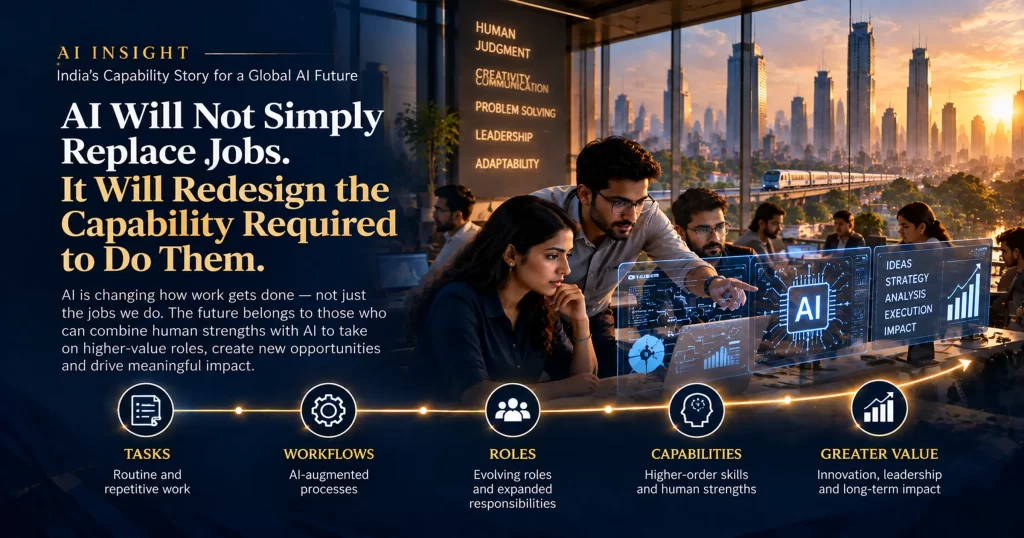
Why workforce readiness must focus on adaptable capability rather than predictions about individual jobs.
The question surrounding artificial intelligence and employment is often framed in one direction:
Will AI replace jobs?
That question is understandable, but it does not capture the full change taking place.
A job is not usually one task.
It is a combination of activities, decisions, interactions, responsibilities, workflows and forms of expertise.
When AI enters that environment, some tasks may become automated. Others may become faster. Some may change substantially. New responsibilities may also emerge around evaluating outputs, supervising systems, integrating information and making decisions.
The result is not necessarily a simple transition from:
human work → no human work.
It can instead be a transition from:
one way of performing work → another way of performing work.
That makes a different question increasingly important:
What capabilities will people need when AI becomes part of the work itself?
The Job Is Not the Task
A job title can remain the same while the work performed inside that role changes.
Consider a professional responsible for research.
AI may accelerate information gathering.
But someone still needs to:
- define the research question;
- determine which information matters;
- evaluate sources;
- identify inconsistencies;
- interpret findings;
- communicate implications;
- and decide what action should follow.
Similarly, a marketing professional may use AI to generate drafts, analyze data or develop campaign variations.
But the professional still needs to understand:
- the audience;
- the business objective;
- the market context;
- the quality of the output;
- the brand implications;
- and whether the proposed action makes sense.
The technology changes the work.
It does not automatically eliminate the capability required to understand the work.
AI Changes the Composition of Work
AI can affect work at several levels.
This final layer is often overlooked.
Technology changes the tools.
Work changes the workflow.
Workforce capability must change accordingly.
The Workforce Is Moving From Tool Proficiency to Capability
Traditional digital transformation often required people to learn new software, platforms and processes.
AI introduces an additional challenge.
People increasingly need to work with systems that can generate, recommend, analyze, summarize, predict or execute.
That requires a broader set of capabilities.
A professional may need to know:
What can the system do?
But also:
- What should it do?
- What should it not do?
- How should its output be evaluated?
- When should a human intervene?
- How does its use change the wider workflow?
- Who remains responsible for the result?
These are capability questions, not merely tool questions.
What Becomes More Valuable?
As AI becomes more capable, some capabilities become increasingly important because they operate around the technology rather than being replaced by it.
The Emerging Capability Combination
The future workforce therefore should not be understood as a choice between technical skills and human skills.
The more relevant model is a combination:
This combination allows people to work effectively in environments where AI is increasingly present.
AI Can Change What Expertise Looks Like
Expertise has traditionally been associated with knowing how to perform a particular task.
AI can increasingly assist with parts of that task.
This does not make expertise irrelevant.
It can change where expertise is expressed.
Expertise may increasingly involve:
- knowing which problem to solve;
- knowing which information matters;
- knowing what constraints apply;
- recognizing an unusual or unreliable output;
- deciding between competing alternatives;
- understanding consequences;
- and determining when technology should or should not be used.
In other words, expertise can move upward from performing every component manually toward understanding, directing, evaluating and integrating the work.
That is a significant change in professional capability.
The Importance of Problem Framing
One of the most important capabilities in an AI-enabled workplace may be the ability to frame problems correctly.
Suppose a team asks AI: “How can we increase conversions?”
The system can generate hundreds of suggestions.
But before those suggestions become useful, the organization may need to establish:
- Which customers are being considered?
- Which stage of the customer journey is underperforming?
- What evidence exists?
- What constraints exist?
- Is the issue traffic, positioning, trust, pricing, product experience or retention?
- What outcome actually matters?
The technology can accelerate analysis.
It cannot automatically determine the organizational significance of the problem.
Problem framing therefore becomes part of AI-era professional capability.
Judgment Becomes More Important as Output Becomes Easier
AI can reduce the effort required to generate an initial answer.
That creates a new risk.
When producing an answer becomes easier, people may become less deliberate about questioning it.
This makes evaluation important.
A professional needs to ask:
- Is this accurate?
- Is it relevant?
- What evidence supports it?
- What assumptions does it contain?
- What might be missing?
- What could go wrong if we act on it?
- Does the recommendation fit the actual context?
The ability to evaluate output becomes increasingly important as output becomes abundant.
From Doing the Work to Directing the Work
AI may gradually shift parts of professional activity from direct execution toward direction and supervision.
That does not mean every professional becomes a manager.
It means professionals may increasingly need to coordinate work involving both humans and AI systems.
For example:
This is a different operating model from simply performing every task manually.
It requires capability across the entire chain.
Workforce Readiness Must Become More Adaptive
A workforce-development model based entirely on today’s tools has an obvious limitation.
Tools change.
Platforms change.
Models improve.
Interfaces change.
New workflows appear.
Some capabilities therefore have a longer useful life than individual tools. These include:
- learning ability;
- problem solving;
- analytical thinking;
- systems thinking;
- communication;
- adaptability;
- judgment;
- responsible technology use;
- execution.
The World Economic Forum’s Future of Jobs Report 2025 identifies analytical thinking as a core skill and lists AI and big data, networks and cybersecurity, and technological literacy among the fastest-growing skill areas through 2030. It also highlights resilience, flexibility and agility, curiosity and lifelong learning, creative thinking and systems thinking among important capabilities. (World Economic Forum)
The implication is not that technical capability becomes less important.
It is that technical capability increasingly needs to operate alongside broader human and organizational capabilities.
India’s Workforce Transition Is Already Expanding
India’s national skilling ecosystem is increasingly addressing AI alongside broader future skills.
The Ministry of Skill Development and Entrepreneurship reported in August 2026 that the SOAR programme had expanded to 50 AI and AI-application-oriented qualifications, with 5,17,477 enrolments and 1,00,664 successful completions and certifications as of 6 August 2026. (Press Information Bureau)
The development is relevant because it illustrates the direction of workforce preparation: AI capability is becoming part of broader employability and professional capability rather than remaining confined to specialist technology roles.
In September 2026, NIELIT and Intel India also convened a national dialogue focused specifically on preparing India’s future workforce for the agentic AI era, bringing government, academia, industry and the skilling ecosystem into the discussion. (Press Information Bureau)
The workforce question is therefore expanding from:
Can people use digital technology?
toward:
Can people remain capable as technology changes the way work is performed?
The Professional Does Not Disappear
A useful way to understand AI’s workforce effect is to separate automation from professional responsibility.
An AI system may perform an activity.
A professional may still be responsible for:
- defining the objective;
- setting constraints;
- evaluating the output;
- making the decision;
- communicating the result;
- managing consequences;
- and improving the process.
This distinction matters because work has both execution and responsibility.
AI can change who or what performs a task.
It does not automatically transfer accountability.
New Capability Can Emerge Around AI
AI also creates capabilities that did not previously exist in the same form.
Organizations increasingly need people who can:
- identify suitable AI applications;
- redesign workflows;
- evaluate AI systems;
- coordinate human-AI collaboration;
- establish appropriate oversight;
- interpret AI-assisted analysis;
- manage AI-related risks;
- and help teams adapt.
These are not simply traditional technical roles.
They sit between technology, operations, people and decision-making.
This is one reason workforce capability needs to be considered at multiple levels.
Individual Capability Is Only One Layer
An organization can train employees and still struggle to become AI-ready.
Why?
Because workforce capability exists inside an institutional environment.
People need:
- appropriate processes;
- access to relevant information;
- clear responsibilities;
- suitable technology;
- decision authority;
- governance;
- feedback mechanisms;
- and opportunities to learn.
This creates a connection between workforce readiness and institutional readiness.
Individual capability enables people to use AI.
Institutional capability enables organizations to use that capability effectively.
The New Workforce Capability Cycle
A useful model is:
This cycle is more durable than training people on a fixed collection of tools.
What Workforce Readiness Should Mean
Workforce readiness in the AI era should therefore not mean knowing a certain number of AI applications.
Nor should it mean predicting exactly which jobs will disappear.
A more useful question is whether people can continue to perform effectively as the composition of their work changes.
That requires capability to:
- learn
- reason
- adapt
- decide
- collaborate
- use technology
- evaluate outputs
- manage responsibility
- execute
This is workforce readiness under conditions of technological change.
From Job Security to Capability Security
The language around AI and employment often focuses on job security.
But an increasingly useful perspective may be capability security.
A person whose work changes substantially needs the ability to acquire new capabilities.
A professional whose tools change needs the ability to learn new systems.
An organization whose workflows change needs the ability to redesign them.
A workforce facing continuous technological change needs mechanisms for continuous capability development.
The objective is therefore not to predict every future job.
It is to develop the capability to remain effective as work changes.
The Deeper Workforce Transition
AI is not simply introducing another category of software.
It is changing the relationship between:
- people
- information
- technology
- tasks
- decisions
- workflows
- organizations
As those relationships change, professional capability must evolve with them.
The workforce challenge is therefore broader than AI literacy.
It is about developing people who can operate effectively in environments where intelligent systems increasingly participate in the work.
From Digital Workforce to AI-Ready Workforce
The progression can be understood as:
Each stage builds on the previous one.
The objective is not to abandon the capabilities developed during the digital era.
It is to extend them.
Digital capability remains foundational.
AI capability adds a new operating layer.
Adaptability allows professionals to respond as technology changes.
Workforce readiness connects these capabilities to real work.
Institutional capability creates the environment in which those capabilities can be applied effectively.
The Question Is Not Only What AI Will Do
The more important workforce question is what people will be capable of doing because they know how to work with increasingly capable technology.
That shifts the conversation away from simple replacement narratives.
The future of work will still involve technology.
It will still involve human expertise.
It will involve changing combinations of both.
The capability requirement will therefore continue to evolve.
AI may automate parts of a job. The deeper workforce transition is that it changes what people need to be capable of doing within the job.
The Future of Work Will Be Defined by What People Become Capable of Doing With AI.
Being Topper approaches workforce readiness as part of the broader capability transition from digital to AI-era work, connecting AI and digital capability with professional readiness, systems thinking, decision capability, responsible technology use and execution maturity.
The objective is not to predict every future job.
It is to build capabilities that allow people to understand, adapt, decide and execute as the environment in which work is performed changes.
The future of work will not be defined only by what AI can do. It will also be defined by what people become capable of doing with AI.