The AI Readiness Index™
What your score actually tells you — and why most AI self-assessments fail professionals.
"Am I AI-ready?" Most instruments answer it badly — a self-assessment about tool use tells you about exposure, not capability. A certification score tells you whether you completed a course. The AI Readiness Index™ answers a more precise question: where exactly are you in your capability development, and what does that mean for what you build next.
Ten questions. Four to five minutes. Free, permanently. It routes you to a direction — it does not rank you against anyone.
The Question Nobody Is Asking Precisely Enough
Every professional working today has some version of the same internal question — and most of the instruments available to answer it are asking the wrong thing.
"Do you use AI tools regularly?"
Tells you about exposure. Says nothing about whether the output was evaluated, verified or owned.
A certification score
Tells you whether a course was completed — not whether the underlying judgment was actually built.
A LinkedIn poll
Useful social data on what the average professional believes. Not a capability diagnostic about you.
The Index measures a different, more precise question: not "are you using AI" but "where exactly are you in your capability development, and what do you need to build next?"
What the Index Measures
The same five capabilities that constitute the 5 Capabilities of an AI-Ready Professional™ — two questions each, scored 1–4.
AI Awareness — how structurally you understand what AI can and cannot do in your domain.
Critical Judgment — your ability to evaluate AI outputs for accuracy, bias and plausibility.
Problem Framing — how precisely you structure a problem before engaging AI with it.
Continuous Learning — how you keep your understanding current as AI capability shifts.
Responsible Application — how consistently you apply AI ethically and accountably.
The diagnostic is not about what you know about AI. It is about how you work with it — or would work with it, given your current capability profile.
Why Ten Questions Is Enough — and How They're Designed
The instinct when building professional assessments is to make them longer. This one is deliberately short, and deliberately hard to flatter your way through.
- Behaviour, not confidence.Every question probes what you actually did — "the last time you used AI output in real work, what did you check?" — never how confident or competent you feel about it.
- Every option sounds reasonable.Each answer describes a specific, recognisable behaviour rather than a quality level, so you can't spot the "correct" answer and select it to look good — you simply recognise which one is yours.
- Two questions per capability.Enough to separate a genuine capability from a one-off behaviour; few enough to finish in four to five minutes without completion rates collapsing.
- The composite score is the least useful output.Two people scoring the same total can need entirely opposite direction. The result's real value is in naming which one capability is weakest.
- No question embarrasses the respondent.The instrument diagnoses; it does not scold. A low score should leave you informed, not judged.
The Five Result Bands
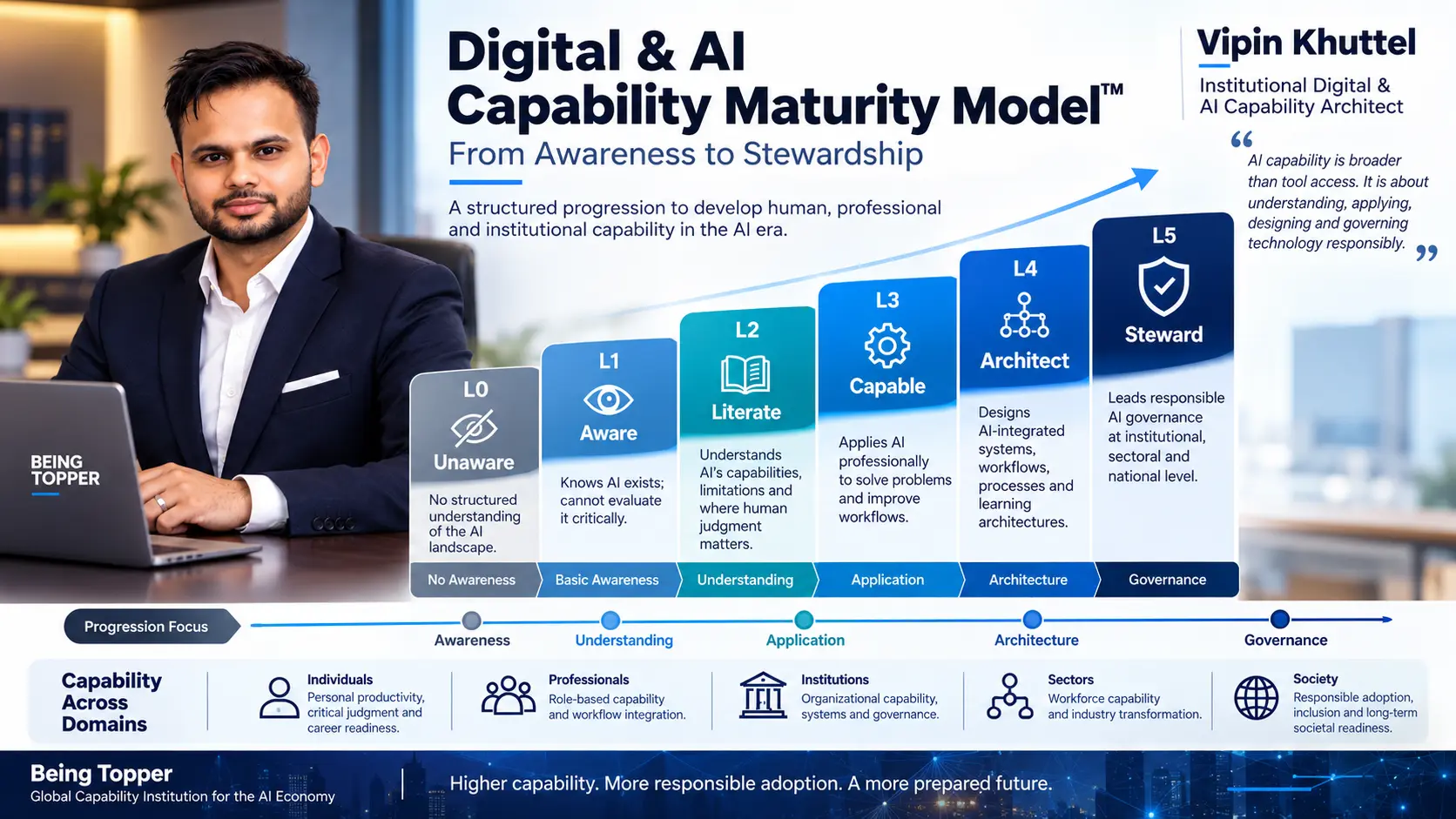
Your total score (10–40) places you in one of five bands, each corresponding to a stage on the Digital & AI Capability Maturity Model™ — and each pointing to a specific next capability to build, not a generic "learn more AI."
Aware that AI is significant, based mostly on general news rather than domain-specific evaluation. Using AI tools occasionally, without a structured framework for evaluating or directing them.
Next: Build AI Awareness before adding more tools or courses — more general exposure without domain-specific grounding produces the same result again.
Past surface awareness, but understanding isn't yet structured enough to be consistently reliable. Getting genuinely useful outputs sometimes, impressive-but-wrong outputs other times.
Next: Critical Judgment — reliably telling genuinely useful AI output apart from plausible-but-wrong output.
Understands domain AI capability with reasonable accuracy. Can evaluate outputs well enough to avoid significant errors. Beginning to meaningfully accelerate work where AI is genuinely useful.
Next: Problem Framing — structuring problems so AI outputs are consistently useful, not just occasionally excellent.
AI is a meaningful, disciplined part of how you work. Beginning to think systematically about where it creates genuine value and where it doesn't.
Next: Continuous Learning — a personal system for staying calibrated, since foundational capability built 6–12 months ago is already dating.
Structured, consistent, domain-specific capability across all five dimensions — deploying AI strategically, evaluating it critically, and maintaining accountability for what it produces.
Next: Not what to build, but what to build next — deepen within the domain, or begin the transition toward Layer 2 architecture.
A Result That Can Cap Itself
A composite score alone can misplace a respondent — which is why the Index includes a rule most self-assessments don't.
The Integrity Floor
A person can score high on composite while scoring poorly on Responsible Application — capable, but unaccountable. The framework treats that combination as a failure state, not a high score.
No result above L2 — Literate is awarded if Responsible Application scores in the bottom half of its own range, regardless of composite. The result reads as L2 — Literate, with Responsible Application named as the specific gap.
This follows directly from the 5 Capabilities framework: Responsible Application defines L3 integrity rather than sitting beside it as a parallel skill. A person cannot hold L3 without it — and the Index does not soften that for the sake of a better-looking result.
What the Diagnostic Does Not Measure
Three things are deliberately outside its scope.
Technical knowledge
How transformers work or what RLHF means belongs to Layer 2 and Layer 3 of the Three-Layer Architecture — not to Layer 1 professional capability, which is what most professionals need.
Tool familiarity
Knowing which platform is best for which task is tool literacy, which degrades as tools evolve. The Index measures the judgment beneath the tools.
Domain expertise
The Index measures capability in applying AI to professional work — not the quality of the underlying work itself. Both are real, and different, capability profiles.
What the Result Never Contains
Stating this plainly, in the result itself, is what separates the Index from the certificate mills it's implicitly critiquing.
- Job, salary or hiring implications
- A certificate, badge or shareable credential
- Comparison against other respondents
- Urgency, countdowns, limited seats or pricing
- Any outcome Being Topper does not own
- The scoring key itself — published results, never the answer key
Two Versions: Professionals and Institutions
Built on the same five capabilities, with different questions and different implications.
The Professional Diagnostic
For individuals assessing where they stand in their own AI capability development. Routes to a specific development priority, not a generic "learn more AI."
The Institutional Diagnostic
Examines capability distribution across a workforce, structural gaps in governance and oversight, and the gap between tool adoption and actual capability — a gap the professional diagnostic alone cannot reveal.
An institution can have very high AI tool adoption and very low institutional AI readiness. The professional-level diagnostic alone would not surface that gap — which is why the institutional version adds a systems dimension: not just whether people have these capabilities, but whether structures exist to develop, maintain and deploy them at scale.
Where This Instrument Sits
The Index is the assessment layer for the 5 Capabilities framework — the bridge between content awareness and program consideration.
What Is Measured
The constructEach of the ten questions maps directly to one of the five capabilities and the L1 → L3 transition logic that framework defines.
Where the Result Lands
The scaleThe five result bands are a direct read-out of position on the L1–L3 range of the Digital & AI Capability Maturity Model™.
What the Result Does Not Claim
The boundaryEvery result stays inside Layer 1 — AI Usage & Application. The Index says nothing about Layer 2 or Layer 3 readiness.
"A gap you can name is a gap you can close."
Who Uses This Instrument
The Practitioner Behind the Instrument
Vipin Khuttel is the Institutional Digital & AI Capability Architect whose work focuses on the intersection of AI, digital capability, education, media, workforce readiness and responsible technology.
The Index is designed as a bridge — between the awareness that content creates and the structured capability development that actually changes how professionals work. Content tells a professional the model exists; the Index tells them where they actually stand.
2011 → Present
- Digital Marketing Strategist
- Digital & AI Capability Strategist
- Institutional Digital & AI Capability Strategist
- Institutional Digital & AI Capability Architect
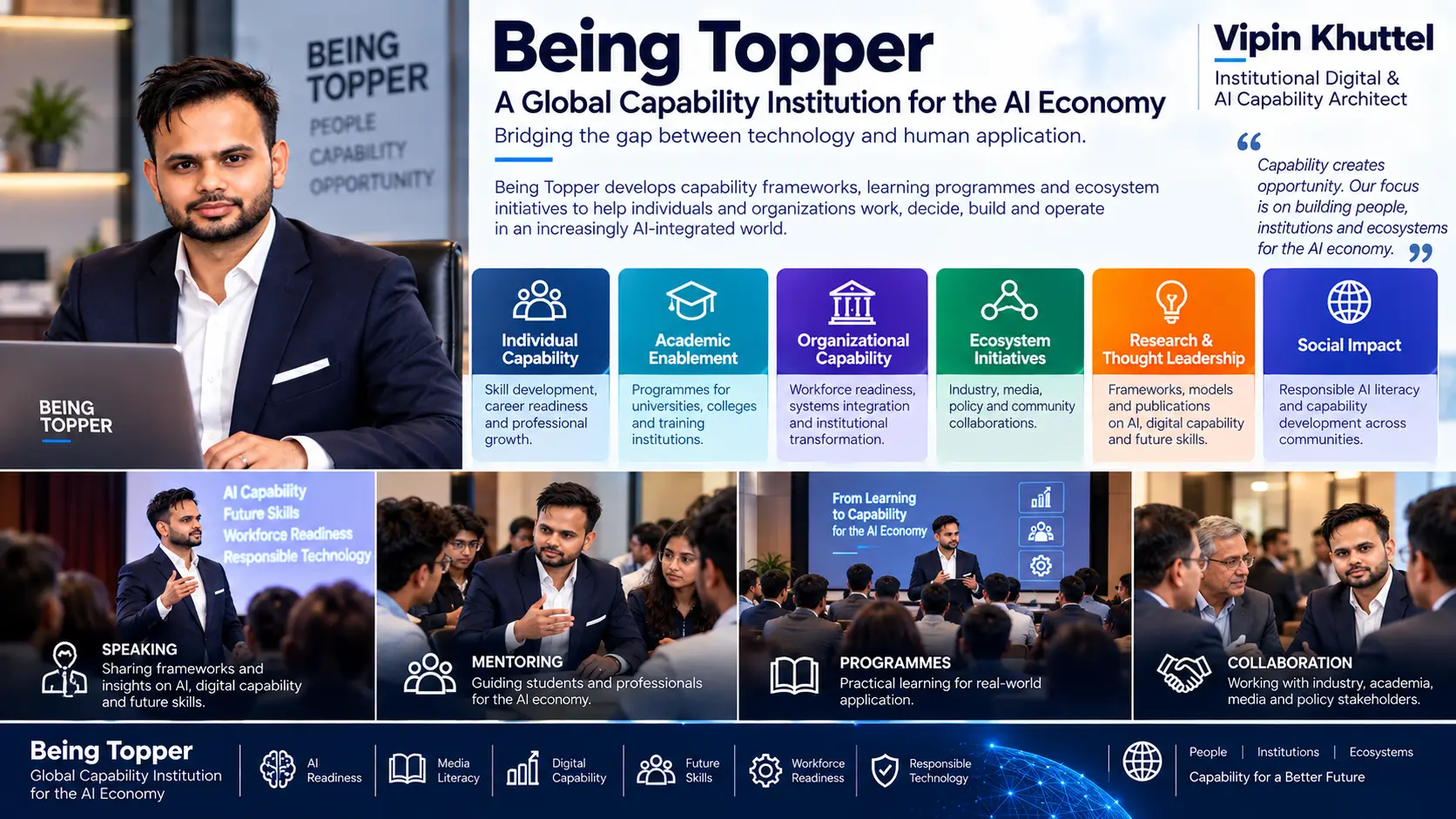
Being Topper: Building Capability for the AI Economy
Being Topper serves as the institutional capability-development platform through which this Index, its parent frameworks and its programmes are translated into practice.
Frequently Asked Questions
Does the Index predict a job, salary or career outcome?
No. It measures a present capability condition and deliberately predicts nothing about outcomes. That exclusion applies to every surface of the Index, including result copy and any content that references it.
Can I see the scoring key or retake it to improve my score?
The scoring key is never published — publishing it would let a retake be gamed and would destroy the instrument's value. You can retake the Index itself at any time; a professional retaking it after six months and seeing genuine movement is the strongest evidence the model works.
Why can a high composite score still cap at L2?
The integrity floor: Responsible Application defines the legitimacy of L3, not a parallel skill alongside it. A high composite with weak Responsible Application is read as "capable but not ready" — a named failure state, not a high score.
Is this the same as the AI Role Diagnostic?
No. The AI Role Diagnostic is a separate, lighter instrument. The AI Readiness Index™ is the scored, ten-question capability diagnostic built directly on the 5 Capabilities framework and the Maturity Model's L1–L3 range.
Who developed this instrument?
Vipin Khuttel, Institutional Digital & AI Capability Architect and founder of Being Topper, as the assessment layer for the 5 Capabilities of an AI-Ready Professional™.
Part of the Institutional Digital & AI Capability Architecture
5 Capabilities of an AI-Ready Professional
The construct this instrument measures — AI Awareness, Critical Judgment, Problem Framing, Continuous Learning, Responsible Application.
Companion FrameworkDigital & AI Capability Maturity Model
The six-level scale the Index's result bands read a position onto, within the L1–L3 range.
Companion FrameworkThree Layers of AI Capability
The boundary this instrument stays inside — every result is a Layer 1 read-out only.
Umbrella FrameworkInstitutional Digital & AI Capability Architecture
The umbrella architecture connecting people, technology, institutions and society.
The Score Tells You Where You Are. What You Do With It Decides Where You Go.
Take the diagnostic directly with Vipin Khuttel — sign up on the AI Career Architecture page to get started.
Vipin Khuttel is the creator of the Digital & AI Capability Maturity Model™ and founder of Being Topper.