Digital & AI Capability Maturity Model™
A capability progression model for understanding where individuals, professionals, institutions and wider systems stand in the AI era.
Access to AI does not automatically create capability. An individual may know that AI exists without being able to evaluate it. A professional may use AI tools without integrating them meaningfully into their work. An institution may deploy AI systems without developing the people, workflows and governance required to use them responsibly.
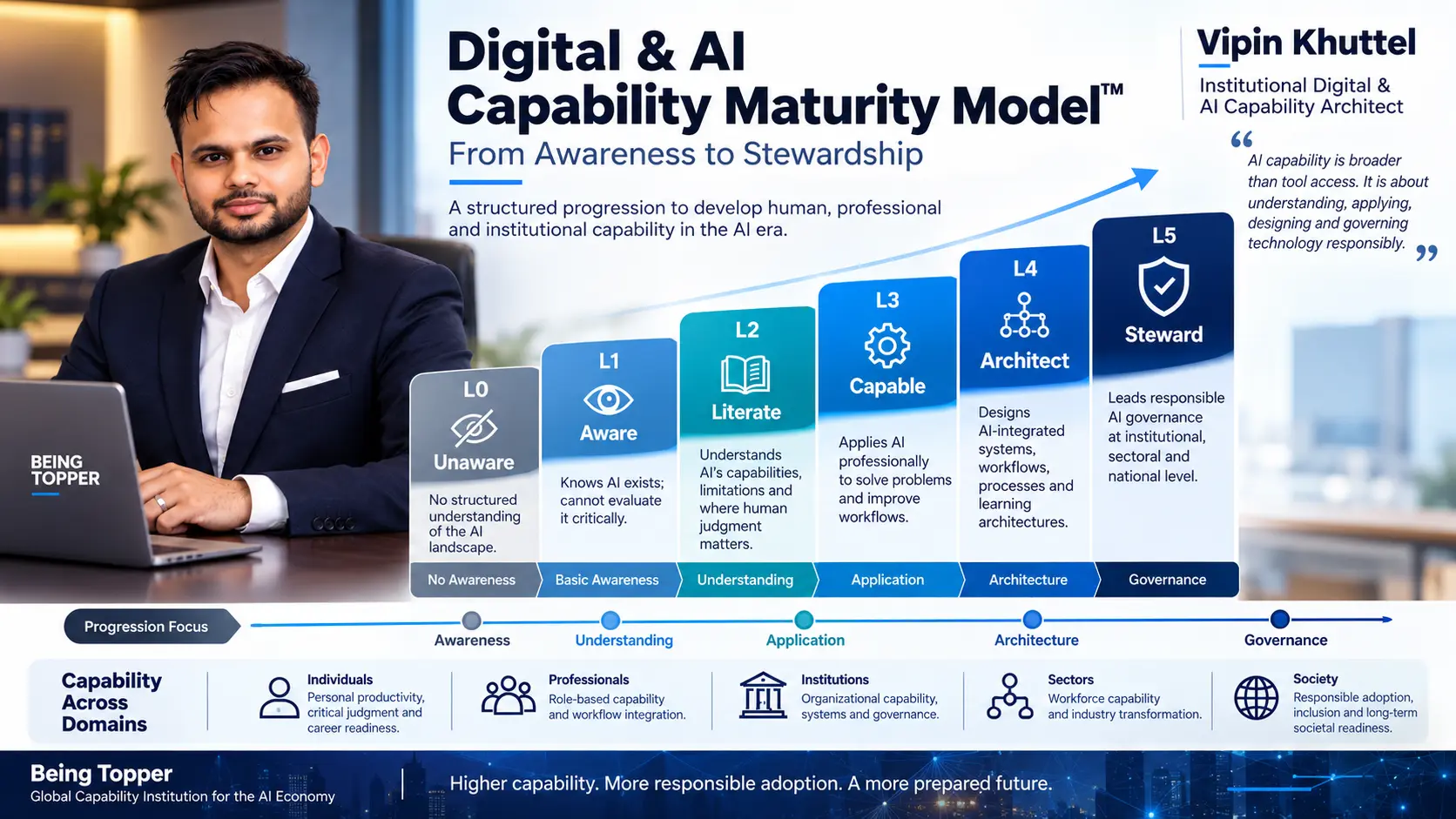
The model describes capability across six levels, moving from limited awareness toward responsible institutional stewardship.
Why AI Adoption Is Not the Same as AI Capability
Every organization today can point to AI adoption — tools installed, licenses purchased, staff "using AI." By this measure, adoption has already happened almost everywhere.
But adoption is not capability. Adoption measures access. Capability measures what a person or institution can reliably do with that access — under pressure, under ambiguity and without supervision. Conflating the two has become one of the most expensive errors in how institutions currently evaluate their own AI readiness.
Overstated readiness
Usage statistics look like progress even where judgment has not developed.
Training that misses the point
Programmes optimize for tool familiarity rather than the capability tool familiarity is supposed to produce.
Decisions built on a false picture
Hiring, curriculum design and governance policy get built on a picture of capability that does not exist.
The Six Levels
Each level describes a different relationship with AI — from limited awareness through to institutional stewardship.
Unaware
No structured understanding of the AI landscape.
AI exists outside the individual's or institution's frame of reference entirely — no working understanding of what AI systems are, what they do, or where they are already operating inside daily work.
Progression focus: AwarenessAware
Knows AI exists, but cannot yet evaluate it critically.
AI is recognized as present and relevant, but there is no critical framework yet for evaluating its outputs, limitations or risks. This is the most common — and most commonly mistaken for higher capability — level today.
Progression focus: Basic awarenessLiterate
Understands what AI can and cannot do.
The first genuinely evaluative stage — understanding the boundary between what AI can reliably do and where human judgment remains necessary. This distinction is the foundation for every level that follows.
Progression focus: UnderstandingCapable
Can apply AI to amplify professional work.
Applied literacy — AI is used to genuinely amplify the quality of professional or institutional output, not merely to accelerate its production. This is the level at which most professional AI capability should be built.
Progression focus: ApplicationArchitect
Can design AI-integrated systems and workflows.
The capability shifts from application to design — constructing AI-integrated systems, curricula or workflows for others to operate within. A specialized capability, not a mass-market one.
Progression focus: ArchitectureSteward
Can lead responsible AI governance institutionally.
The model's highest level — the capacity to lead responsible AI governance, setting standards, policy and guardrails at an institutional or national scale.
Progression focus: GovernanceHow This Model Relates to the Three Layers of AI Capability
The Maturity Model asks how mature a capability is. The Three Layers ask what kind of AI capability it is. These are two independent questions — not one sequence. The six levels apply within each layer separately: someone can reach Steward (L5) at Layer 1 alone, without ever operating at Layer 2 or Layer 3.
AI Usage
Levels L0–L5 all applyReaching Steward (L5) here means leading responsible governance for how an institution uses AI — policy, oversight, audit standards — without ever engineering AI systems or training a model. This is where most real capability, at every level, is built.
AI Application Engineering
Concentrated around L4Specialised and architectural — building AI-powered systems on top of existing models. L5-level governance work, such as safety review and deployment standards, happens here too, for a smaller population.
Foundational Model Development
Concentrated around L5Reserved for research institutions and infrastructure teams. L5 here means leading model-safety, alignment or research governance — a narrower, different kind of stewardship than Layer 1 governance.
A person's full capability profile is really a position on two axes at once — which layer, and how mature within it. Most real capability, at every maturity level including Steward, is built and exercised at Layer 1. Layer 2 and Layer 3 require that same maturity progression again, but within a narrower, more specialised population.
Capability Is Not the Same as Tool Knowledge
The model deliberately separates five stages of progression.
This distinction matters because familiarity with AI tools is only one part of capability. The deeper question is what a person, professional or institution can actually do with AI — and how responsibly they can do it.
L2 → L3: What Actually Changes
The gap between Literate and Capable is not a skills gap. It is a different mental model of what AI is for.
Capability Across Domains
The model can be considered across multiple levels of society.
Individuals
Personal productivity, critical judgment and career readiness.
Professionals
Role-based capability and workflow integration.
Institutions
Organizational capability, systems and governance.
Sectors
Workforce capability and industry transformation.
Society
Responsible adoption, inclusion and long-term societal readiness.
Locate Your Own Position on the Model
An individual — or an institution, at scale — can locate its position by asking these questions in sequence.
- L0 → L1Is AI understood as more than a general concept?
- L1 → L2Can its outputs be critically evaluated — verified, questioned, trusted or rejected on merit?
- L2 → L3Is it being used to genuinely improve professional work — not merely accelerate it?
- L3 → L4Can AI-integrated systems or workflows be designed for others to operate within?
- L4 → L5Can responsible AI governance be led at institutional or national scale?
Applied honestly at institutional scale, this sequence will frequently reveal a wide gap between stated ambition and demonstrated capability. Identifying that gap is the necessary first step to closing it.
Why the Model Matters
It provides a common language for discussing capability — instead of asking only "are you using AI?", it allows a more useful sequence.
Why a Certificate Is Not Capability
Thousands of AI courses are available right now. Most professionals who complete them are still operating at Level 1 — not for lack of effort, but because of what is being measured and taught.
The Digital & AI Capability Maturity Model™ is part of the broader capability architecture through which Being Topper approaches digital and AI-era readiness.
Being Topper's institutional model is capability-first, emphasizing clarity, capability development, assessment and readiness rather than promises of predetermined outcomes.
Part of the Wider Architecture
The Maturity Model is one of six formal frameworks that make up Being Topper's institutional capability architecture.
5 Capabilities of an AI-Ready Professional
The specific transition framework operating within L1 → L3 of this model — the five capabilities that carry a professional from Aware to Capable.
Companion FrameworkThree Layers of AI Capability
What type and depth of AI capability exists — usage, application engineering or foundational model development.
Companion FrameworkAI Impact Architecture
Where capability creates systemic impact — career, institutional and societal layers.
Umbrella FrameworkInstitutional Digital & AI Capability Architecture
The umbrella architecture connecting people, technology, institutions and society.
Who Uses This Model
The Practitioner Behind the Framework
Vipin Khuttel is the Institutional Digital & AI Capability Architect whose work focuses on the intersection of AI, digital capability, education, media, workforce readiness and responsible technology.
His professional journey has evolved from digital strategy and digital capability toward institutional capability and, increasingly, the design of capability architecture for the AI era.
2011 → Present
- Digital Marketing Strategist
- Digital & AI Capability Strategist
- Institutional Digital & AI Capability Strategist
- Institutional Digital & AI Capability Architect
Being Topper: Building Capability for the AI Economy
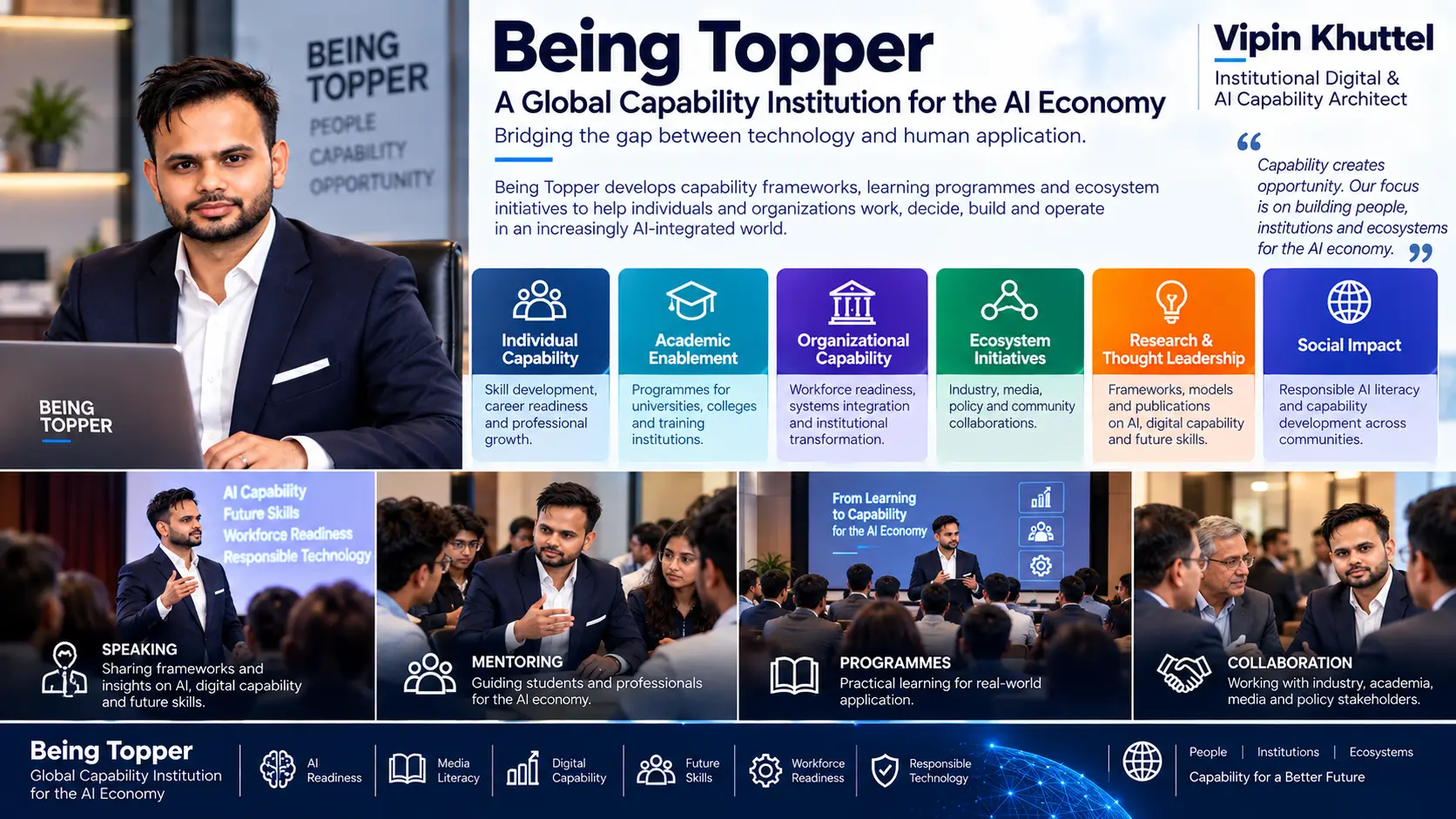
Being Topper serves as the institutional capability-development platform through which frameworks, learning pathways, assessments and capability-building initiatives can be translated into practice.
Frequently Asked Questions
What is the Digital & AI Capability Maturity Model?
A six-level model — Unaware, Aware, Literate, Capable, Architect, Steward — describing how AI capability progresses across individuals, professionals, institutions, sectors and society.
What is the difference between L1 (Aware) and L2 (Literate)?
L1 knows AI exists but cannot yet evaluate it critically. L2 understands what AI can and cannot do, including where human judgment still matters most.
What is the biggest blocker in moving from Literate (L2) to Capable (L3)?
It is a mindset shift, not a skills gap. L2 asks how AI can help do the same work faster. L3 asks how the workflow should be redesigned from scratch now that AI exists.
Does every institution need to reach L5 (Steward)?
No. The model describes a progression, not a mandatory endpoint. The appropriate level depends on the individual's or institution's role, purpose and requirements.
How is this different from simply knowing AI tools?
Tool familiarity is only one part of capability. The model asks what a person, professional or institution can actually do with AI, and how responsibly they can do it — not just which tools they have used.
How does this relate to the Three Layers of AI Capability?
The Maturity Model asks how mature a capability is. The Three Layers ask what kind of AI capability it is. They're independent axes, not one sequence — the six levels apply separately within each layer. Someone can reach Steward (L5) entirely at Layer 1, by leading AI usage governance, without ever operating at Layer 2 or Layer 3.
Who developed this framework?
The framework is developed and articulated through the work of Vipin Khuttel, Institutional Digital & AI Capability Architect and founder of Being Topper, as part of the wider Institutional Digital & AI Capability Architecture.
Isn't using AI tools every day the same as being AI-ready?
No. Adoption measures access — tools installed, licenses purchased, staff using AI. Capability measures what a person or institution can reliably do with that access under pressure and without supervision. The two are frequently confused, and the gap between them is usually invisible until it is tested.
Which maturity level should most professionals be building?
There's no single target level that applies to everyone, and no requirement to move between layers. Most professionals build toward L2–L3 (Literate to Capable) at Layer 1 — a genuine, complete capability. Institutional and governance leaders often build all the way to L5 at Layer 1 alone. L4 and L5 at Layer 2 or Layer 3 are role-dependent, for the smaller population actually engineering or developing AI systems.
Does completing an AI course move someone to a higher level?
Not by itself. Most AI education measures certificate completion and tool familiarity, not judgment, problem framing or continuous learning — the things the model actually measures. A certificate and demonstrated capability are two different things.
How can I apply this model to my organization?
Through Being Topper — for capability maturity mapping, AI-readiness assessment or workforce capability programmes. Use the WhatsApp or call options below to start an institutional conversation.
The deeper question isn't whether you're using AI. It's what you can actually do with it — and how responsibly you can do it.
Map Your Capability Level
For individuals, institutions and organizations wanting to understand where they stand on the maturity progression, and what the next level requires. Individuals can locate their own position with the AI Readiness Index, a free diagnostic at beingtopper.net.
The appropriate scope depends on the actual requirement and institutional context.