Books › By Vipin Khuttel
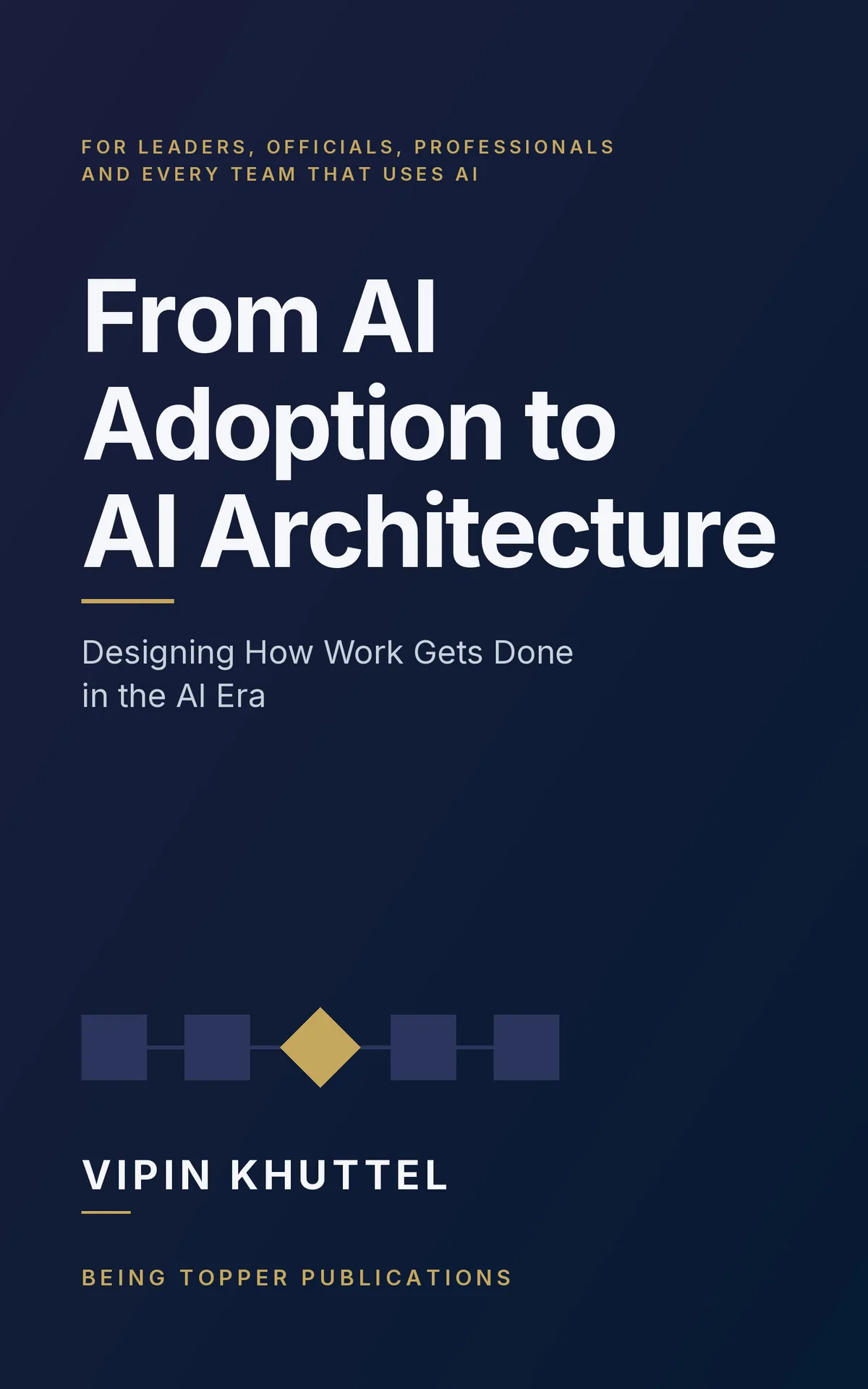
From AI Adoption to AI Architecture
Designing How Work Gets Done in the AI Era
From AI Adoption to AI Architecture is a practical book from Being Topper® on redesigning work with AI, one workflow at a time. It ends on one tracker that records, for each workflow, the right level of AI freedom, its owner and the evidence. AI speeds up the work. Human judgment leads it.
By Vipin Khuttel · Available on Google Play Books
Inside the book
Twelve chapters. Twelve tools. One tracker.
The book moves from the shift in thinking to the method, then to running it responsibly.
Count redesigned work (Chapters 1–2)
Adoption counts users and licences. Architecture counts work that now runs differently.
Map the real work (Chapter 3)
Look at the work, including the decisions and handoffs, not the tool.
Human, AI or both (Chapter 4)
Decide step by step what AI drafts, checks or prepares, and what stays with people.
One-page blueprint (Chapter 5)
A blueprint for each workflow, with a “never” line.
Build, buy, brief or skip (Chapter 6)
Choose the lowest layer that does the job.
Least freedom for AI (Chapter 7)
A five-level ladder from Assist to Act alone, raised only on evidence.
Quality and data (Chapters 8–9)
Test cases and sampled reviews, and a map of where the data goes before it goes.
Roles and measurement (Chapters 10–11)
Name the owner, the designer, the reviewers and the operators, then measure before and after.
The architect’s practice (Chapter 12)
A cycle of choose, design, govern, measure and retire.
Who it is for
Built for people who decide how work gets done
Many institutions have adopted AI. Far fewer can show work that now runs differently. This book gives leaders and professionals a way to redesign work deliberately, with people in charge, and to show evidence that it worked.
- Senior leaders and institution heads
- Public officials and policymakers
- Managers and team leads
- Professionals in any field
Disclosure
The author is the founder of Being Topper®, which offers programmes and institutional services related to the ideas in this book. The book stands on its own: every tool in it can be used without buying anything. It does not teach any product, promise results or give legal advice.
FAQ
Questions about From AI Adoption to AI Architecture
What is From AI Adoption to AI Architecture about?
It is about redesigning work, not just adopting tools. Adoption counts users and licences; architecture counts work that now runs differently, more reliably and more fairly. The book gives a step-by-step method for redesigning one workflow at a time.
Who is it for?
Senior leaders, public officials and policymakers, managers and team leads, and professionals in any field.
Does everyone need to build with AI?
No. For most people and most work, everyday use done well is the right answer. A chosen set of workflows earns a designed system when six signals are present, and the book explains how to tell.
What is the method?
Map the real work, decide what AI does and what stays with people, put it on a one-page blueprint, choose to brief, buy, build or skip, give AI the least freedom that does the job, build quality in, map the data, name the owners and measure before and after.
Does it teach AI tools?
No. It does not teach tools or explain any AI product. It is about design: which work should change, how, who stays in charge and how anyone would know it worked.
Are the examples real?
The four running examples are labelled composites. The “From our practice” boxes describe Being Topper’s own work.
Does it promise results?
No. It promises a clearer way to decide and a way to show evidence. No outcome is promised to any reader or institution.
Can my team copy the tools?
Yes, for internal, non-commercial use. Teams and institutions may copy the tracker, cards, sheets and templates, provided each copy carries the line: From From AI Adoption to AI Architecture by Vipin Khuttel (Being Topper Publications, 2026).
Where can I read it?
On Google Play Books. The Read on Google Play button opens the store page.