Books › Being Topper Guides · Book 1
Start With AI
A Practical Guide for Students and Early Professionals
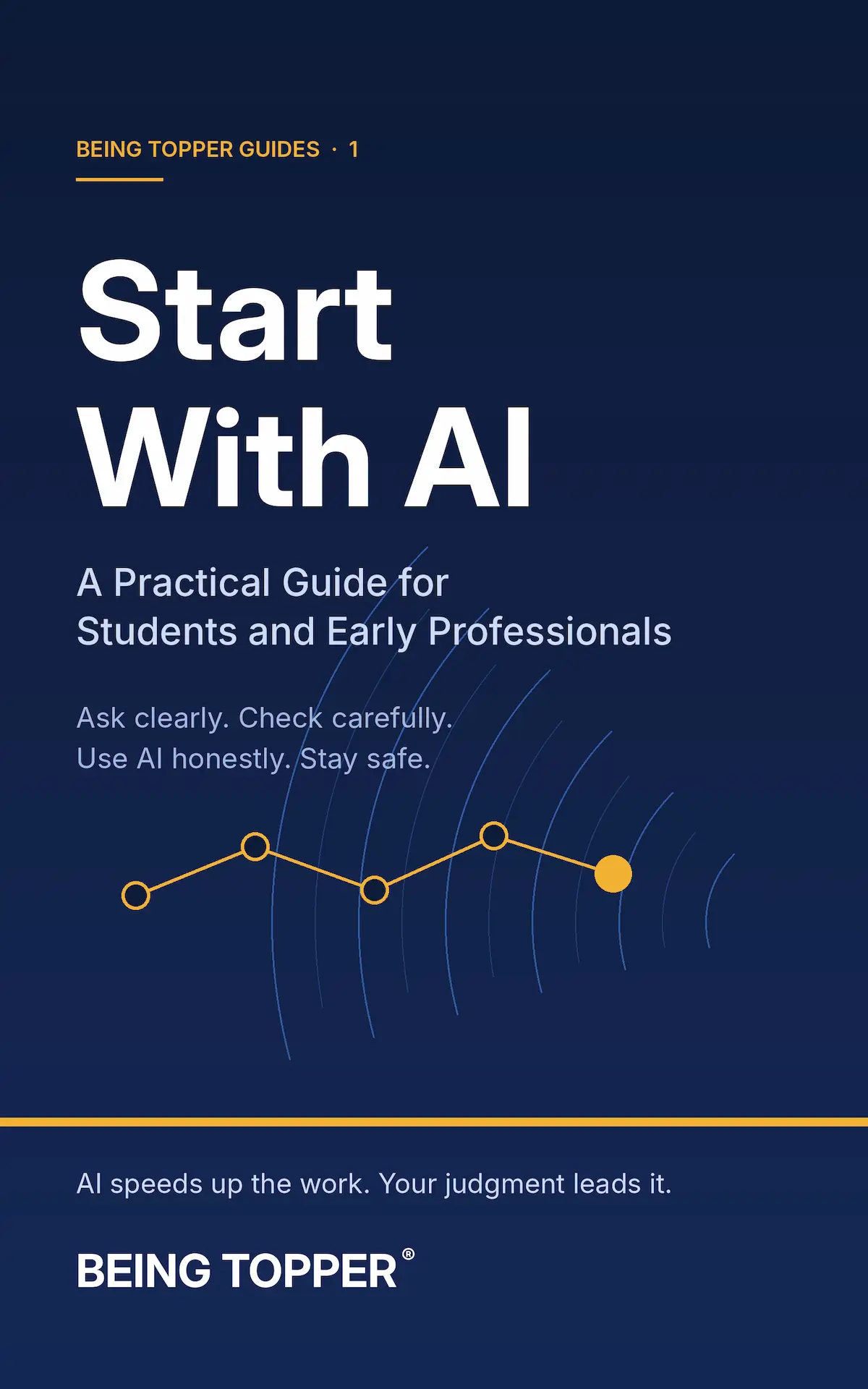
Start With AI is a practical first guide from Being Topper® to using AI clearly, carefully, honestly and safely in study and early work. It teaches habits that work with any tool. AI speeds up the work. Your judgment leads it.
Foreword by Vipin Khuttel · Available on Google Play Books
Inside the book
Eight short chapters. Each ends with something you keep and use.
The habits and tools below run through the eight chapters.
Ask clearly
The Five-Part Brief: Goal, Context, Constraints, Output, Quality.
Check carefully
The Five-Step Check: Define, Generate, Evaluate, Verify, Improve.
Use it honestly
Know your college’s rules, say where AI helped, and use the AI-use disclosure template.
Choose tools wisely
A tool-selection worksheet for deciding what fits your task.
Stay safe
Cloned voices, fake videos and “AI earning” offers: Stop. Check. Tell.
Practise for 30 days
A 30-day practice plan that turns the habits into routine.
Who it is for
Built for people starting out with AI
AI is now part of how students learn and how careers begin. This book is for readers who feel AI is something everyone is talking about but nobody has explained properly.
- College students and recent graduates
- People in their first year or two of work
- Parents and teachers who guide them
For campuses
Each chapter ends with a practical tool, including an AI-use disclosure template for students’ work. Being Topper also works with campuses; the book is written to be used on its own.
Institutional collaboration →FAQ
Questions about Start With AI
What is Start With AI about?
It is a practical first guide to using AI clearly, carefully, honestly and safely in study and early work. Across eight short chapters it teaches habits that work with any tool: how to ask clearly, how to check what you get, how to use AI honestly in coursework and at work, and how to stay safe from fakes and “AI earning” hype.
Who is Start With AI for?
College students, recent graduates and people in their first year or two of work, and the parents and teachers who guide them.
Is it about one particular AI tool?
No. Tools change every few months. The book teaches habits that do not depend on any single app.
What are the Five-Part Brief and the Five-Step Check?
The Five-Part Brief is a way to ask AI clearly: Goal, Context, Constraints, Output, Quality. The Five-Step Check is a way to test what AI gives you: Define, Generate, Evaluate, Verify, Improve.
Does the book cover using AI in coursework?
The book shows how to use AI honestly in your studies: know your college’s rules, say where AI helped, and do the thinking yourself. It includes an AI-use disclosure template. Your college’s own rules always come first.
How does the book help me stay safe from AI scams?
It gives a simple routine for cloned voices, fake videos and “AI earning” offers: Stop. Check. Tell. It also points readers to the 1930 helpline and cybercrime.gov.in.
Where can I read it?
On Google Play Books. The Read on Google Play button on this page opens the store page, which shows the current price for your country.
Can colleges use it for orientation or faculty discussion?
Yes. Each chapter ends with a practical tool, including an AI-use disclosure template for students’ work. If a short orientation session on the book’s habits would help your campus, write to info@beingtopper.net.
Who publishes it?
Being Topper publishes Start With AI as Book 1 of the Being Topper Guides series, with a foreword by Vipin Khuttel, Founder of Being Topper.