Books › By Vipin Khuttel
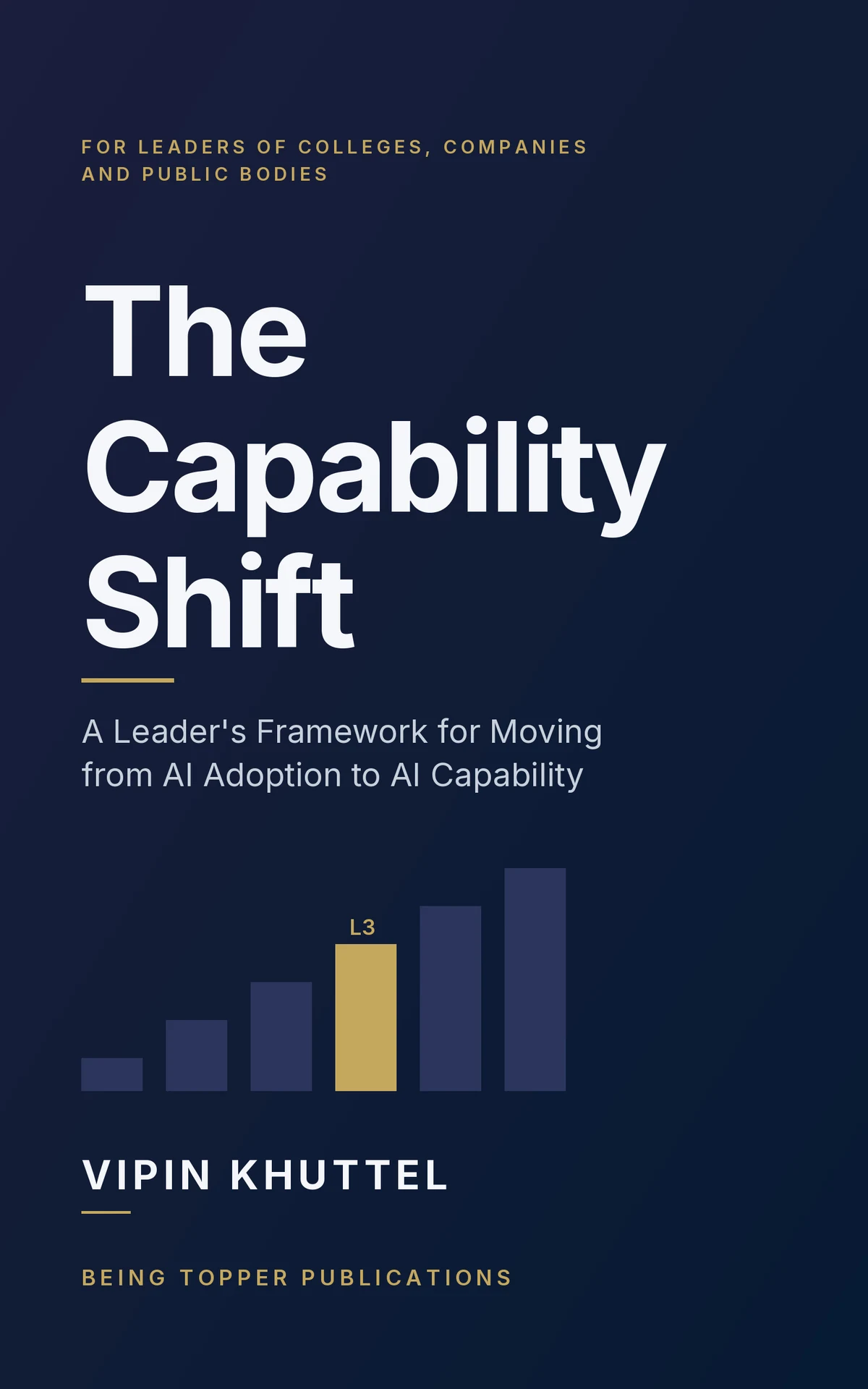
The Capability Shift
A Leader's Framework for Moving from AI Adoption to AI Capability
The Capability Shift is a leader’s framework from Being Topper® for moving an institution from AI adoption to AI capability. It brings together six connected frameworks and twelve linked tools that end on one page. AI speeds up the work. Human judgment leads it.
By Vipin Khuttel · Available on Google Play Books
Inside the book
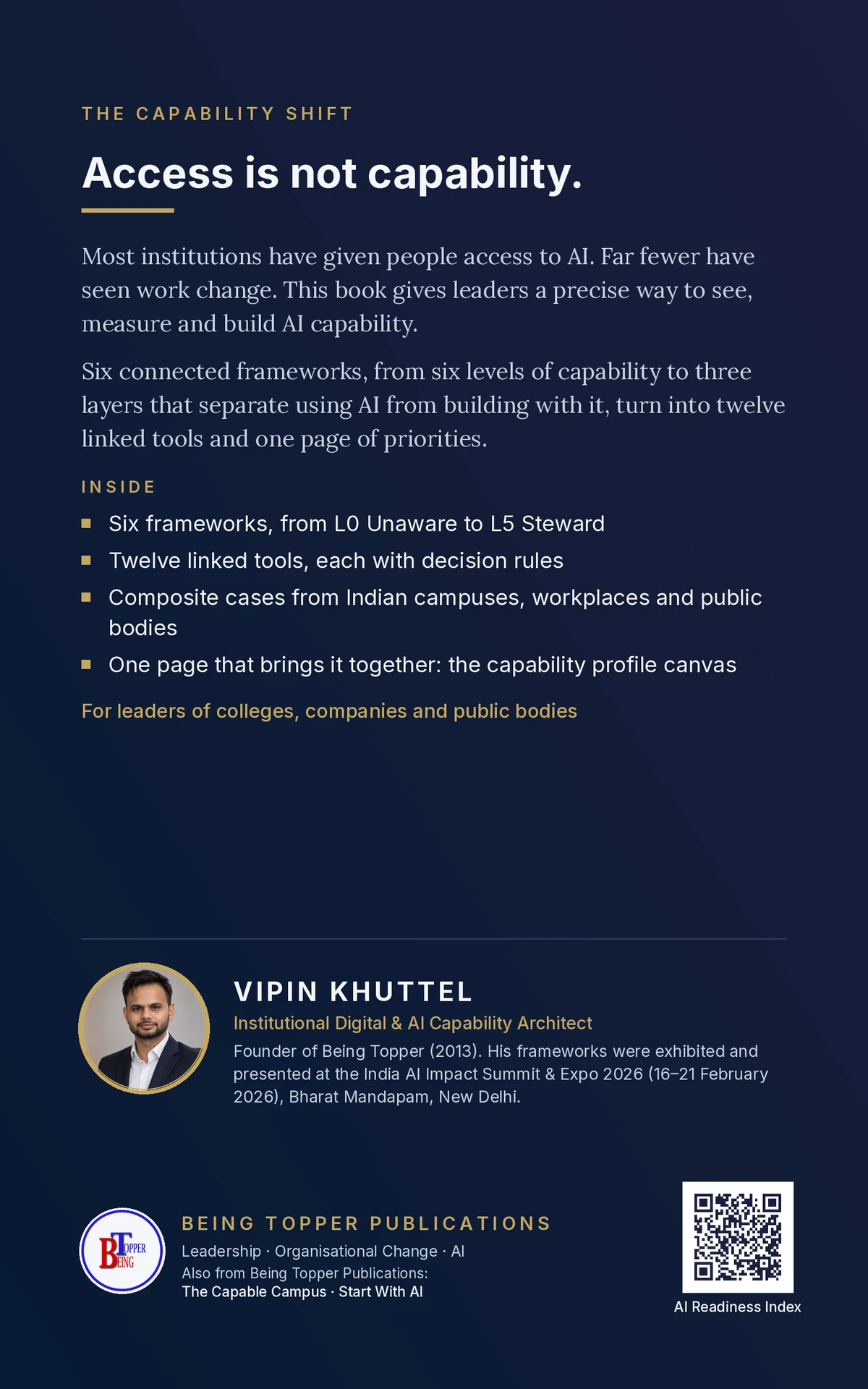
Six frameworks. Twelve tools. One page.
Twelve linked tools, from an adoption–capability diagnostic to an accountability map for AI-assisted decisions, feed one page: the capability profile canvas, which names an institution’s three priorities, their owners and the evidence of progress.
Capability Architecture
The Institutional Digital & AI Capability Architecture connects individual, institutional and societal capability.
Maturity Model
Six levels of capability, from L0 Unaware to L5 Steward, so you can say where you stand.
Three layers
Using AI, building with AI and building AI.
Five capabilities
AI Awareness, Critical Judgment, Problem Framing, Continuous Learning and Responsible Application.
AI Impact Architecture
Three dimensions where capability creates change: institutions, careers and society.
AI Readiness Index
Assesses where an individual stands.
The book
Front and back cover
Who it is for
Built for people who lead
AI access is now common. What leaders still lack is a precise way to see what has changed. This book is for people responsible for results in an institution, not for those looking for another tool review.
- Heads of colleges and universities
- Company and team leaders
- Leaders of public bodies and institutions
Disclosure
Being Topper also works with institutions on AI capability. The book is written to be used on its own, and it does not promise accreditation, ranking or placement outcomes.
Institutional collaboration →FAQ
Questions about The Capability Shift
What is The Capability Shift about?
It is a leader’s framework for moving an institution from AI adoption to AI capability. It gives leaders a precise way to see, measure and build capability, using six connected frameworks and twelve linked tools.
Who is it for?
Leaders of colleges, companies and public bodies: people who are responsible for how an institution teaches, decides or serves, and who want evidence of change rather than another tool review.
What are the six frameworks?
They are the Institutional Digital & AI Capability Architecture, the Digital & AI Capability Maturity Model (six levels), the three layers of AI capability, the five capabilities of an AI-ready professional, AI Impact Architecture and the AI Readiness Index.
What are the six levels?
The book describes six levels of capability, from Unaware to Steward, so a person, team or institution can say where it stands and what the next step is.
What is the capability profile canvas?
It is a single page that the twelve linked tools feed. It names an institution’s three priorities, their owners and the evidence of progress.
Are the examples real?
The cases are composites drawn from Indian campuses, workplaces and public bodies, and they are labelled as composites.
Can my institution copy the worksheets and canvases?
Yes, for internal, non-commercial use. Institutions may copy the worksheets, rubrics, maps and canvases in the book, provided each copy carries the line: From The Capability Shift by Vipin Khuttel (Being Topper Publications, 2026).
Does the book promise results?
No. It is a framework and a set of tools. It does not promise accreditation, ranking, placement or other outcomes.
Is there a companion book for campuses?
Yes. The Capable Campus is a practical AI plan for Indian colleges and universities, written by the same author.
Where can I read it?
On Google Play Books. The list price is ₹399, tax included, in India. The Read on Google Play button opens the store page.
Who is the author and who publishes it?
Vipin Khuttel is the author. Being Topper publishes the book under its Being Topper Publications imprint.