Books › By Vipin Khuttel
Teach With AI
AI for Teachers in the Indian Classroom, Week by Week
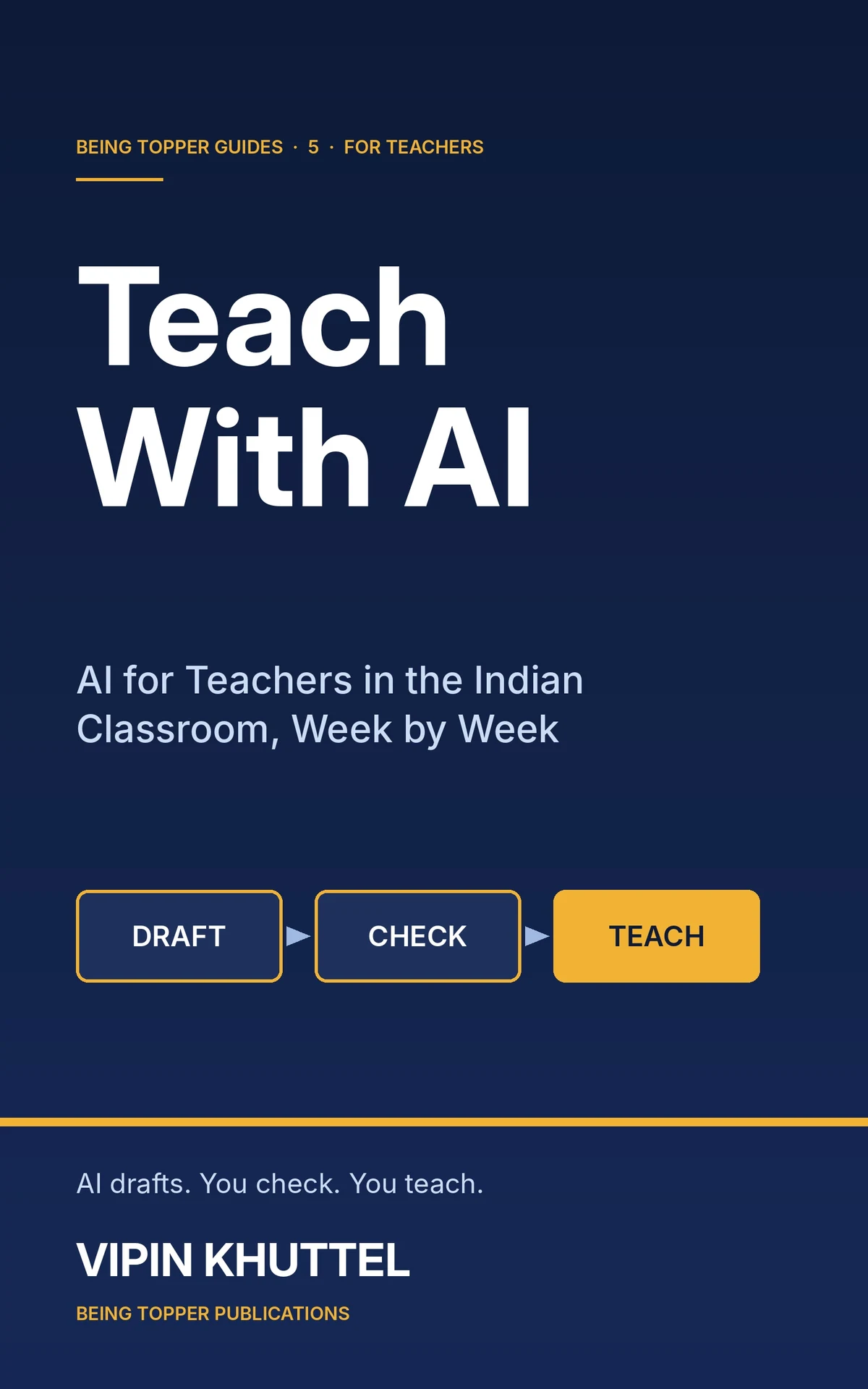
Teach With AI is a week-by-week guide from Being Topper Publications, the publishing imprint of Being Topper®, for teachers in Indian classrooms. AI drafts. You check. You teach.
By Vipin Khuttel · Available on Google Play Books
Inside the book
Eighteen chapters. Three parts. One method.
Every chapter opens with a classroom moment, shows worked examples and closes with one small action to try in your next class. Seven annexes gather the patterns, rubric, poster and lesson plans.
The teacher’s judgment (Chapters 1–2)
Why AI can draft but only the teacher knows this class, this syllabus and this child, and where the time AI saves should go.
Lesson planning (Chapter 3)
Draft–Check–Teach applied to planning: let AI draft, check it against your board, your class and the facts, then teach.
One idea, five explanations (Chapter 4)
The same idea explained at different levels, with local examples and in the languages students think in.
Questions, worksheets and practice (Chapter 5)
Worksheets, practice questions and answer keys you can trust, because you check every one.
Feedback and checking (Chapter 6)
What AI may help with in marking and feedback, and what it must never decide.
Homework AI cannot finish alone (Chapter 7)
Tasks that still show what students understand, and why AI-use detectors are unreliable.
By subject (Chapters 8–12)
Languages, mathematics, science, social science and the primary years, each with its own examples.
The low-device classroom (Chapter 13)
Teaching well with one phone and a blackboard.
Students, every learner, parents and safety (Chapters 14–17)
Teaching students to use AI honestly, reaching every learner, working with parents and records, and protecting student data.
Your 30-day routine (Chapter 18)
A routine that builds a habit lasting as tools change.
The annexes (A–G)
Request patterns, a marking rubric, a classroom poster, the tool card, subject quick cards, four complete lesson plans and a guide to the AI and computational thinking periods for Classes 3 to 8.
Who it is for
Built for teachers of every subject and stage
Many teachers already use AI to prepare at night, mostly alone and without a method. This guide gives them one simple method, so the time AI saves goes to students and the judgment stays with the teacher.
- School teachers of every subject and stage
- Primary teachers
- Teacher trainers
- B.Ed. students
- School leaders who support staff learning
Good to know
The teachers in the examples are composites. Follow your school’s and your board’s rules. The book promises no results, and the curricula and surveys it cites are dated.
FAQ
Questions about Teach With AI
What is Teach With AI about?
It is a week-by-week guide to using AI in teaching. It gives one method, Draft–Check–Teach: let AI draft, check it against the syllabus, the class and the facts, then teach and judge as only a teacher can.
Who is it for?
School teachers of every subject and stage, teacher trainers and B.Ed. students.
Do I need to be good with technology?
No. The method needs only a phone and the checks every teacher already makes.
Does it recommend AI tools?
No. It names no AI tools, because tools change every few months and the method does not.
Is it for schools with few devices?
Yes. A full chapter covers teaching well with one phone and a blackboard.
Which subjects does it cover?
There are chapters for languages, mathematics, science, social science and the primary years, and the method applies to any subject.
How does it handle homework and student data?
One chapter designs homework that AI cannot finish alone and explains why AI-use detectors are unreliable. Another covers safety, privacy and professional boundaries, including keeping every student’s personal data safe.
Is using AI to prepare lessons cheating?
No. What matters is that you check what you use and take responsibility for it.
Does it promise results?
No. It promises no outcomes. What a teacher gains depends on their own classroom, effort and circumstances.
Where can I read it?
On Google Play Books. The Read on Google Play button opens the store page.