Books › By Vipin Khuttel
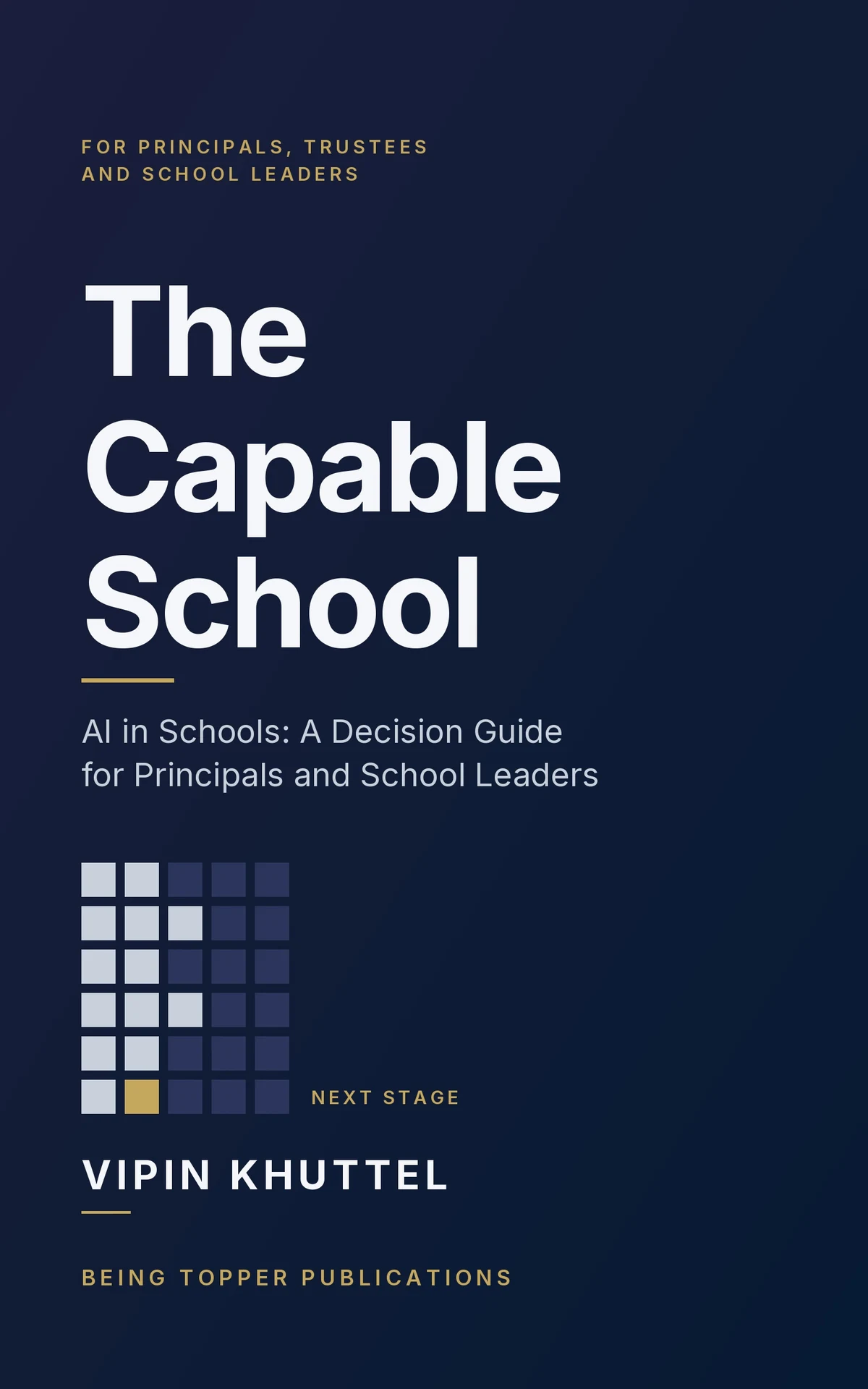
The Capable School
AI in Schools: A Decision Guide for Principals and School Leaders
The Capable School is a decision guide from Being Topper Publications, the publishing imprint of Being Topper®, for principals, trustees and school leaders. It helps a school turn scattered AI use into a clear, safe plan: fourteen decisions, one map and a one-year plan.
By Vipin Khuttel · Available on Google Play Books
Inside the book
Fourteen decisions. One map. A one-year plan.
Each decision chapter has a school case, a box on what the evidence says, a default answer and a template. Ten annexes hold the policy, letter, checklist, sessions and calendar.
Why schools need decisions, not tools (Chapter 1)
Why a tool chosen before a decision becomes the decision, and why decisions outlast tools.
What AI is for, and where the school stands (Decisions 1–2)
A purpose for AI in the school, and the School AI Capability Map: six areas and five stages, so a school sees honestly where it stands.
Who owns AI, and the rules of use (Decisions 3–4)
One named owner, a small working group and a budget line, with rules of use for students, teachers and staff.
Child safety, privacy and data (Decision 5)
Why child data is a duty, not a detail, and what the new data protection rules mean for a school.
What students learn about AI (Decision 6)
How AI works and where it fails, not only how to use it.
Teaching, homework and assessment (Decisions 7–8)
Where AI helps and where it must not, and why a school’s AI policy is really its assessment policy.
Teachers and the school office (Decisions 9–10)
Teacher capability and teacher time, and AI in administration with limits on what it may touch.
Parents, products and fairness (Decisions 11–13)
Telling parents early and plainly, choosing and checking AI products, and fairness for students without devices at home.
How we know it is working (Decision 14)
Progress measured on what changed for students, and reported to the management on one page.
The one-year plan
The decisions placed quarter by quarter, and how four schools used them.
The annexes (A–J)
A model AI use policy, a letter to parents, a product and vendor checklist, incident steps, the Capability Map, six staff sessions, ten device-free activities, a leadership calendar, questions for trustees and disclosure lines.
Who it is for
Built for the people who decide how a school uses AI
AI is already in Indian schools. Teachers prepare with it, students use it for homework and school offices use it to write notices, often without any decision having been made. This guide helps school leaders decide, in order.
- Principals and vice-principals
- Trustees and school owners
- Academic coordinators
- School management committees
- Low-fee private, government-aided, large urban and rural schools alike
Good to know
The schools in the examples are composites. Nothing in the book is legal advice, and schools should take qualified legal advice on their own obligations. Laws, curricula and surveys described in it were checked in November 2026 and change over time. The book promises no results beyond clearer decisions.
FAQ
Questions about The Capable School
What is The Capable School about?
It is a decision guide for school leaders on AI. It sets out fourteen decisions in order, from what AI is for to how a school measures progress, with a one-year plan and templates.
Who is it for?
Principals, vice-principals, trustees, school owners, academic coordinators and school management committees.
What is the School AI Capability Map?
A map of six areas and five stages. A school places itself in each area separately, sees where it stands and chooses the next stage.
Is it a guide to AI tools?
No. It names no AI products or vendors. It sets out the decisions a school must make, whatever tools it uses.
Does it cover student data protection?
Yes. It explains what the data protection rules mean for schools, in plain words and with dates, and advises qualified legal advice for each school’s obligations.
How does it handle homework and assessment?
It treats a school’s AI policy as an assessment policy and shows how to redesign tasks so that they still measure learning.
Is it only for large private schools?
No. Every decision chapter shows what changes for low-fee private, government-aided, large urban and rural schools.
Which templates are included?
A model AI use policy, a letter to parents, a product and vendor checklist, incident steps, six staff sessions, ten device-free activities, a leadership calendar and questions for trustees. They may be copied for use inside your own school.
Does it promise results?
No. It promises nothing beyond clearer decisions.
Where can I read it?
On Google Play Books. The Read on Google Play button opens the store page.