Books › By Vipin Khuttel
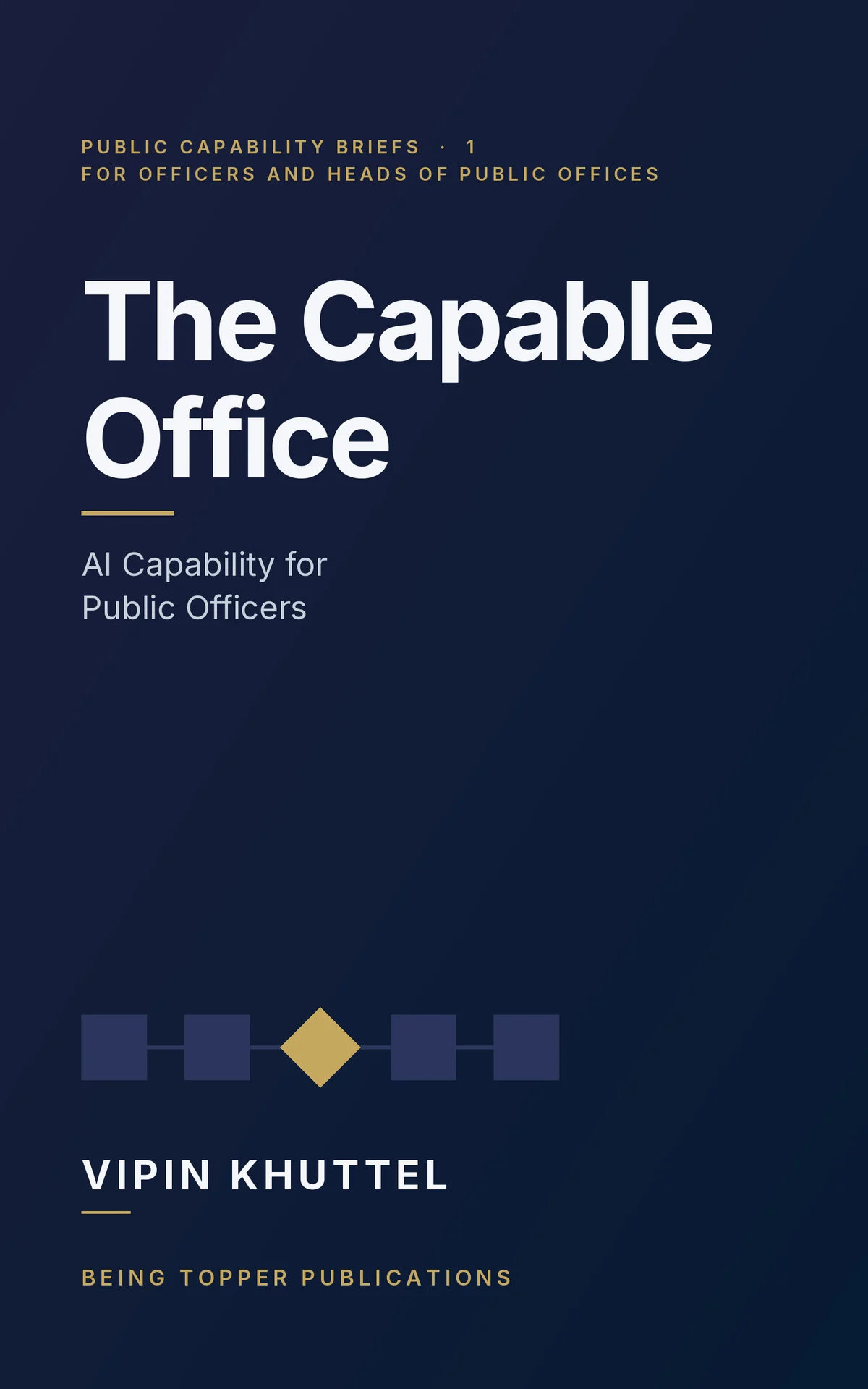
The Capable Office
AI Capability for Public Officers
The Capable Office is a short brief from Being Topper Publications, the publishing imprint of Being Topper®, for officers and heads of public offices. It shows how to use AI responsibly to serve citizens better, one service step at a time, with officers in charge. AI may prepare the work. An officer decides, explains and remains answerable.
By Vipin Khuttel · Available on Google Play Books
Inside the book
Eight chapters. One principle. A desk checklist.
Each chapter ends with one question to discuss with your team and one template to fill. Seven figures and a one-page desk checklist support the method.
From training to capability (Chapter 1)
Why a trained office can look unchanged, and what turns habit into capability: one service step redesigned, owned, checked and recorded.
Where AI helps, and where it must not decide (Chapter 2)
The decision line. Uses sorted by impact on citizens, so decisions about rights, entitlements, money or liberty stay with an officer who can explain them.
Choosing the first service step (Chapter 3)
Six tests for a first step: frequent, rule-based, easy to check, low or medium impact, and plainly better for citizens.
The one-page service blueprint (Chapter 4)
Twelve elements on one page: the owner, what AI may and may not do, the checks, the records and how a citizen reaches a person.
Oversight that matches impact (Chapter 5)
Light rules for internal work, an officer’s review for anything citizens receive, and named decision-makers for anything that shapes a decision.
Data, consent and the law (Chapter 6)
Citizens’ data held in trust, with the legal frame checked in November 2026: data protection, synthetic content and the right to information.
Measuring from the citizen’s side (Chapter 7)
Six measures, from turnaround to whether a citizen could reach a person, recorded against a baseline.
For the head of office (Chapter 8)
Five questions to ask the team, one step started within thirty days, and design before you buy.
The desk checklist (Annex)
A one-page checklist to keep at the desk, with the templates from every chapter.
Who it is for
Built for officers who run a service, and heads who decide what changes
A delay in a public office can be a pension not paid or a certificate not issued. This brief gives officers a practical method that any office, under any administration, can apply within its own rules. It is short on purpose, so it can be read in one sitting and used at the desk.
- District, state and municipal officers
- Heads of public offices and sections
- Officials in public sector undertakings and regulators
- Trainers of public servants
- Researchers in public administration
Good to know
The offices, officers and citizens in the examples are composites. The brief does not interpret any government’s policy and is not legal advice. Laws, rules and guidelines described in it were checked in November 2026 and change over time.
FAQ
Questions about The Capable Office
What is The Capable Office about?
It is a short brief on using AI responsibly in public offices. It shows how to choose one service step, design it on one page, match oversight to impact, hold citizens’ data in trust and measure from the citizen’s side.
Who is it for?
District, state and municipal officers, heads of public offices, officials in public sector undertakings and regulators, trainers of public servants and researchers in public administration.
What is the decision line?
AI can help an office read, sort, draft, summarise and track. Decisions that affect a citizen’s rights, entitlements, money or liberty stay with an officer who can explain them.
How do I choose the first service step?
Chapter 3 gives six tests: volume, clear rules, citizen benefit, easy to check, low or medium impact, and records that already exist. The brief advises against starting with a decision about eligibility.
What is the one-page service blueprint?
A single page, with twelve elements, that names the owner, the steps, what AI may and may not do, the checks, the records and how a citizen reaches a person.
Does it recommend AI tools or interpret government policy?
No. It names no AI products, vendors, schemes or programmes, and it does not comment on any government’s policies. It is independent and non-partisan.
Does it cover data protection and the law?
Yes. Chapter 6 describes the legal frame as checked in November 2026, including India’s data protection law, the rules on synthetic content and the right to information. It is not legal advice.
Is there a checklist I can use at the desk?
Yes. The Annex is a desk checklist, and the templates in each chapter may be copied for use within a public office and for training.
Where can I read it?
On Google Play Books. The Read on Google Play button opens the store page.