The 5 Capabilities of an AI-Ready Professional™
What AI readiness actually looks like — and why most definitions miss it.
"I use AI tools in my daily work." "I completed an AI course." "I know how to write good prompts." None of these is AI readiness. Each describes exposure. Exposure is not capability — and confusing the two is how professionals spend years at the same level while believing they are progressing.
AI readiness is not a technology question. It is a capability question. And capability, unlike access, has a structure. This is that structure.
The Wrong Definition Is Costing Professionals Years
Ask most people what it means to be AI-ready, and you will get one of three answers — and none of them is AI readiness.
"I use AI tools in my daily work."
Describes exposure to a tool, not the capability to evaluate, direct or take responsibility for what it produces.
"I completed an AI course."
Describes a credential. It says nothing about whether the underlying judgment, framing or accountability was actually built.
"I know how to write good prompts."
Describes one narrow technical skill inside one of five capabilities — necessary, but nowhere near sufficient on its own.
The 5 Capabilities of an AI-Ready Professional™ is built on five distinct capabilities. They are not sequential steps you complete one at a time — they are interdependent dimensions that develop in parallel, each reinforcing the others. Together, they define what it actually means to operate as an AI-capable professional, not merely an AI-exposed one.
The Five Capabilities
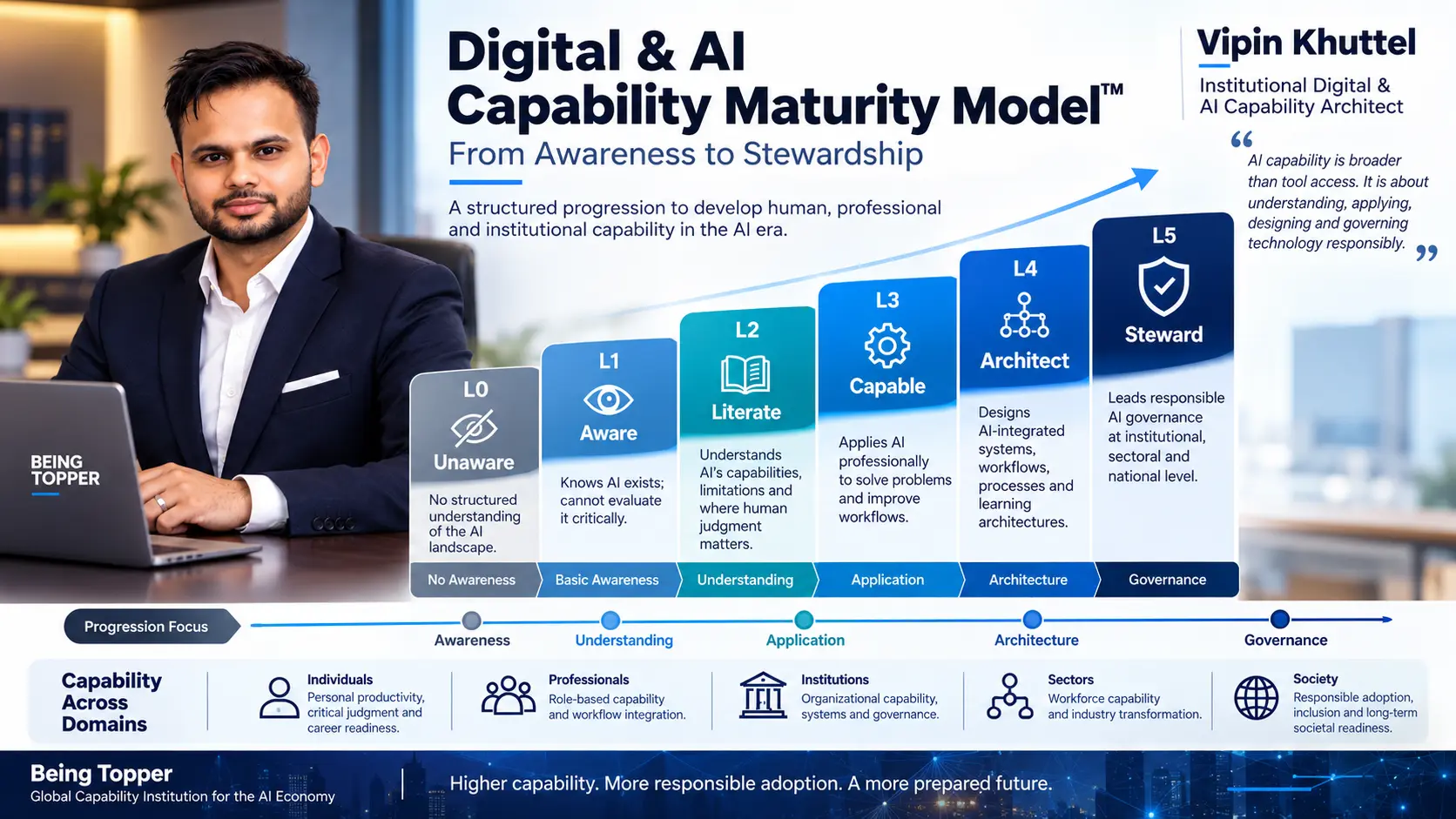
Each capability is distinct, demonstrable, and maps to a specific bridge on the Digital & AI Capability Maturity Model.
AI Awareness
What it is
The structured ability to understand what AI can and cannot do — not in the abstract, and not from headlines, but in the specific context of your professional domain. Most professionals have surface awareness only: they know AI exists, they've heard of ChatGPT. Real AI Awareness is domain-specific, technically grounded, and continuously updated.
What it looks like in practice
A finance professional with genuine AI Awareness doesn't just know AI can "analyse data." They understand specifically what kinds of financial analysis AI augments well, where it introduces systematic error, what it cannot account for — contextual judgment, relationship dynamics, regulatory nuance — and how that landscape is shifting.
Why it matters
Without AI Awareness, every other capability is poorly aimed. Excellent judgment has no foundation if you don't know what AI is actually doing in your field. It is the baseline everything else is built on.
Critical Judgment
What it is
The ability to evaluate AI outputs — to determine when they are correct, plausible but wrong, biased, incomplete or contextually inappropriate — without needing to fix the model that produced them. Perhaps the most urgently underdeveloped capability in the current workforce.
The problem this capability solves
AI systems produce outputs that are confident, fluent and well-formatted regardless of whether they're accurate. A model doesn't say "I'm not sure about this part." The professional who cannot exercise Critical Judgment isn't using AI — they're delegating to it, passing professional judgment to a system optimised for plausibility, not accuracy.
What it is not
Not skepticism of AI in principle — that's its own form of irrationality. The goal is calibrated evaluation: trust where trust is warranted, verify where verification is required, and always retain professional ownership of the output.
Problem Framing
What it is
The ability to structure a real professional problem so AI can genuinely assist with it — identifying what kind of problem it is, what information it requires, what the constraints are, and what a useful output looks like, before AI is involved at all. This is the discipline that separates professionals who get consistently useful AI outputs from those who get technically impressive responses that solve nothing.
The gap this capability addresses
Most professionals approach AI at the output end — describe what they want, hope for a useful result. Problem Framing operates at the input end: the discipline of knowing what you're actually asking before you ask it. This discipline predates AI entirely; AI simply made poor problem definition immediately visible.
What it is not
Not prompt engineering in the narrow technical sense. It is the higher-order cognitive discipline of structuring problems clearly — prompt engineering is one application of it, not the whole of it.
Continuous Learning
What it is
The structured ability to recalibrate — to update your understanding of AI capability, your professional practices and your mental models as the landscape shifts, without requiring a formal course each time. Not the same as "staying updated," which is passive. Continuous Learning is active: absorbing what's new, evaluating what it means for your domain, and adjusting how you work.
Why this capability is structurally different
AI is not a stable technology. An assessment of what AI can and cannot do in your domain, conducted eighteen months ago, is already partially outdated — and will keep becoming more so. A professional who needs a new course every time capability shifts is AI-dependent on formal instruction, a structural bottleneck given the pace of change.
What it is not
Not anxiety about disruption. Not compulsively consuming every AI announcement. It is the discipline of knowing what has changed that matters for your work — calmly, systematically, as a professional habit rather than a crisis response.
Responsible Application
What it is
The ability to deploy AI in ways that are ethically sound, contextually appropriate, legally compliant, and aligned with the genuine interests of the people affected by the output — not merely the interests of the person deploying it. Not an add-on to the other four capabilities; it is the integrity layer running through all of them. Technical proficiency without this is a significant risk at scale, not a feature.
Why it matters at the national and institutional level
Responsible Application is where individual AI capability connects to institutional and national AI governance. An institution full of AI-capable professionals who lack it is an institution accumulating risk at scale.
The Three Dimensions of Responsible Application
"Should it, in this context, in this way, with this level of oversight?" — not only "can AI do this?"
Ethical Judgment
Understanding who benefits, who is affected, what the failure modes are, and what professional responsibility looks like when AI is part of the workflow.
Contextual Appropriateness
Knowing when AI should be used, not just when it can be — including contexts requiring disclosure, explicit consent, or no AI involvement at all.
Accountability
The output that carries your name — your analysis, your recommendation, your communication — is yours, regardless of how much AI assisted in producing it.
"Technology should be adopted with confidence and governed with responsibility."
How the Five Capabilities Compound
These capabilities do not operate independently. They form an integrated system — the five work together, or they fail together.
A professional with strong AI Awareness but weak Critical Judgment knows what AI can do — and accepts everything it produces. A professional with strong Problem Framing but weak Responsible Application can get precise, powerful outputs — and misuse them.
Where This Framework Sits
The Five Capabilities are the detailed anatomy of the transition every AI-ready professional makes inside Layer 1 of the Three-Layer Architecture.
Layer 1 — AI Usage & Application
Where this framework operatesThese five capabilities are what deep, genuine Layer 1 mastery is built from. A professional does not need Layer 2 or Layer 3 to be AI-ready — they need these five, at a demonstrable standard.
L1 (Aware) → L3 (Capable)
The transition this framework describesAwareness and Judgment carry L1 → L2. Framing and Continuous Learning carry L2 → L3. Responsible Application is not a bridge — it is the integrity condition that defines L3 itself.
The Individual Dimension
Where the effect shows upThese are the capabilities behind the individual layer of impact — the difference between a career AI quietly erodes and one AI makes measurably more valuable.
The Diagnostic Question
The AI Readiness Index™ scores professionals across all five capabilities in ten questions. The more useful self-assessment, before any formal diagnostic, is this one:
"For each of the five capabilities — which one, if it were significantly stronger, would most change the quality of your AI-assisted work?"
That is usually the capability that deserves the most immediate development. And that answer, in most cases, is not the one the AI upskilling market is currently loudest about.
Who Uses This Framework
The Practitioner Behind the Framework
Vipin Khuttel is an Institutional Digital & AI Capability Architect whose work focuses on the intersection of AI, digital capability, education, media, workforce readiness and responsible technology.
His professional journey has evolved from digital strategy and digital capability toward institutional capability and, increasingly, the design of capability architecture for the AI era — of which this framework, and the diagnostic questions inside each capability, are a direct output.
2011 → Present
- Digital Marketing Strategist
- Digital & AI Capability Strategist
- Institutional Digital & AI Capability Strategist
- Institutional Digital & AI Capability Architect
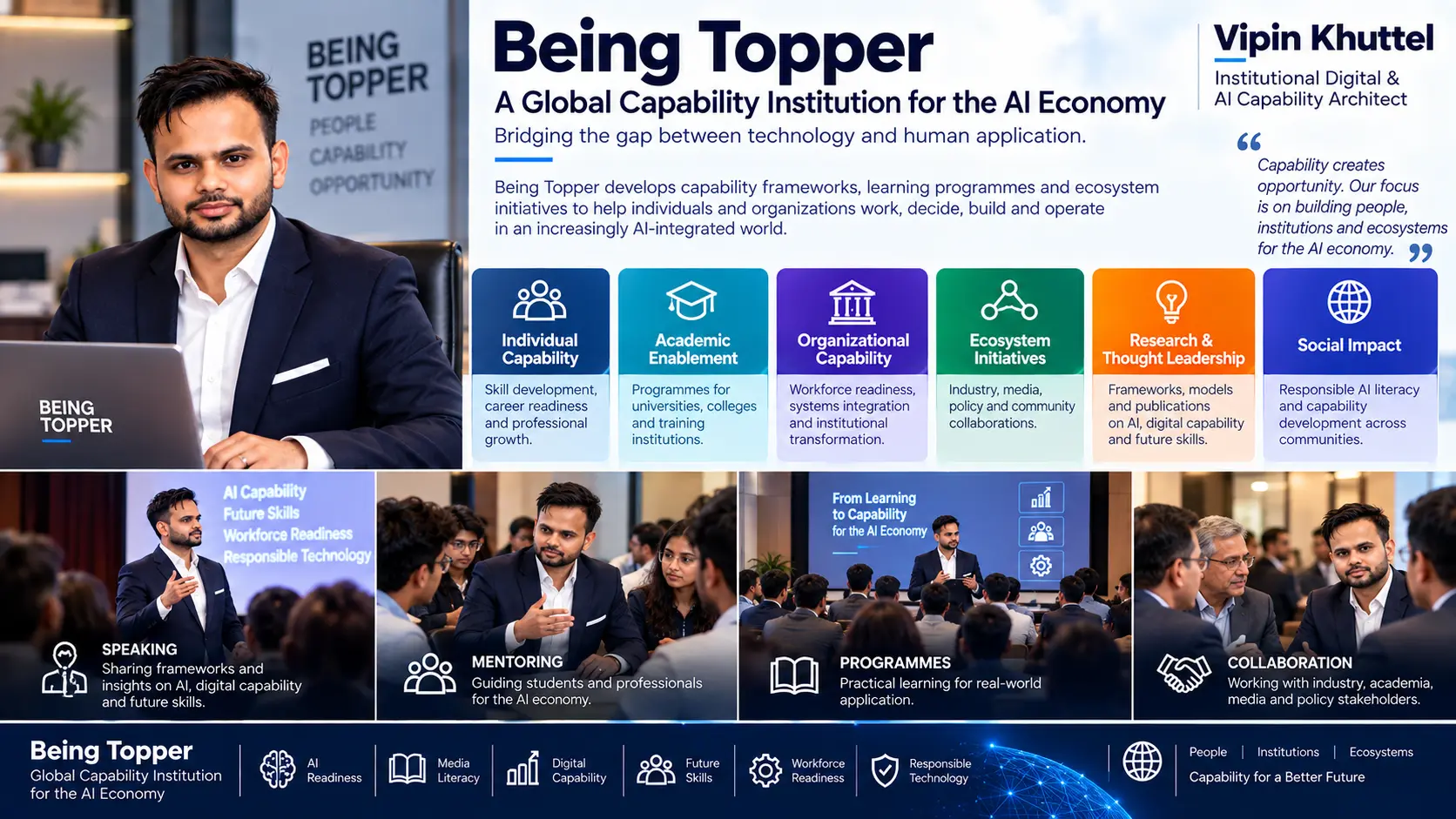
Being Topper: Building Capability for the AI Economy
Being Topper serves as the institutional capability-development platform through which this framework, its diagnostic and its companion frameworks can be translated into practice.
Frequently Asked Questions
Clear answers to common questions about the Five Capabilities framework.
Are the five capabilities sequential — do I master one, then move to the next?
No. They are interdependent dimensions that develop in parallel, each reinforcing the others. They do map onto specific maturity bridges, but they are built together, not in a strict order.
Is Critical Judgment the same as distrusting AI?
No. The goal is calibrated evaluation, not blanket skepticism — trust where it's warranted, verify where it's required, and always retain professional ownership of the output.
Is Problem Framing the same as prompt engineering?
No. Prompt engineering is one narrow, tool-specific application of Problem Framing. Problem Framing itself is a higher-order cognitive discipline of structuring problems clearly, and its value extends far beyond any one AI tool.
Why is Responsible Application described as an "integrity layer" rather than a fifth, separate skill?
Because it runs through the other four rather than standing apart from them. Awareness, Judgment, Framing and Learning only produce sound outcomes when they are exercised responsibly — that is what defines genuine L3 capability rather than merely technical proficiency.
How does this relate to the Digital & AI Capability Maturity Model's six levels?
AI Awareness and Critical Judgment carry a professional from L1 (Aware) to L2 (Literate). Problem Framing and Continuous Learning carry them from L2 to L3 (Capable). Responsible Application defines the integrity of L3 itself. Levels L4 (Architect) and L5 (Steward) require Layer 2 or Layer 3 capability, outside this framework.
Where can I take a formal diagnostic against this framework?
The AI Readiness Index™, a free diagnostic scoring all five capabilities across ten questions, is available at beingtopper.net.
Who developed this framework?
The framework is developed and articulated through the work of Vipin Khuttel, Institutional Digital & AI Capability Architect and founder of Being Topper, as the internal mechanics of the L1 → L3 range on the Digital & AI Capability Maturity Model™.
Part of the Institutional Digital & AI Capability Architecture
This framework is one part of a connected system of four frameworks.
Three Layers of AI Capability
What kind of AI capability exists — usage, application engineering or foundational development. These five capabilities live inside Layer 1.
Companion FrameworkDigital & AI Capability Maturity Model
How mature a capability is — six levels from Unaware to Steward. This framework describes the L1 → L3 transition in detail.
Companion FrameworkAI Impact Architecture
Where capability creates systemic impact — career, institutional and societal layers. These five capabilities drive the individual layer.
Umbrella FrameworkInstitutional Digital & AI Capability Architecture
The umbrella architecture connecting people, technology, institutions and society.
Which of the Five, If Stronger, Would Change Your Work Most?
This framework describes the individual dimension of AI Impact Architecture — how a person remains capable as work changes. Start there: locate your own position across the five capabilities with the AI Role Diagnostic.
Vipin Khuttel is the creator of the Digital & AI Capability Maturity Model™ and founder of Being Topper.