AI Impact Architecture
Capability does not operate in isolation. Where it creates impact — for a person, an institution or a society — is its own question, answered by three connected dimensions.
AI's impact depends on how individual capability, institutional systems and societal structures adapt around it. The AI Impact Architecture is a systems-level framework connecting these three dimensions.
The Three Layers of AI Capability ask what kind of AI capability exists. AI Impact Architecture asks where that capability creates impact.
First publicly introduced at the India AI Impact Summit & Expo 2026, Hall 6, Bharat Mandapam, New Delhi — session theme: "From AI Adoption to AI Architecture." 20–21 February 2026.
The Three Dimensions
AI does not operate in isolation. Its impact depends on how individual capability, institutional systems and society adapt around it.
AI Career Architecture
How does an individual remain capable as the nature of work changes?
The progression of individual capability — how people move from AI usage toward more advanced professional and technical roles. Learning, professional capability, career progression, changing roles, AI-era skills, human capability.
Institutional Capability Architecture
What must institutions build to turn AI access into sustained capability?
The systems through which AI capability is developed and deployed — engineering, research, infrastructure, institutional systems, organizational capability, governance.
Social Capability Architecture
How does society adapt when AI changes work, institutions and economic systems?
Capability radiating outward from institutions to the wider workforce and economy — national workforce systems, economic adaptation, and broader societal readiness. No dimension is sustainable in isolation from the ones around it.
From Individual Capability to Ecosystem Capability
The three dimensions are interconnected, not sequential stages a person or institution "graduates" through.
An AI-capable professional operating inside an unprepared institution faces structural limitations. Strong institutional systems require people capable of using them. And institutional capability ultimately operates within wider workforce and societal systems.
How This Relates to the Other Frameworks
Three Layers, the Maturity Model and AI Impact Architecture are three independent lenses on the same underlying capability — not one sequence.
What kind?
AI Usage & Application, AI Application Engineering, or Foundational AI Development.
How mature?
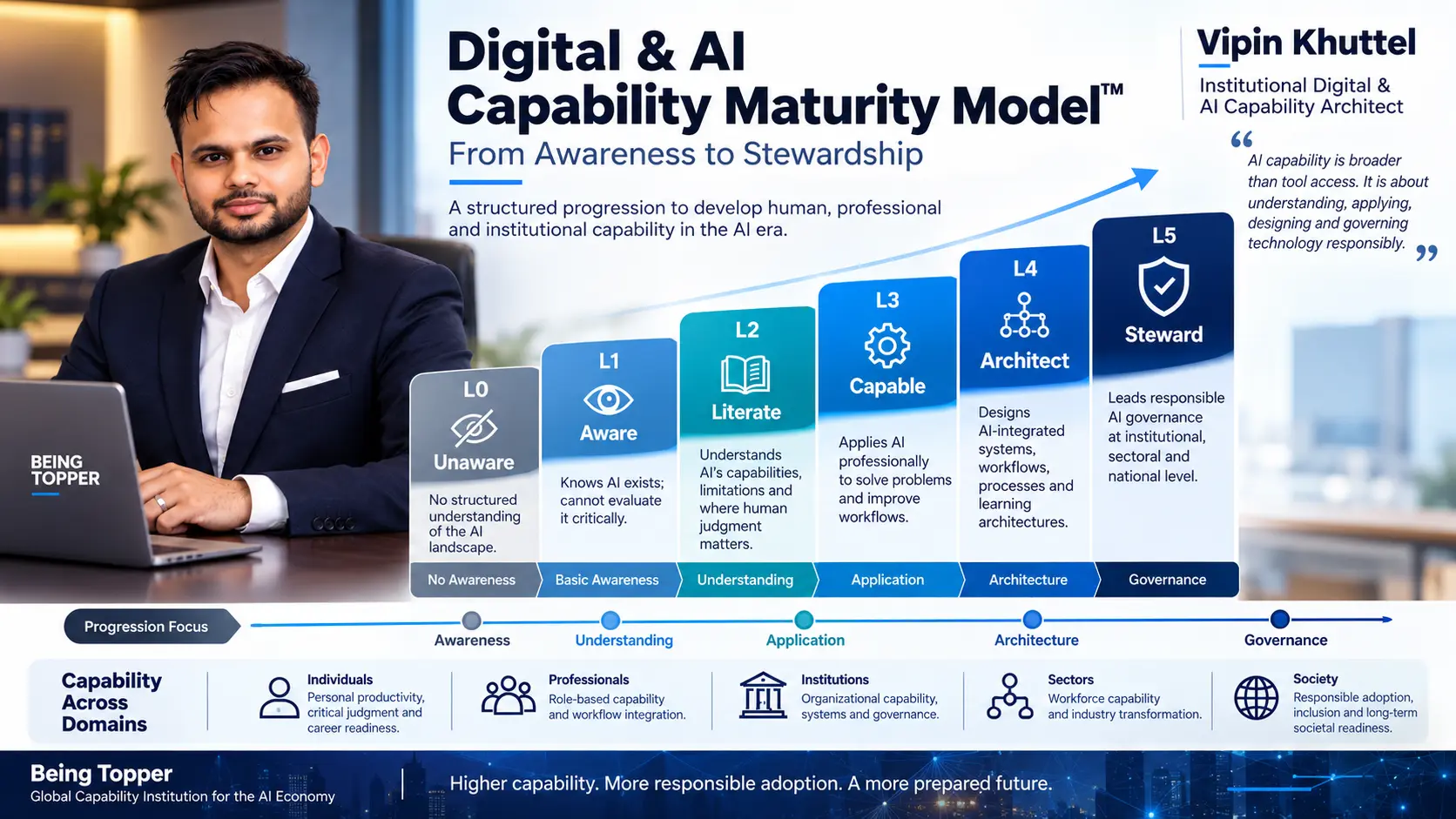
Six levels, from Unaware to Steward, applying independently within any layer or dimension.
Where does it create impact?
Individual career, institutional systems, or societal adaptation.
Where This Framework Applies
Part of the Wider Architecture
AI Impact Architecture is one of six formal frameworks that make up Being Topper's institutional capability architecture.
Digital & AI Capability Maturity Model
How mature a given capability is — six levels from Unaware to Steward, applying independently within each dimension here.
Companion FrameworkThree Layers of AI Capability
What kind of AI capability exists — usage, application engineering or foundational development.
Sub-Framework5 Capabilities of an AI-Ready Professional
The specific capabilities behind the individual dimension of this architecture.
Umbrella FrameworkInstitutional Digital & AI Capability Architecture
The umbrella architecture connecting people, technology, institutions and society.
The Practitioner Behind the Framework
Vipin Khuttel is the Institutional Digital & AI Capability Architect whose work focuses on the intersection of AI, digital capability, education, media, workforce readiness and responsible technology.
His professional journey has evolved from digital strategy and digital capability toward institutional capability and, increasingly, the design of capability architecture for the AI era.
2011 → Present
- Digital Marketing Strategist
- Digital & AI Capability Strategist
- Institutional Digital & AI Capability Strategist
- Institutional Digital & AI Capability Architect
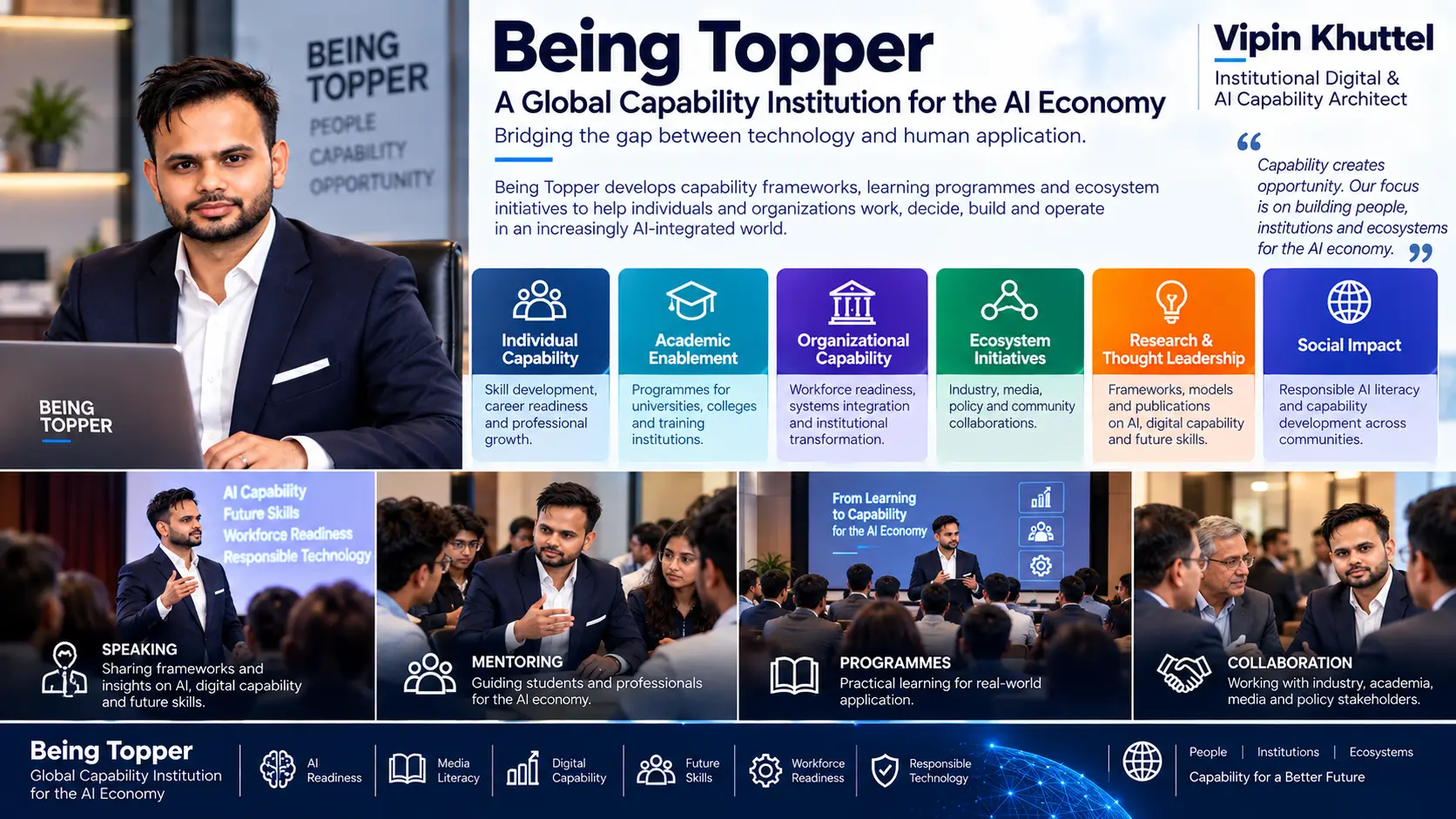
Being Topper: Building Capability for the AI Economy
Being Topper serves as the institutional capability-development platform through which frameworks, learning pathways, assessments and capability-building initiatives can be translated into practice.
Where to Begin
Each dimension has its own starting point.
Ready to diagnose your AI career path?
Discover where you actually stand — and the next real step in your AI career, mapped in minutes.
Start the AI Role DiagnosticLooking to build institutional capability?
Bring structured AI capability into your institution — built around your people, not just your tools.
Request Institutional DialoguePartner to close the societal gap?
Extend real AI capability to the people too often left out of the conversation — inclusive by design, built to include.
Initiate Structured DialogueFrequently Asked Questions
What is AI Impact Architecture?
A systems-level framework connecting individual capability, institutional systems and societal adaptation — describing where AI capability creates impact, across three dimensions: AI Career Architecture, Institutional Capability Architecture and Social Capability Architecture.
What are the three dimensions?
AI Career Architecture (individual — how a person remains capable as work changes), Institutional Capability Architecture (institutional — what institutions must build to turn AI access into sustained capability), and Social Capability Architecture (societal — how society adapts when AI changes work, institutions and economic systems).
How is this different from the Three Layers of AI Capability?
The Three Layers ask what kind of AI capability exists — usage, application engineering or foundational development. AI Impact Architecture asks where that capability creates impact — individual, institutional or societal. They are independent lenses on the same capability.
How is this different from the Digital & AI Capability Maturity Model?
The Maturity Model asks how mature a capability is, across six levels from Unaware to Steward. AI Impact Architecture asks where that capability creates impact. The six levels apply independently within any of the three dimensions here.
Are the three dimensions sequential stages?
No. They are interconnected, not a ladder. An AI-capable professional inside an unprepared institution faces structural limits; strong institutions need capable people; and institutional capability ultimately operates within wider societal systems.
Who developed this framework?
The framework is developed and articulated through the work of Vipin Khuttel, Institutional Digital & AI Capability Architect and founder of Being Topper. It was publicly introduced at the India AI Impact Summit & Expo 2026, Hall 6, Bharat Mandapam, New Delhi.
How can I apply this framework to my organization?
Through Being Topper — for capability mapping across individual, institutional and societal dimensions, AI-readiness assessment, or workforce capability programmes. Use the WhatsApp or call options below to start an institutional conversation.
Individual capability, institutional systems, societal adaptation — capability is only complete when it reaches all three.
Map Your Impact
For individuals, institutions and organizations wanting to understand where AI capability is creating impact today — and where the gaps between individual, institutional and societal readiness actually sit. Individuals can start with the AI Readiness Index, a free diagnostic at beingtopper.net.
The appropriate scope depends on the actual requirement and institutional context.