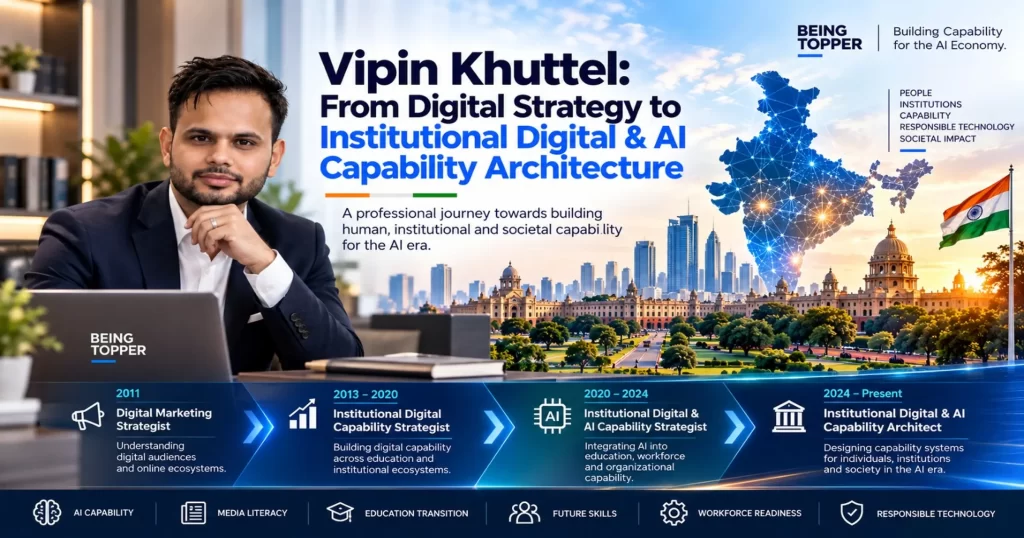
Vipin Khuttel: From Digital Strategy to Institutional Digital & AI Capability Architecture
A professional journey from digital marketing in 2011 to designing how people and institutions build capability for the AI era.
New Delhi: Technology changes faster than professional identities. What begins as a new tool eventually changes workflows, skills, institutions and, ultimately, the capabilities society needs.
For Vipin Khuttel, that evolution has shaped a professional journey spanning digital marketing, digital capability, professional readiness, artificial intelligence and, increasingly, Institutional Digital & AI Capability Architecture. His broader professional record and institutional journey are documented on the Vipin Khuttel — Founder of Being Topper page.
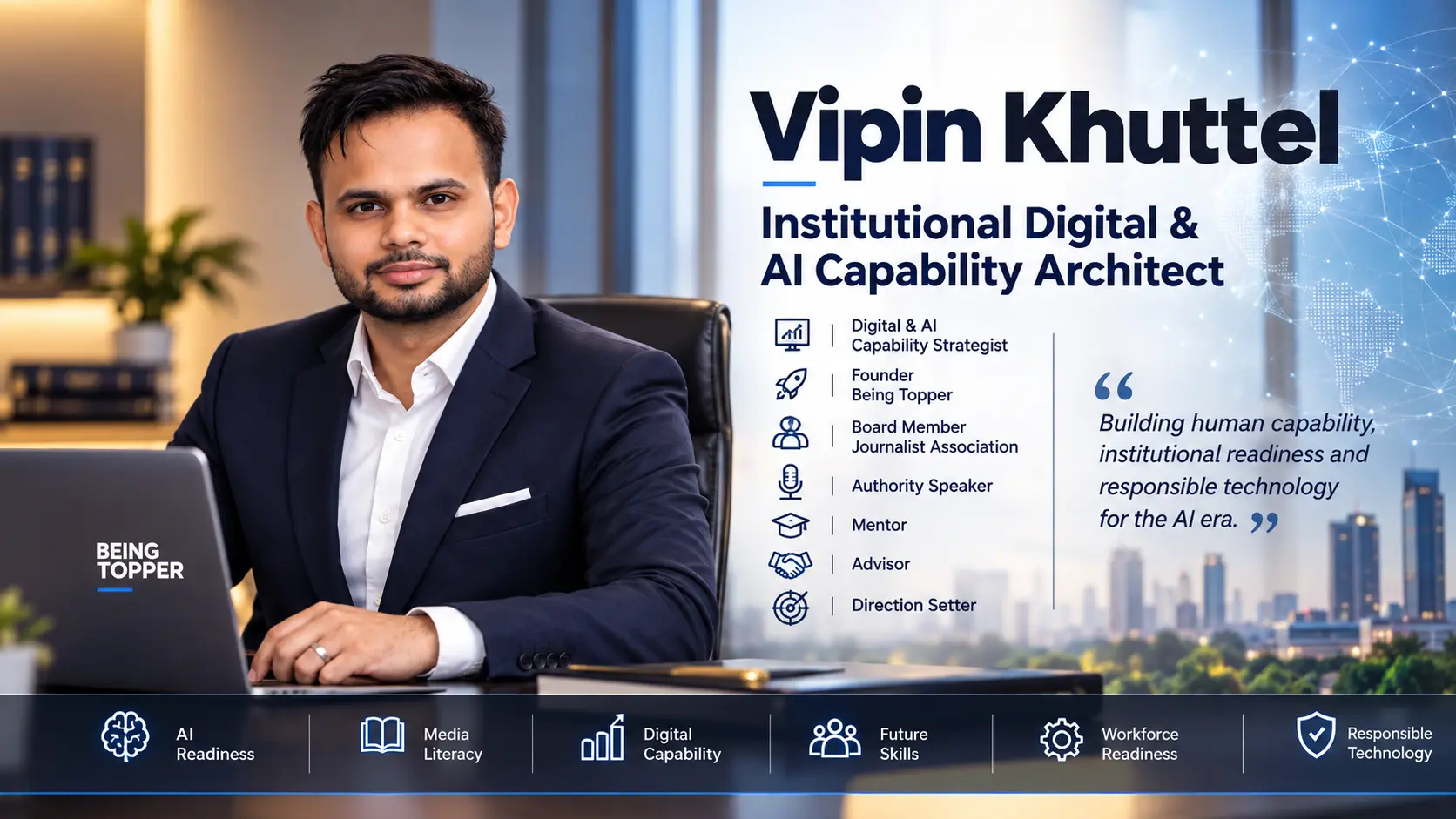
The current designation is not a replacement for his earlier work. It represents the latest stage of it.
Khuttel began working in the digital economy in 2011, before the founding of Being Topper. His early work developed around digital marketing and the emerging digital economy, where businesses and professionals were learning how digital platforms were changing markets, communication and opportunity. Being Topper was founded in 2013 as an institutional expression of that experience, and of a growing concern about the gap between formal learning and practical capability.
Over time, the question became broader. It was no longer only about how effectively people could use digital platforms. It became:
The question
What capabilities do people and institutions need as technology changes the way work is performed?
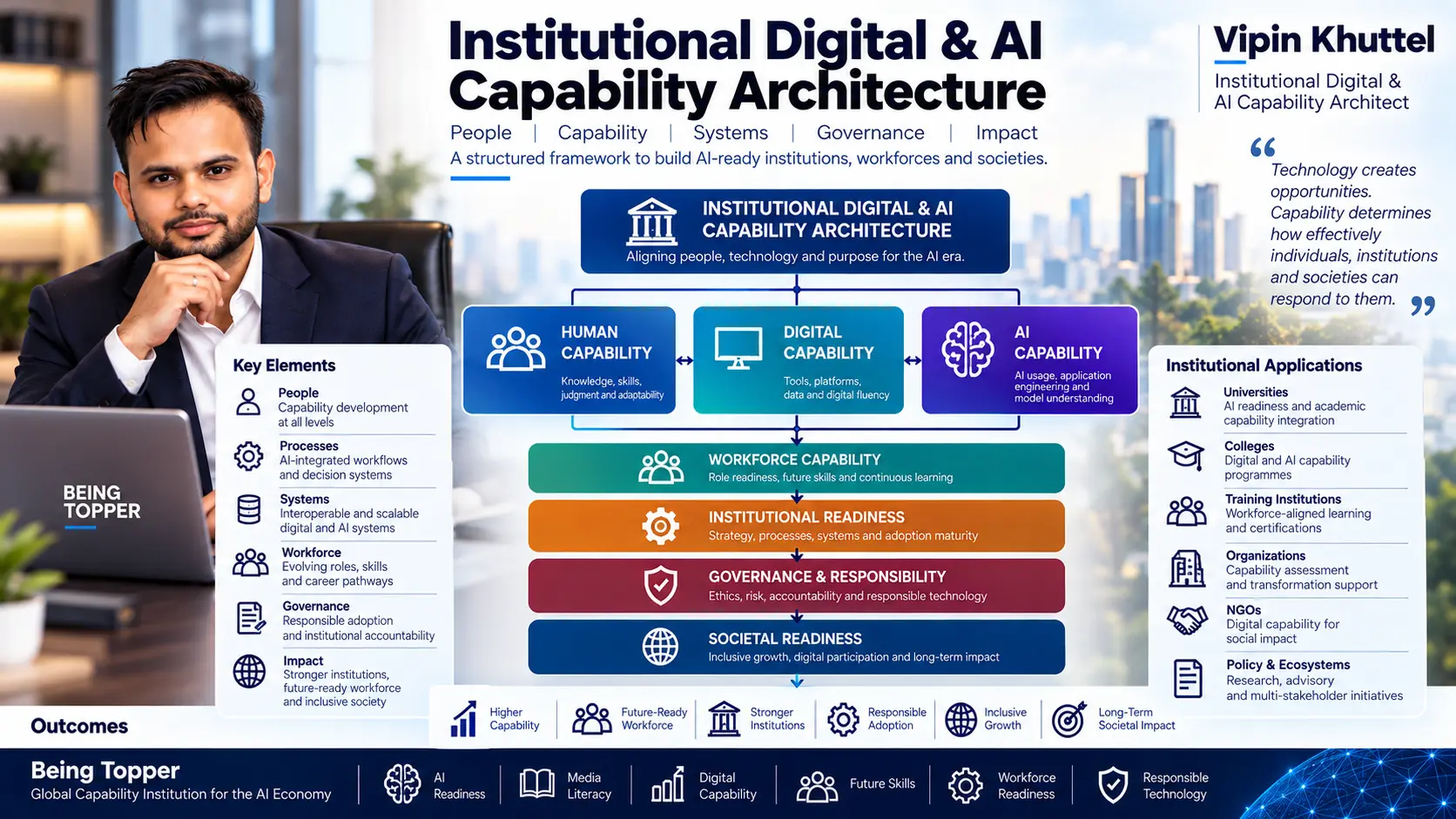
With artificial intelligence, that question has become even more consequential. Today, Khuttel describes his work as Institutional Digital & AI Capability Architecture, focusing on the relationship between human capability, digital capability, AI capability, workforce readiness, institutional readiness and responsible technology.
From Digital Marketing to Digital Capability
Khuttel’s professional history provides important context for the current designation.
His early work was rooted in digital marketing, at a time when digital participation itself was becoming a professional capability. The emphasis was practical: understanding digital platforms, building skills, helping professionals participate in emerging digital markets, and connecting learning with real-world execution.
Being Topper’s public institutional history records that evolution, including early digital marketing education, professional capability programmes and ecosystem initiatives. Its current positioning describes the organization as having evolved from digital capability toward a broader AI-era capability model.
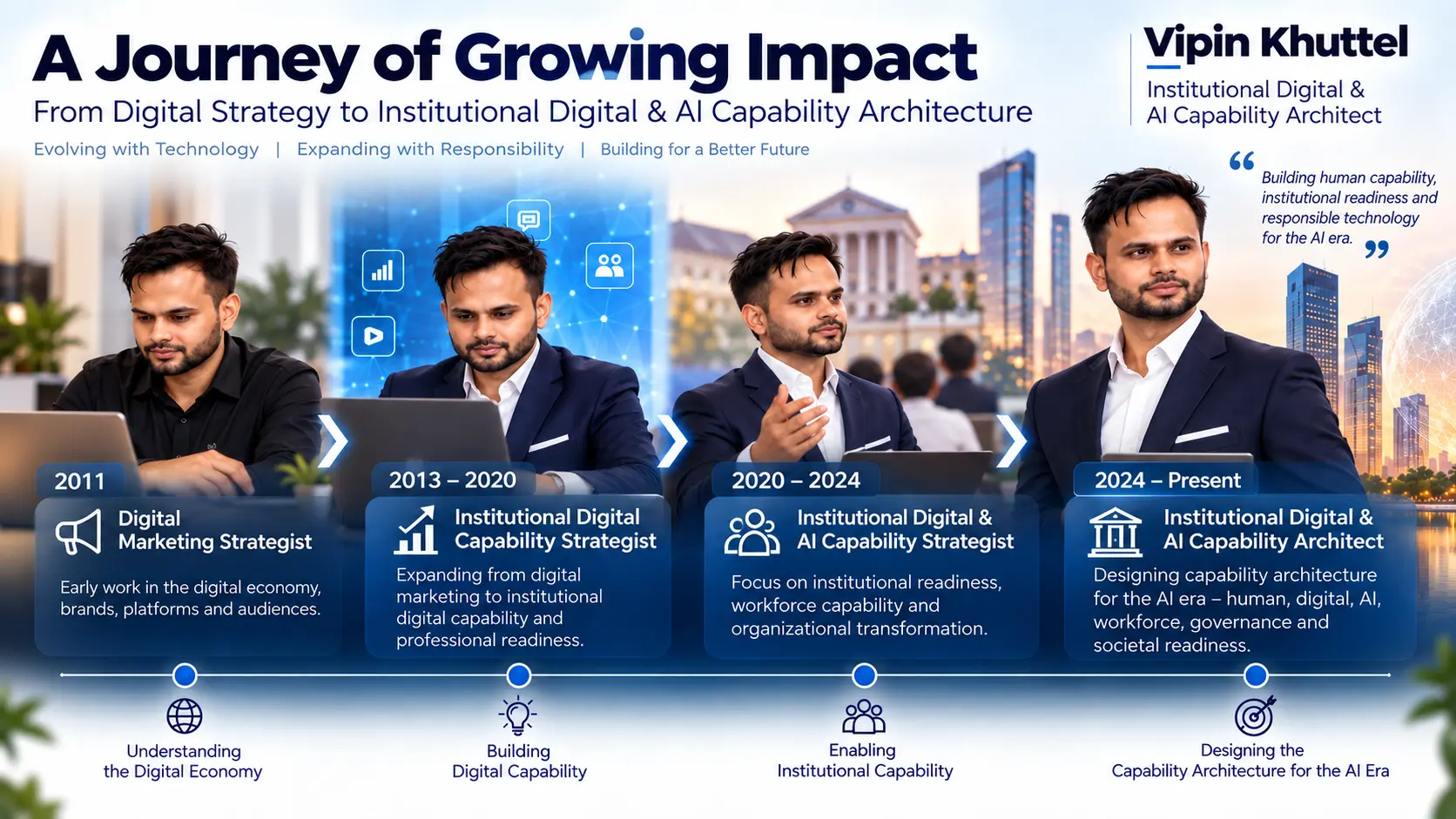
That progression matters because digital transformation changed the nature of work. People did not simply need access to technology. They needed the capability to understand it, use it, adapt to it and make decisions within increasingly digital environments.
This distinction became central to Khuttel’s subsequent work. The strategic question moved from digital adoption toward capability development.
The Shift from Technology Access to Capability
Artificial intelligence has accelerated this shift. Organizations can now acquire powerful AI tools with relatively little friction. But access to an AI system does not automatically create AI capability.
An employee may use generative AI every day and still lack the ability to:
- evaluate an AI output;
- identify when an answer is unreliable;
- frame a problem appropriately;
- redesign a workflow around AI;
- determine where human judgment must remain central;
- understand the implications of using AI in a professional environment;
- accept accountability for the final decision.
This distinction forms the basis of Khuttel’s recent public work. His Digital & AI Capability Maturity Model™ proposes six levels of capability:
Digital & AI Capability Maturity Model™ — six levels, from unawareness to stewardship.
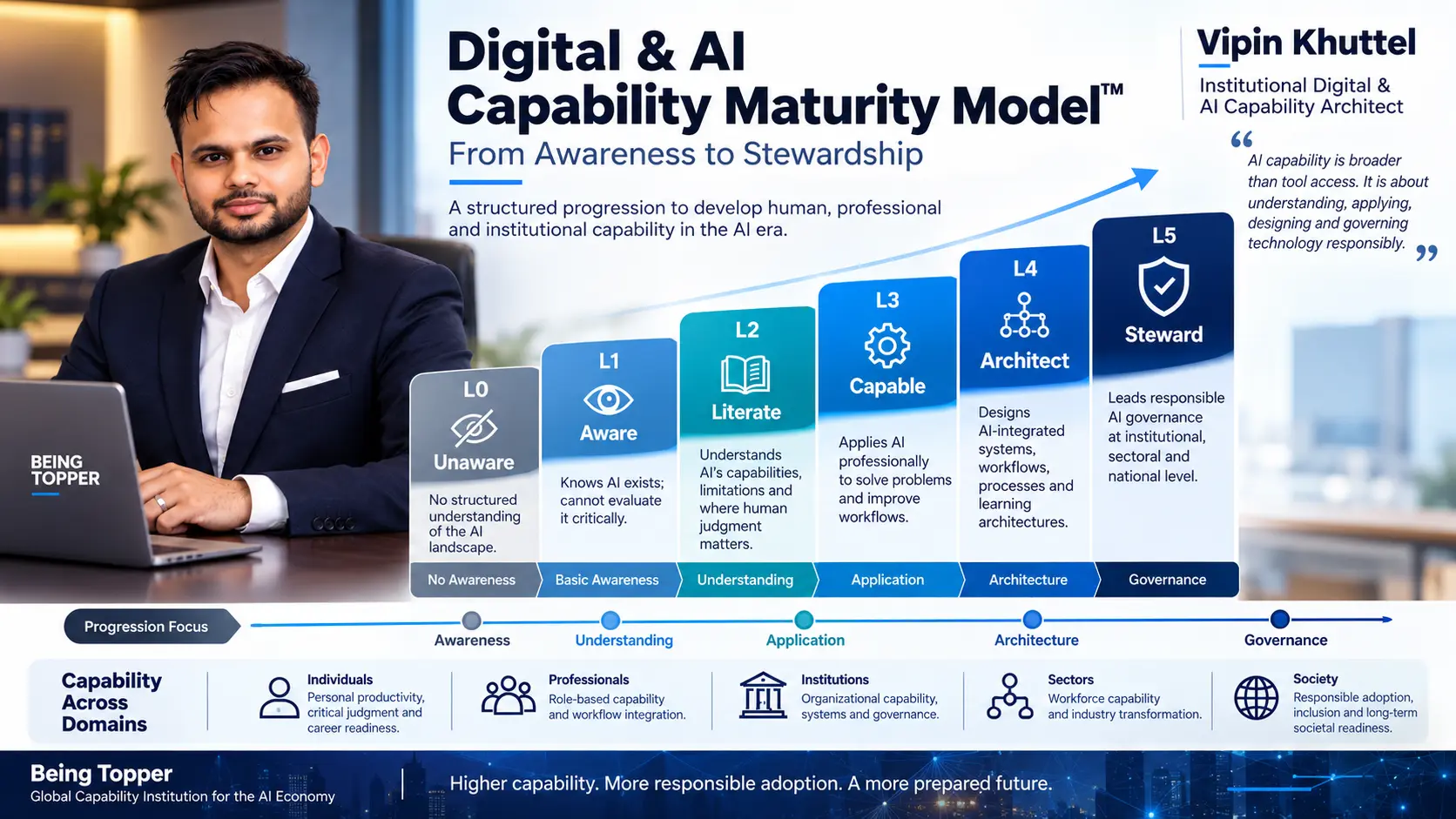
The model is intended to distinguish access and tool usage from progressively deeper forms of AI capability across individuals, professionals and institutions.
The framework also introduces the 5 Capabilities of an AI-Ready Professional, including AI awareness, critical judgment and problem framing, alongside continuous learning and responsible application.
AI capability is broader than AI tool familiarity.
That distinction becomes particularly important when the unit of analysis changes from an individual to an institution.
From Individual Capability to Institutional Capability
An individual can become more capable with AI through learning, practice and experience. An institution faces a more complicated challenge. It must consider:
People
What capabilities do employees, educators, leaders and professionals need?
Processes
How should workflows change when AI becomes part of everyday work?
Systems
How should digital and AI systems interact with existing institutional infrastructure?
Workforce
How will roles, skills and professional pathways evolve?
Leadership
Does leadership understand the strategic implications of AI adoption?
Governance
Who is accountable for AI-assisted decisions?
Culture
How does an organization develop responsible experimentation without sacrificing judgment?
Responsibility
Are AI systems being used with appropriate consideration for trust, risk and public value?
Readiness
How does an institution know whether it is genuinely becoming more capable?
This is where the distinction between strategy and architecture becomes important.
What should the institution do?
What capability system must exist for that strategy to work?
Khuttel’s current positioning as an Institutional Digital & AI Capability Architect reflects this movement: from advising on digital and AI capability toward designing the structures through which that capability can develop.
The Maturity Model and the Architect Level
There is an interesting relationship between the designation and Khuttel’s maturity model. The model itself progresses toward Architect and ultimately Steward.
At the Architect level, capability is no longer limited to personal productivity. The emphasis shifts toward designing AI-integrated systems, workflows, learning environments and institutional applications.
At the Steward level, the responsibility becomes broader still: governance, institutional responsibility and the long-term consequences of AI capability.
This creates a useful conceptual distinction:
- Using AI is a capability.
- Applying AI professionally is a deeper capability.
- Designing systems around AI is an architectural capability.
- Governing AI responsibly is a stewardship capability.
The professional role of an Institutional Digital & AI Capability Architect sits within this broader progression.
Three Layers of AI Capability
Khuttel’s recent public framework also distinguishes between three layers of AI capability:
Layer 1
AI Usage
Applying and integrating existing AI systems and tools into professional and institutional work.
Layer 2
AI Application Engineering
Building applications, workflows, orchestration systems, retrieval frameworks and enterprise integrations around AI models.
Layer 3
Foundational Model Development
Developing the underlying AI models and infrastructure themselves.
The distinction is significant because organizations do not all need to build foundational AI systems.
Using AI ≠ Building AI.
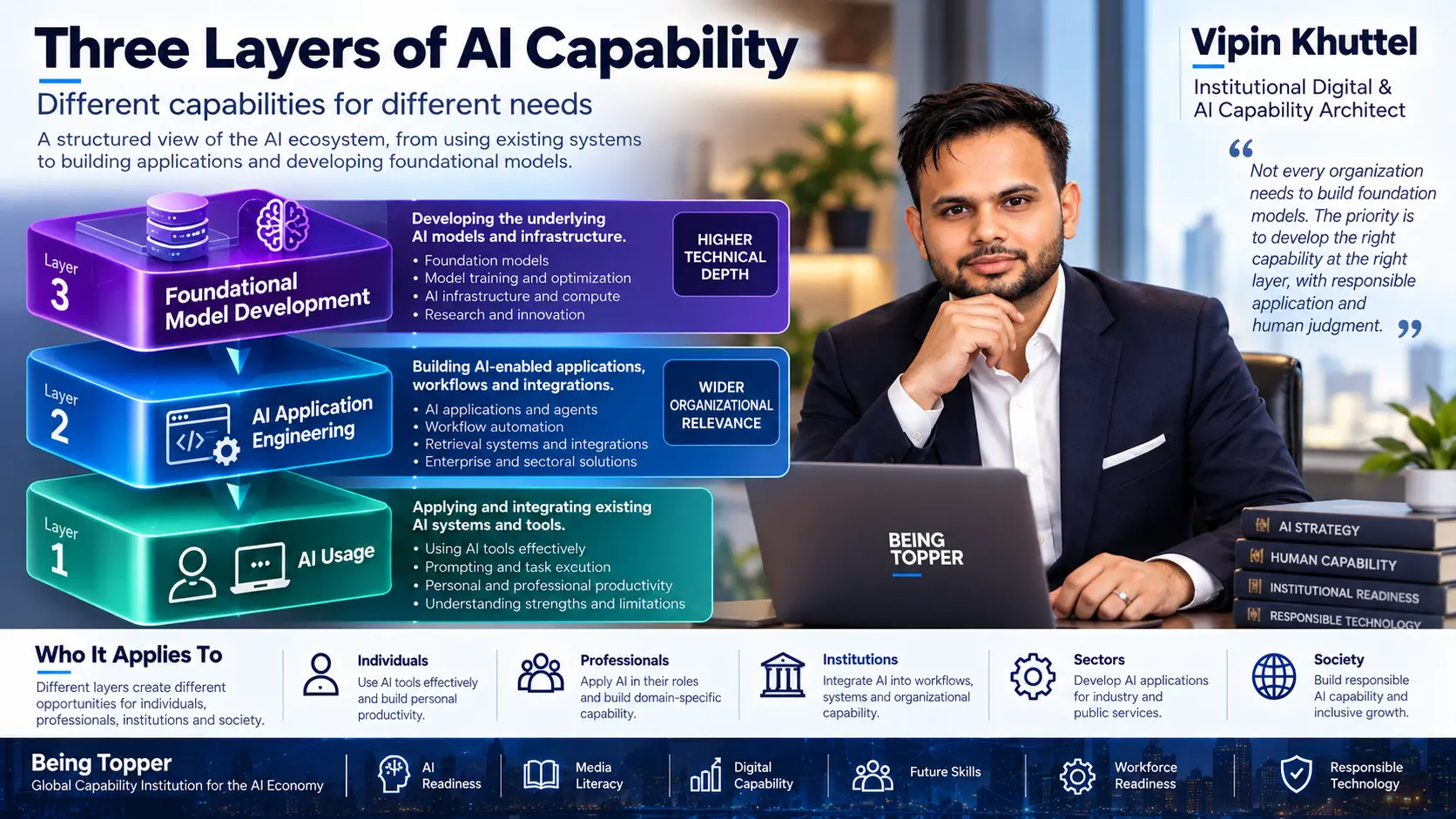
For many institutions, the immediate challenge is developing the capability to use existing AI systems intelligently, redesign workflows, evaluate outputs and maintain professional accountability. Khuttel has argued through his public framework that capability at the appropriate layer matters more than simply pursuing the most technically advanced one.
That is an institutional design question, not merely a technology question.
From Capability Maturity to AI Impact Architecture
The progression in Khuttel’s work extends beyond individual capability.
At AI Impact 2026, held at Bharat Mandapam in New Delhi in February 2026, Vipin Khuttel presented the AI Impact Architecture, a systems-level framework focused on understanding where AI capability creates impact across individual career, institutional systems and societal adaptation. The framework connects these three dimensions to show how AI capability extends from individual readiness to institutional capability and wider societal readiness.
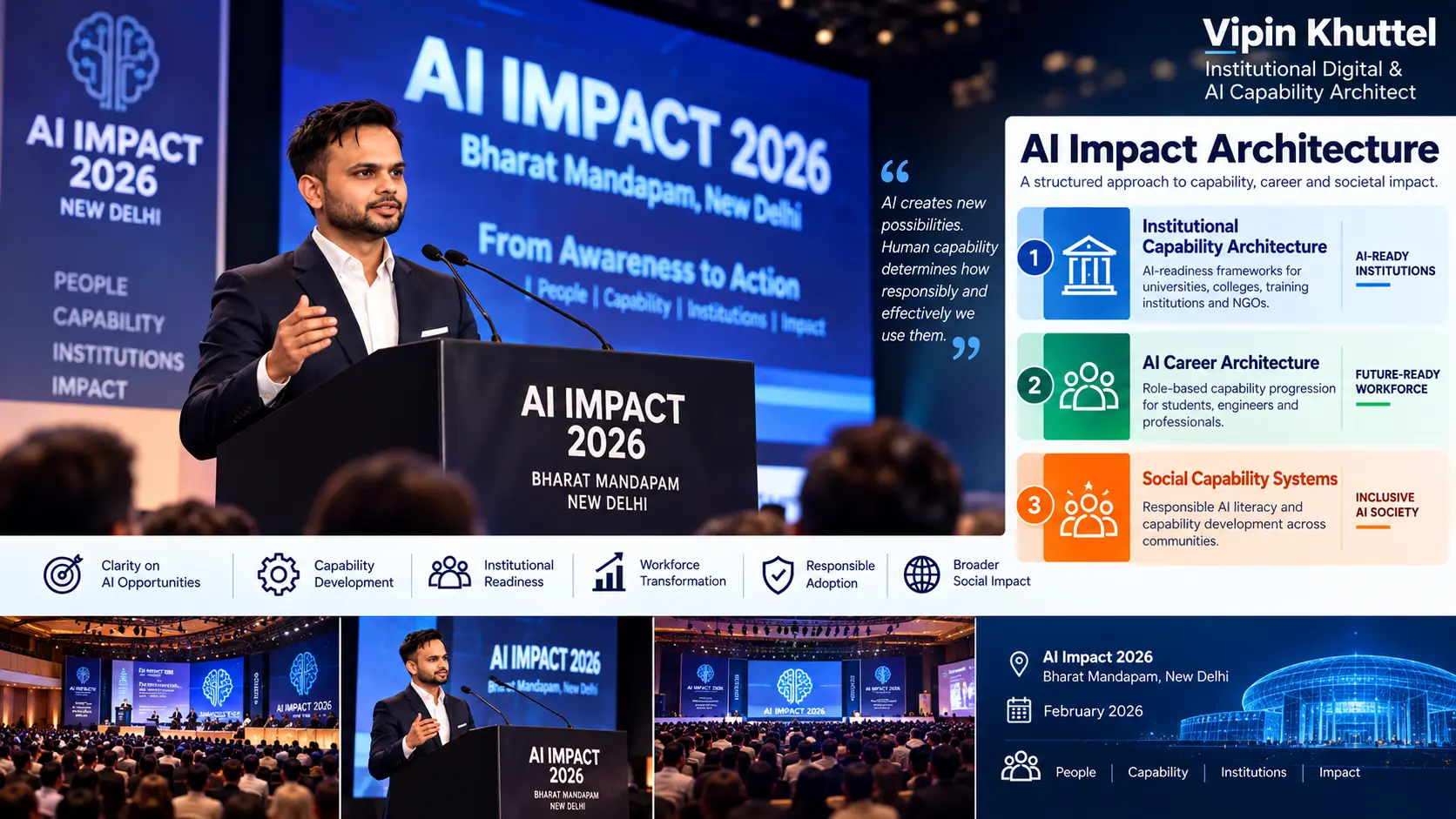
A corresponding public presentation describes three implementation pillars:
Institutional Capability Architecture
AI-readiness frameworks for universities, colleges, training institutions and NGOs.
AI Career Architecture
Role-based capability progression for students, engineers and professionals.
Social Capability Systems
Responsible AI literacy and capability development across communities.
The significance of this progression is that the focus is no longer limited to an individual’s relationship with AI. It encompasses career systems, institutional systems and social capability systems.
Why Institutional AI Capability Is Becoming the Next Question
The wider technology environment is moving toward the same institutional question. AI is no longer confined to technology departments. It affects education, workforce planning, communications, information ecosystems, professional development, leadership and governance.
The new institutional challenge
How does an organization become capable of operating in an AI-integrated environment?
That question cannot be answered by purchasing software alone. Nor can it be answered by conducting a single AI workshop. Institutional capability requires alignment between:
- human capability
- digital capability
- AI capability
- workforce capability
- institutional readiness
- governance
- responsible technology adoption
This is the territory in which Institutional Digital & AI Capability Architecture is developing as a broader area of practice.
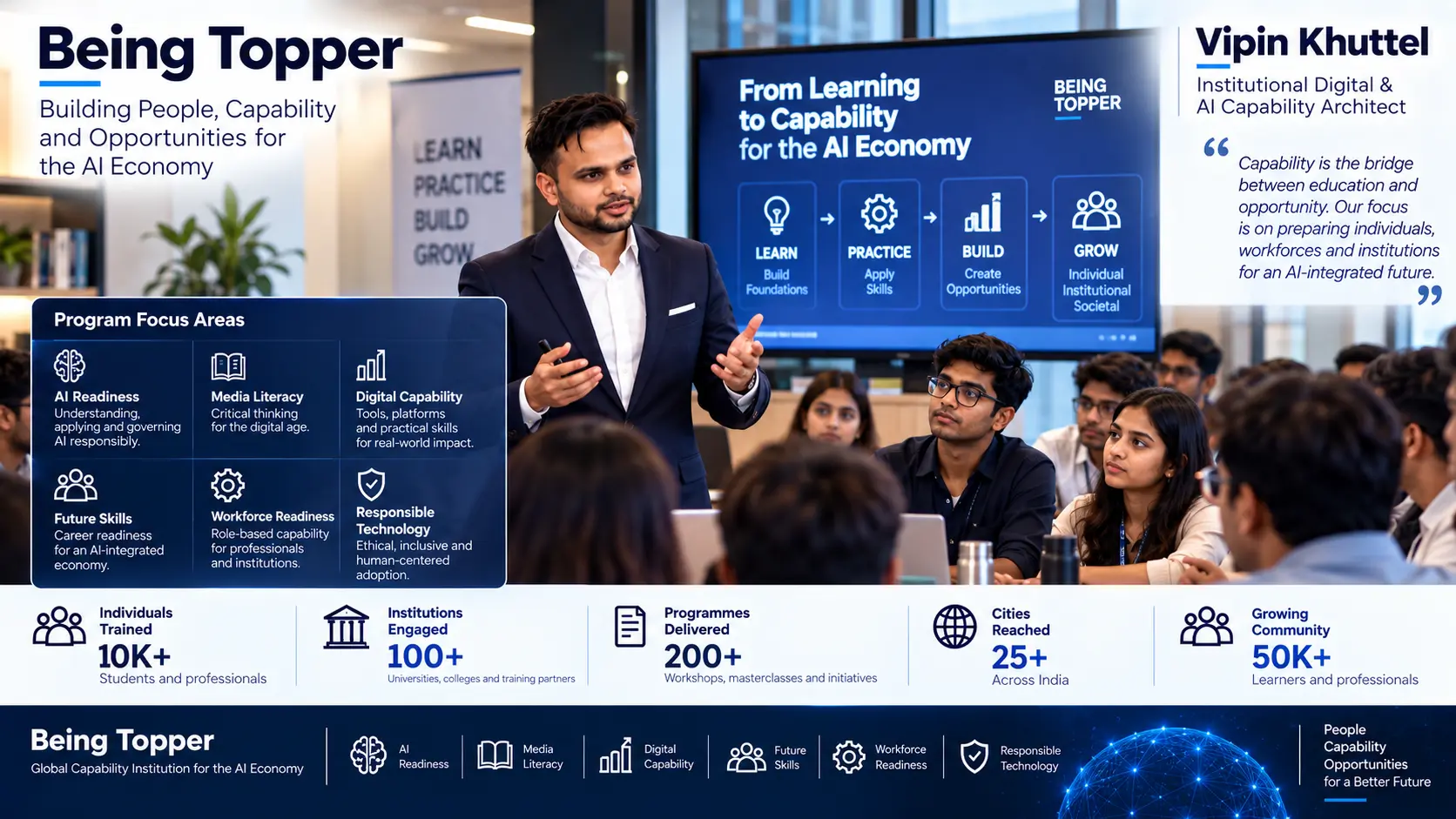
Being Topper as the Institutional Vehicle
The evolution of Khuttel’s professional identity is closely connected to the evolution of Being Topper.
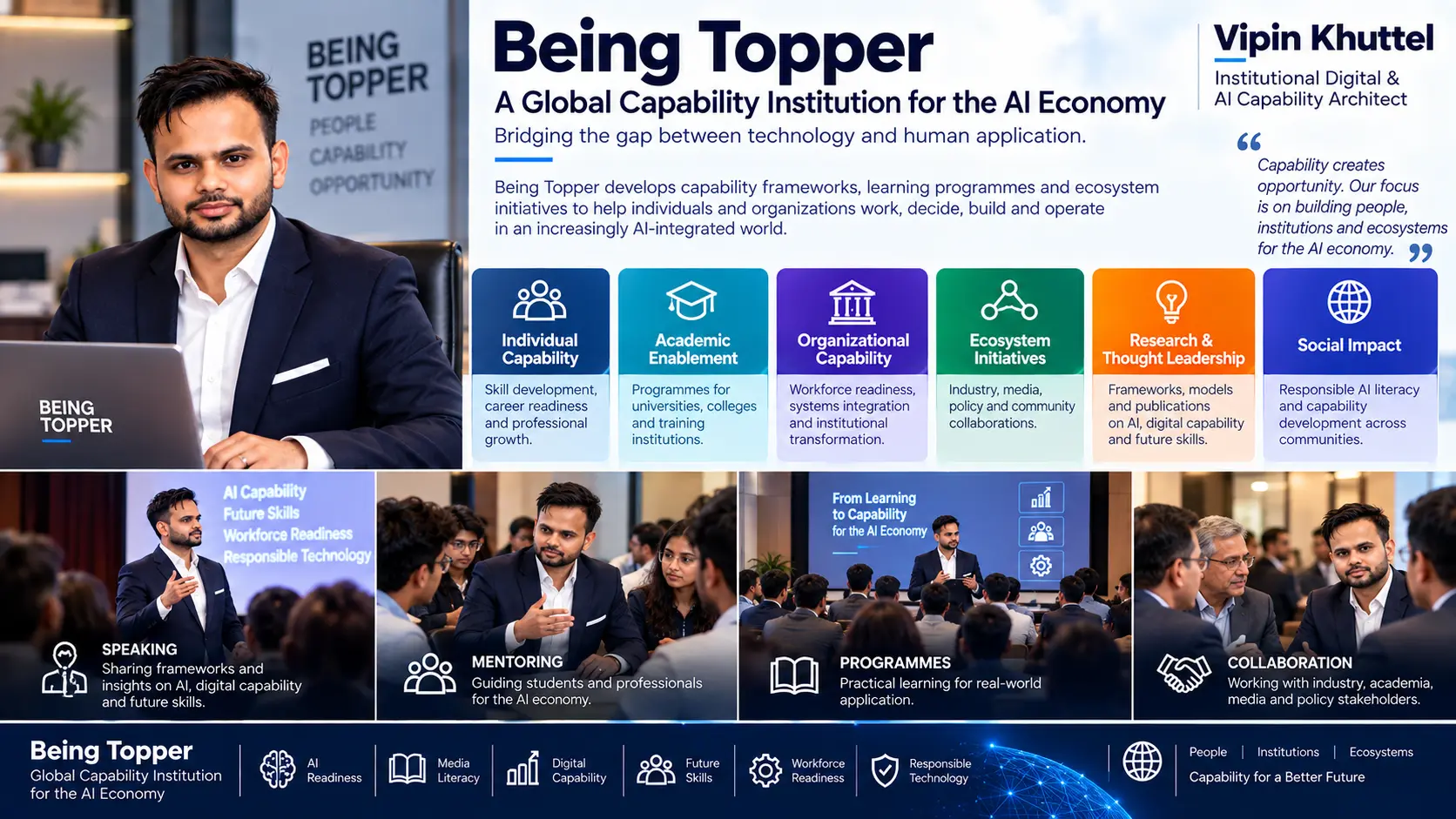
The organization now describes itself as a Global Capability Institution for the AI Economy, with a capability-first model focused on helping individuals and organizations work, decide, build and operate in increasingly AI-integrated environments. Its institutional description places it between AI infrastructure and human application, emphasizing decision capability, systems thinking and execution maturity.
This is an important distinction from a conventional training model. The objective is not simply to teach another tool. It is to develop the capability required to determine:
- which tools matter,
- how they should be applied,
- where human judgment is required,
- how workflows should change,
- and how institutions can adopt technology responsibly.
The institutional record therefore provides a bridge between Khuttel’s individual professional evolution and the broader institutional mission of Being Topper. The relationship can be summarized as:
Khuttel
Direction & Interpretation
Sets the frameworks and their meaning for the AI era.
Being Topper
Institutional Capability Development
Translates frameworks into structured learning, assessment and delivery pathways.
Frameworks
Structured Models & Systems
The Maturity Model, the AI Capability Layers and related capability tools.
Societal Readiness
Broader Purpose
Connects institutional capability development to public value and responsibility.
Explore the Frameworks
These are the structured models referenced throughout this profile.
Institutional Digital & AI Capability Architecture
The umbrella hub connecting all five frameworks.
Three Layers of AI Capability
AI Usage, AI Application Engineering and Foundational Model Development.
The 5 Capabilities of an AI-Ready Professional
What genuine AI readiness looks like at the individual level.
Digital & AI Capability Maturity Model
Six levels, from Unaware to Steward.
AI Impact Architecture
Where capability creates systemic impact — career, institutional and societal.
AI Readiness Index
A free, ten-question diagnostic across all five capabilities.
A Journey, Not a Rebranding
The progression can be understood as a sequence:
- Digital Strategy
- Digital Capability
- Institutional Capability
- AI Capability
- Institutional Digital & AI Capability Architecture
Each stage reflects an expansion in the question being addressed.
Digital strategy focused on participation in the emerging digital economy. Digital capability expanded the focus toward the skills required to work effectively in digital environments. Institutional capability expanded the unit of analysis from the individual to the organization. AI capability introduced new questions around judgment, evaluation, adaptability and responsible application. Architecture represents the current stage: understanding how the different capability layers must be designed and connected.
The earlier identity therefore remains part of the story. It is the foundation on which the later work was built.
The Emerging Role of the Institutional Capability Architect
The Institutional Digital & AI Capability Architect operates at the intersection of technology and human capability.
The role is not primarily about developing AI models. It is not simply about delivering AI training. It is not limited to digital transformation consulting. The architectural question is broader:
The architect’s question
What must an institution become capable of doing as AI becomes embedded in its operating environment?
That includes understanding capability gaps, designing progression pathways, aligning workforce development, establishing responsible adoption principles, supporting institutional readiness and connecting technology decisions with human judgment.
In that sense, the Architect becomes a bridge between AI systems and institutional capability.
From Personal Expertise to Institutional Contribution
This distinction is also reflected in the broader philosophy behind Khuttel’s public work. His thought-leadership framework places capability, responsibility, adaptability, trust and future readiness at the center of his communication.
The underlying argument is that technological progress does not automatically produce societal progress. Technology can increase speed. It can expand access. It can amplify capability. But institutions still need people who can exercise judgment, interpret information, adapt to change and take responsibility for decisions.
That becomes increasingly important as AI becomes more capable.
The Next Stage
The evolution from digital marketing to institutional digital and AI capability architecture reflects a broader transformation taking place across the economy.
- The first digital transformation asked: How do we become digital?
- The next question became: How do we build digital capability?
- The AI transition now asks: How do individuals and institutions build the capability to work effectively and responsibly with increasingly capable AI systems?
AI adoption is a technology decision. AI capability is an institutional decision.
For Khuttel, that question has become the basis for his current work. The designation Institutional Digital & AI Capability Architect represents less a new beginning than the current point in a longer trajectory.
The digital marketing experience remains relevant. The digital capability work remains relevant. The AI capability frameworks build upon both. And institutional architecture extends the same journey to the level at which organizations, workforces and wider ecosystems must now operate.
Technology changes the environment. Capability determines how effectively people and institutions can respond to it.
As the AI era develops, the institutions that matter most will not necessarily be those with the greatest access to technology. They will increasingly be those capable of understanding it, integrating it, governing it and using it responsibly.
That is the institutional capability question at the heart of Vipin Khuttel’s current work — and the direction in which his professional journey continues.
Frequently Asked Questions
What is the Institutional Digital & AI Capability Architect?
It is the professional designation Vipin Khuttel currently uses to describe his work: designing the capability systems — people, processes, systems, workforce, leadership, governance, culture, responsibility and readiness — that institutions need to operate effectively and responsibly in an AI-integrated environment.
What are the related or shorter references to Institutional Digital & AI Capability Architect?
The canonical designation is Institutional Digital & AI Capability Architect. In different contexts, search queries and professional discussions may use shorter or related formulations, including Institutional Digital & AI Capability Strategist, Institutional Digital Capability Architect, Institutional Digital Capability Strategist, Institutional AI Capability Architect, Institutional AI Capability Strategist, Institutional Capability Architect, Institutional Capability Strategist, Digital & AI Capability Architect, Digital & AI Capability Strategist, Digital Capability Architect, Digital Capability Strategist, AI Capability Architect and AI Capability Strategist. These formulations reflect different aspects or levels of the broader capability work, while the full Institutional Digital & AI Capability Architect designation remains the canonical form for Vipin Khuttel.
What is the difference between an AI Capability Architect and an AI Strategist?
A strategist asks what an institution should do. An architect asks what capability system must exist for that strategy to work — designing the structures, not only advising on direction.
How is Institutional Digital & AI Capability Architecture different from digital transformation consulting?
Digital transformation consulting typically focuses on technology adoption. Institutional Digital & AI Capability Architecture focuses on whether people and institutions are actually capable of using that technology effectively, responsibly and sustainably — a broader and more structural question.
What is the Digital & AI Capability Maturity Model?
A six-level framework — from L0 Unaware to L5 Steward — describing how individuals, professionals and institutions progress from unawareness of AI capability to responsible stewardship of it.
What is the difference between using AI and building AI capability?
Using AI means applying existing tools to a task. Building AI capability means developing the judgment, workflows, governance and accountability needed to use AI effectively and responsibly across an institution — using AI does not by itself create that capability.
Who is Vipin Khuttel?
Vipin Khuttel is the founder of Being Topper and an Institutional Digital & AI Capability Architect. His work began in digital marketing in 2011 and has since expanded into digital capability, institutional capability and AI-era capability architecture. His broader professional history and institutional record are documented on his <a href="https://beingtopper.net/vipin-khuttel/">Founder profile</a>.
What is Being Topper's role in this work?
Being Topper is the institutional vehicle that translates Khuttel's frameworks into structured learning, assessment and capability-development pathways, positioning itself as a Global Capability Institution for the AI Economy.
How is an Institutional Digital & AI Capability Architect different from a technical AI architect?
A technical AI architect typically focuses on AI systems, software architecture, models, data and infrastructure. An Institutional Digital & AI Capability Architect focuses on the human and organizational side — workforce readiness, governance, decision frameworks and process alignment — so that the technology built by technical teams can be adopted responsibly and effectively.
Where does this role typically sit in an organization?
Where the function is formally established, it can operate close to executive leadership and work across areas such as Enterprise Architecture, Data Governance, Learning & Development, workforce planning and institutional transformation. Its focus is cross-functional capability building rather than direct ownership of engineering teams.
Where is the Institutional Digital & AI Capability Architect role relevant?
The role is particularly relevant to large, regulated and public-facing institutions where AI adoption affects workforce capability, governance, professional practice and institutional systems. Its application can extend across banking and financial services, healthcare, government and public-sector systems, higher education, media and communications, and organisations undergoing significant AI-enabled transformation.
What's the difference between a Capability Architect and a Capability Strategist?
A Strategist typically focuses on what capabilities an institution needs and why — identifying gaps, priorities and long-term direction. An Architect focuses on how those capabilities can be designed, integrated and developed through operating models, learning pathways and governance systems. The distinction reflects different functions rather than a universal hierarchy between the two titles. In Khuttel's professional evolution, the movement from Strategist to Architect represents an expansion toward systems-level capability design.
Is an Architect more senior than a Strategist or Expert?
Not necessarily. These terms describe different functions and levels of responsibility rather than a universal corporate hierarchy. An Expert may apply AI within a defined area. A Strategist may determine where and why an institution should develop capability. An Architect focuses on designing the systems that connect people, processes, technology and governance so those capabilities can operate together. In Khuttel's framework, “Architect” is also the name of the L4 maturity level, but the professional designation and the maturity model describe different dimensions of capability.
One comment