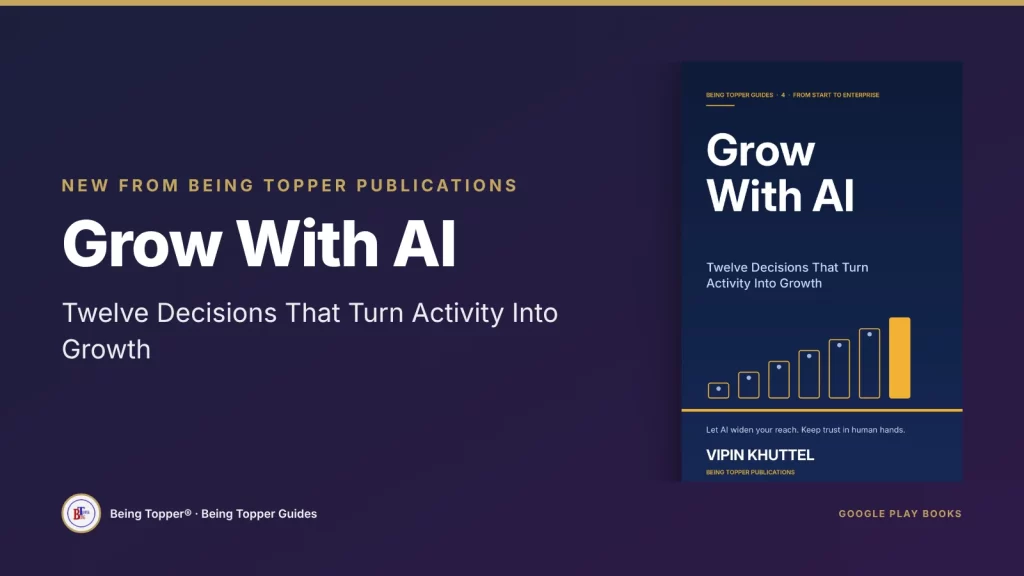
A guide for people who are busy but not growing: twelve decisions, in order, from the first day of a business to the day it becomes an institution.
New Delhi: Being Topper® has published Grow With AI: Twelve Decisions That Turn Activity Into Growth, by its founder Vipin Khuttel, under its Being Topper Publications imprint. The 120-page guide is on Google Play Books and is Book 4 of Being Topper Guides.
Most businesses that stop growing are not lazy. They are busy. They post, call, run advertisements, attend events and try new AI tools. The guide starts from that observation: activity is what you do, and growth is what changes because of it. What is usually missing is a small number of decisions that nobody asked the owner to make.
The question
If your business stopped doing one activity this month, which one would you be able to stop by rule rather than by mood?
What the guide gives readers
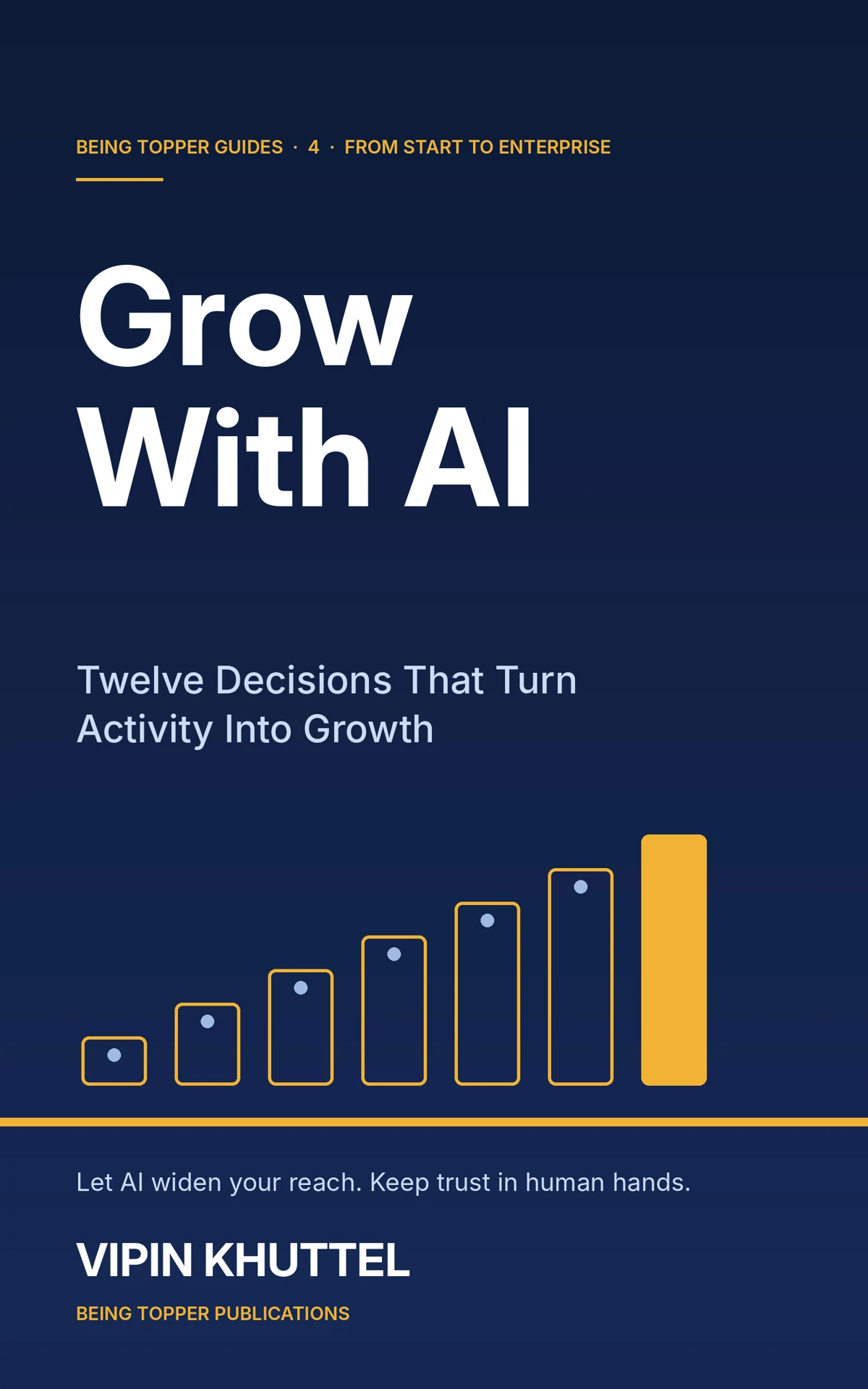
Grow With AI
Twelve Decisions That Turn Activity Into Growth
A blueprint to read in an evening and return to chapter by chapter. It names no AI tools, apps or platforms on purpose, and describes channels by type, because tools change every few months and the decisions do not.
- Twelve decisions, in order, from who the business is for and where it stands, to channels, spending, follow-up, build-buy-hire, AI use and what must never be traded for growth.
- Two ladders: the seven-stage Growth Stage Ladder, from Define to Compound, and the five-level AI Use Ladder, from Generate to Agentic system.
- One pattern in every decision chapter: the decision on one page, a case, a decision matrix, what changes with the size of the business, the evidence that should move you, and when the advice is wrong.
- A template to close each chapter, with thirteen in all, collected in Annex C, plus eight decision patterns and an industry finder.
- A trust standard: when AI may speak to customers, and why growth should go only as fast as trust allows.
Why the order of decisions matters
The guide observes that a business moves up its growth ladder only when the stage below holds. Skipping a stage is the most common reason growth stalls: advertising before follow-up works, or buying a sales system before there are sales.
The same logic applies to AI. A business at an early stage that runs agents is automating confusion, while one that is ready but still drafts every reply by hand is leaving growth unclaimed. The guide asks readers to raise AI’s freedom only on evidence.
Grow as fast as trust allows, and no faster.
— From the closing line of Chapter 13
Who it is for
Owners and founders
Business owners and founders who work hard every day and want to see which decisions are missing.
Marketers, freelancers and coaches
Marketers, freelancers, coaches and consultants who want a system for finding and keeping customers.
Sales, growth teams and leaders
Sales and growth teams, and leaders of larger organisations who need to see growth as a system.
Good to know: The examples in the guide are composites. It promises no income, sales, jobs or results, and it is not legal or financial advice. Laws and rules described in it were checked in November 2026 and change over time.
At a glance
| Book | Grow With AI: Twelve Decisions That Turn Activity Into Growth |
|---|---|
| Author | Vipin Khuttel, Founder of Being Topper |
| Publisher | Being Topper, under the Being Topper Publications imprint |
| Length | 120 pages |
| Format | eBook on Google Play Books |
| Available | Google Play Books |
| List price | ₹299, tax included |
| Links | Google Play Books · Book page · All books |
Frequently asked questions
What is Grow With AI about?
It is a business growth guide for the AI era. It sets out twelve decisions, in order, that turn activity into growth, from the first day of a business to the day it becomes an institution.
Who is it for?
Business owners, founders, marketers, freelancers, coaches, sales and growth teams, and leaders of larger organisations who need to see growth as a system.
What are the two ladders?
The Growth Stage Ladder has seven stages, from Define to Compound. The AI Use Ladder has five levels, from Generate to Agentic system. A business moves up only when the level below holds and the evidence supports it.
Does it recommend AI tools or platforms?
No. It names no AI tools, apps or platforms on purpose, and describes channels by type.
Does it promise income, sales or results?
No. What each reader achieves depends on their own business, effort and circumstances.
Can I use the templates?
Yes. The templates in the guide may be copied for your own use and for teaching.
Where is it available?
On Google Play Books, at a list price of ₹299 with tax included. The Read on Google Play Books button opens the store page.
Can I use the templates?
Yes. The templates in the guide may be copied for your own use and for teaching.
What does AI have to do with business growth?
Growth comes first and AI supports it. The book treats AI as one layer inside the twelve decisions, with a five-level AI Use Ladder from Generate to Agentic system, and AI’s freedom rises only on evidence.

About Vipin Khuttel
Vipin Khuttel is an Institutional Digital & AI Capability Architect, Founder of Being Topper and a Board Member of the All Journalists Association (AJA). He has worked in the digital economy since 2011 and holds a B.Tech in Information Technology from Guru Gobind Singh Indraprastha University (2011–2015). His work covers digital and AI capability, readiness and the responsible use of technology for individuals, professionals and institutions. Based in New Delhi. Read the full profile.
About Being Topper®
Being Topper is a capability-first institution founded on 10 October 2013 and based in New Delhi. It began with digital capability and digital marketing and has grown into a broader AI-era capability architecture. Its designation is Global Capability Institution for the AI Economy; its work is India-focused. Books are published under Being Topper Publications, the publishing imprint of Being Topper.
Media contact: +91 75290 19575 · info@beingtopper.net · www.beingtopper.net
Disclaimer: Google Play and Google Play Books are trademarks of Google LLC. They are referenced only to show where the book is available, and their use does not imply any endorsement, sponsorship or affiliation.