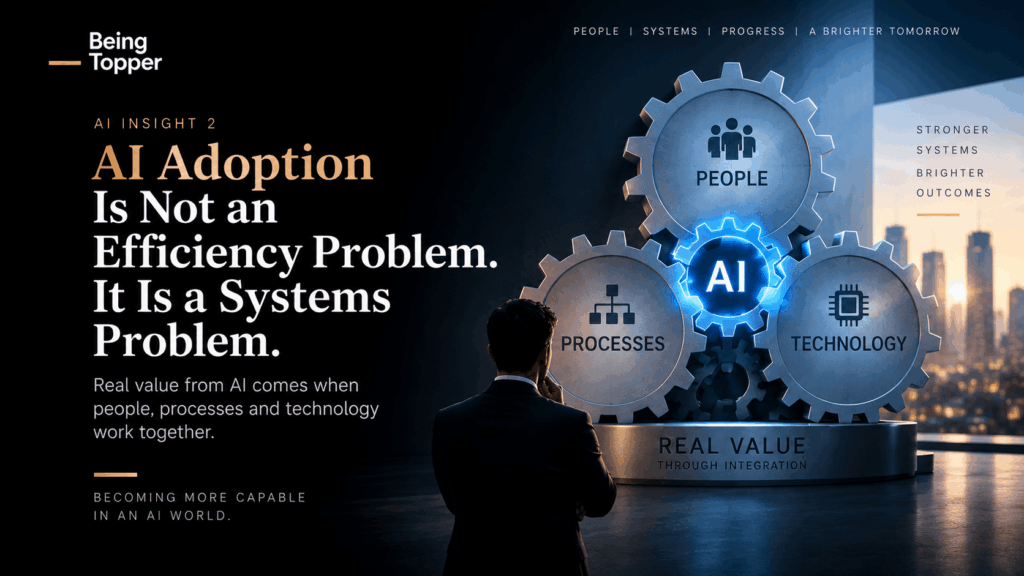
AI can make individual tasks faster. The more important question is what happens to the wider system — its dependencies, decisions and capability requirements — once that task no longer works the same way.
Artificial intelligence is increasingly being introduced into everyday work through a familiar promise: make processes faster, reduce repetitive effort, lower costs, and increase productivity. Those benefits are real. But they are only the first layer of what happens when AI enters an organization.
The deeper question is not simply whether an AI system can make an individual task more efficient.
It is what changes across the system when that task is no longer performed in the same way.
AI adoption is therefore not only an efficiency problem.
It is a systems problem.
The First-Order View of AI Adoption
Most organizations naturally begin with immediate effects.
A process takes two hours and AI reduces it to thirty minutes. A team previously produced ten reports and can now produce fifty. A customer-service workflow becomes partially automated. A marketing team can generate more variations of content. A professional can analyse larger volumes of information.
These are first-order effects. They are visible, measurable and relatively easy to communicate. They are also useful.
The problem begins when organizations treat these effects as the complete measure of AI adoption.
A system does not remain unchanged simply because one of its components becomes more efficient. When one part changes, other parts respond.
Workflows change. Dependencies change. Responsibilities change. Skill requirements change. Decision points change. Risk changes.
And sometimes, the organization begins producing more of something without becoming better at deciding what should be produced in the first place.
That is where the second-order effects begin.
Efficiency Can Change the System Itself
Consider a simple example.
An organization introduces AI to accelerate the production of internal analysis. The immediate result is positive. Reports are produced faster. More information is available. Employees spend less time preparing documents.
But what happens next?
If decision-makers begin receiving substantially more analysis, their cognitive environment changes. They may now have more information than before, but not necessarily more clarity.
If the organization begins relying on AI-generated analysis without strengthening evaluation capability, the volume of available information can increase faster than the organization’s ability to assess it.
The apparent productivity gain may therefore create a new capability requirement.
The organization has not simply adopted a tool. It has changed the conditions under which people make decisions.
This pattern appears across many forms of AI adoption.
A local efficiency improvement can create a system-wide capability requirement.
The Problem of Local Optimization
Systems thinking begins with a simple observation: optimizing one part of a system does not necessarily optimize the system as a whole.
An organization can make individual tasks faster while making the overall operating environment more complicated. For example:
- More automated outputs can create more review requirements.
- Faster content production can increase the need for quality control.
- Automated recommendations can increase the importance of human judgment.
- AI-generated code can accelerate development while increasing the importance of architecture, testing and security.
- Automated customer interactions can reduce human workload while creating new escalation and trust requirements.
- Greater access to information can increase the importance of knowing which information deserves attention.
The mistake is not using AI for efficiency.
The mistake is assuming that efficiency at the task level is equivalent to effectiveness at the system level.
It is not.
AI Changes Dependencies
Every organization operates through dependencies.
People depend on processes. Processes depend on information. Decisions depend on analysis. Teams depend on one another. Systems depend on data. Customers depend on outcomes.
When AI enters one of these relationships, the dependency structure can change.
A human may previously have created an analysis from several sources. With AI, the analysis may now be generated automatically. That appears to remove work.
But the organization still needs to know:
- What sources were used?
- Was the information appropriate?
- What assumptions were made?
- What was omitted?
- How should the output be evaluated?
- Who remains accountable for the decision?
- What happens when the system is wrong?
The work has not necessarily disappeared.
Some of it has moved.
Execution may become easier while evaluation becomes more important. Production may become faster while judgment becomes more consequential.
This is one of the central shifts of AI-integrated work.
The Capability Shift
As AI becomes more capable, the value of certain human capabilities does not simply disappear. It changes.
Knowing how to produce an output remains useful. But knowing what output is required, why it matters, how it should be evaluated, where it should be used, and what should happen next becomes increasingly important.
This creates a capability shift from isolated task execution toward broader operating capability. That capability includes:
These capabilities become more important precisely because AI makes production easier.
The Automation Paradox
There is an important paradox in AI adoption.
The easier it becomes to generate something, the more important it can become to determine whether that thing should exist.
When content becomes cheap to produce, editorial judgment matters more. When analysis becomes easier to generate, analytical judgment matters more. When software becomes faster to produce, architectural judgment matters more. When recommendations become easier to obtain, decision-making responsibility matters more.
AI can therefore reduce the cost of producing an answer without reducing the importance of determining whether the answer is useful.
Generation and judgment are not the same capability.
This distinction will become increasingly important as organizations move from experimentation toward deeper AI integration.
The Organizational Question Is Changing
The first generation of AI adoption often asks one question. A more mature question follows it.
It is no longer only “Where can we use AI?”
It is increasingly “Where should AI change the way we work?”
The second question requires more than tool familiarity.
It requires an understanding of workflows, organizational objectives, risk, decision authority, human capability and system dependencies. It also requires the ability to recognize when an AI intervention produces an unintended consequence.
That is why AI readiness cannot be reduced to the number of tools an organization uses.
An organization can have extensive access to AI and still lack the capability required to integrate it effectively.
From Tool Adoption to Operating Capability
AI adoption becomes more meaningful when it moves beyond isolated tools and enters the organization’s operating environment. This means examining:
This is the difference between adopting AI and becoming capable with AI.
The Institutional Dimension
The same principle applies beyond individual organizations.
Institutions increasingly have to consider how AI affects education, employment, professional readiness, public systems, entrepreneurship and social participation.
A society can expand access to AI very quickly. But access alone does not guarantee that people can use that access effectively.
The capability layer matters.
People need to understand AI. Organizations need to integrate it responsibly. Professionals need to make decisions within AI-augmented environments. Institutions need to establish appropriate governance. And policymakers need to consider capability alongside infrastructure.
This is why the AI transition is ultimately larger than a technology adoption cycle.
It is a capability transition.
A Better Measure of AI Adoption
The question should therefore move beyond “How much efficiency did AI create?” That remains a useful question. But it should be accompanied by others:
- What changed in the system?
- What new dependencies were created?
- Which decisions changed?
- Which human capabilities became more important?
- What new risks emerged?
- What happens when the AI output is wrong?
- Has the organization become more capable, or simply more automated?
These questions produce a more complete picture of AI adoption. They also make it possible to distinguish between technological activity and genuine organizational readiness.
The Next Stage of AI Adoption
AI adoption is entering a stage where simply experimenting with tools is no longer sufficient.
The competitive question will increasingly be about the quality of the operating environment built around those tools.
Organizations will need people who can work with AI without surrendering judgment to it. They will need systems that incorporate AI without becoming dependent on unexamined outputs. They will need governance that enables useful adoption without treating every application as equally appropriate. And they will need capability development that keeps pace with technological change.
The organizations that navigate this transition effectively will not necessarily be those using the greatest number of AI tools.
They will be those capable of understanding where AI creates value, where it changes the system, and where human capability must remain decisive.
A Capability Perspective
This is one reason the distinction between AI access and AI capability matters.
Access provides the possibility of using AI. Capability determines whether that access can be converted into effective action.
The same principle applies at the organizational level. AI can be introduced into a workflow quickly. Building the capability to operate that workflow effectively is a different task.
The difference will become increasingly consequential as AI moves from experimentation into everyday work, business operations and institutional environments.
Being Topper approaches this transition through the broader lens of Digital & AI Capability — developing the capabilities people and institutions need to work, decide, build and operate effectively in an increasingly AI-integrated economy.
The objective is not simply to increase exposure to technology.
It is to build the capability required to use technology with context, judgment, systems thinking, responsibility and execution.
The Question Ahead
The AI adoption conversation has spent considerable time asking what artificial intelligence can automate.
The next stage requires a broader question:
What kind of human and organizational capability does an AI-integrated system require?
That question changes the frame.
It moves the discussion from tools to operating environments. From automation to capability. From individual efficiency to system effectiveness. And from technology adoption to responsible integration.
AI does not operate in isolation.
It operates inside systems.
Understanding those systems may become one of the defining capabilities of the AI economy.
Efficiency Can Improve a Task. Capability Determines Whether the System Improves.
AI will keep making individual tasks faster. That part of the story is largely settled.
What remains open is whether organizations build the judgment, systems thinking and governance required to convert that speed into something the whole system is actually better for.
That is a capability question, not a tool question — and it is the one that will separate genuine AI readiness from simple automation.
Efficiency can improve a task. Capability determines whether the system improves.