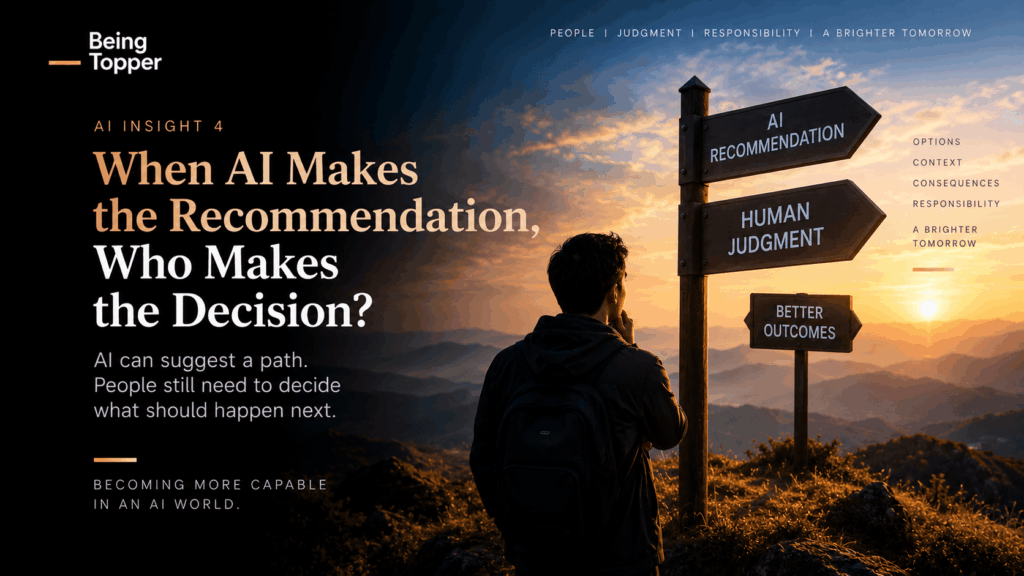
AI can generate a recommendation. Responsibility still requires someone to decide what should happen next.
AI systems are becoming increasingly capable of generating recommendations. They can summarize information, identify patterns, rank possibilities, generate alternatives, predict likely outcomes and suggest possible courses of action. These capabilities can significantly improve the speed and scale at which people work with information.
But a recommendation is not the same thing as a decision.
A recommendation describes a possible course of action. A decision requires determining whether that course of action is appropriate in the circumstances.
That distinction becomes increasingly important as AI moves from experimentation into real workflows and consequential environments.
The Recommendation Is Not the Decision
The distinction may appear obvious, but it becomes less obvious as AI systems become more capable.
When an AI system produces an answer that appears well-reasoned, relevant and confident, it can become tempting to treat the output as a conclusion rather than an input into a decision.
But the quality of a recommendation does not eliminate the need for judgment.
A recommendation still needs to be interpreted within a particular context. Its assumptions may need to be examined. Alternative options may need to be considered. Its potential consequences may need to be understood.
The system can contribute to the decision.
It does not automatically become the decision-maker.
AI Can Produce Options Faster Than People
One of the most significant changes brought by AI is the speed at which alternatives can be generated.
A person who previously had to research several possibilities may now be able to generate many options in a fraction of the time.
This can be valuable.
But producing more options does not automatically produce better decisions.
In fact, an increase in available recommendations can create another requirement: someone must evaluate, compare and prioritize them.
The bottleneck can therefore move.
Instead of generating possibilities, the more difficult task may become determining which possibilities deserve attention.
As AI expands the range of available options, the ability to evaluate those options becomes increasingly important.
Context Still Matters
A recommendation can be technically plausible while being inappropriate for the situation in which it is being considered.
Context determines relevance.
The same recommendation may produce very different consequences depending on the objectives, constraints, people involved, available information and potential impact.
A recommendation that appears reasonable in isolation may become inappropriate when additional circumstances are considered.
This is why decision-making cannot be separated from context.
AI can process information and identify patterns, but the person responsible for the decision must still understand the environment surrounding that decision.
This becomes particularly important where information is incomplete, circumstances are changing or consequences are difficult to reverse.
Effective AI use therefore requires more than the ability to obtain a recommendation.
It requires the capability to place that recommendation in context.
Judgment Becomes More Important
As AI becomes better at producing information and recommendations, human judgment does not necessarily become less important.
In many situations, its importance increases.
Someone still needs to determine whether the information is relevant, whether assumptions are reasonable, whether important factors have been missed and whether the proposed action aligns with the actual objective.
Judgment also involves knowing when not to act.
An AI system can present an apparently reasonable recommendation. A capable decision-maker must remain willing to question it, modify it or reject it.
This is an important distinction between using AI and depending on AI.
Using AI means incorporating its capabilities into a broader process of human reasoning and action.
Depending on AI without sufficient judgment risks allowing the recommendation to become the decision by default.
The stronger the recommendation becomes, the more important it is to know when to accept it, when to question it and when to reject it.
Who Owns the Consequence?
Decisions have consequences.
An AI system may contribute information to a decision, but organizations still need clarity about who owns the outcome.
This becomes especially important when AI is integrated into processes involving customers, employees, finances, operations, professional judgments or institutional priorities.
Responsibility cannot simply disappear because technology was involved.
If an AI-generated recommendation influences an important action, there needs to be an appropriate understanding of who reviewed it, who authorized the action and who remains accountable for the result.
This is not an argument against AI.
It is an argument for using AI within systems where responsibility remains clear.
The introduction of AI can change how a decision is made without changing the need for accountability around that decision.
The Risk of Recommendation Acceptance
One of the less visible risks of increasingly capable AI is the tendency to treat a well-presented recommendation as more authoritative than it actually is.
The problem is not necessarily that the system is always wrong.
The problem is that a recommendation can appear sufficiently coherent or confident that the person receiving it stops examining it critically.
This can weaken the very judgment that is needed to use the system responsibly.
The more fluent and convincing AI becomes, the easier it may become to overlook the distinction between a plausible recommendation and a justified decision.
The appropriate response is not to reject AI-generated recommendations.
It is to establish the capability and discipline to evaluate them.
Decision Capability in an AI-Integrated Environment
Decision capability is the ability to make appropriate decisions when working with information, technology and changing circumstances.
In an AI-integrated environment, that capability increasingly includes the ability to:
- understand the context surrounding a decision;
- evaluate the quality and relevance of available information;
- question assumptions behind recommendations;
- consider alternatives and potential consequences;
- recognize uncertainty and limitations;
- determine the appropriate level of human involvement; and
- take responsibility for the decision that is ultimately made.
These capabilities cannot be reduced to knowing how to operate an AI tool.
They represent a broader form of capability required to work effectively in an AI-integrated environment.
The objective is not to make every decision without AI.
The objective is to ensure that AI can contribute to decisions without removing the human capability required to make them responsibly.
Not Every Decision Needs the Same Level of Human Involvement
Human involvement should not be treated as an identical requirement for every AI-assisted decision.
Different decisions carry different levels of consequence.
A low-risk and easily reversible decision may require a different level of review from a decision that has significant financial, professional, operational or human consequences.
Factors such as impact, uncertainty, reversibility and responsibility can influence how much human judgment is appropriate.
This means mature AI adoption requires more than a generic instruction to keep a human involved.
It requires understanding where human judgment matters most and designing the workflow accordingly.
A useful AI operating environment therefore does not simply ask whether a human is somewhere in the process.
It asks whether the right person has the right information, authority and capability to exercise meaningful judgment at the point where it matters.
From Human-in-the-Loop to Human-in-the-Decision
The phrase “human-in-the-loop” is often used to describe responsible AI workflows.
But simply placing a person somewhere in the process does not guarantee meaningful oversight.
A person who merely approves an output without understanding the context, limitations or consequences is technically involved but may not be exercising meaningful judgment.
A stronger model is human participation in the decision itself.
This means the person understands the recommendation, evaluates its relevance, considers alternatives and remains capable of making a different decision when the circumstances require it.
The distinction matters because responsibility is not created merely by inserting a human checkpoint into an automated workflow.
Meaningful responsibility requires capability.
The question is not simply whether a human is present in the process. It is whether the human still has the capability and authority to make the decision.
The Institutional Dimension
At an institutional level, AI-assisted decision-making introduces a broader requirement.
Organizations need clarity around decision rights, review mechanisms, escalation paths and accountability.
If AI becomes part of an operational workflow, people need to know what the system is permitted to recommend, what requires human review and which decisions cannot simply be delegated.
These are not merely technology questions.
They are questions of organizational capability and governance.
An institution may have access to highly capable AI systems and still lack the structures required to use those systems responsibly.
Technology can support institutional decision-making, but the institution still needs to establish who decides, who reviews, who can intervene and who remains accountable.
This becomes increasingly important as AI moves from isolated experimentation into interconnected organizational systems.
The Capability Question
The deeper issue is therefore not whether AI should participate in decision-making.
AI will increasingly participate in many forms of decision support.
The more important question is whether the people using those systems have developed the capability to work with recommendations without surrendering judgment to them.
That capability includes understanding when AI is useful, when additional information is required, when a recommendation should be challenged and when a decision requires a different form of human consideration.
It also requires the ability to recognize that responsibility does not transfer automatically to the system simply because the system produced the recommendation.
A capable person does not have to reject AI to demonstrate judgment.
They have to remain capable of disagreeing with it.
The Question Ahead
AI will continue to become better at generating recommendations.
It will identify patterns faster, process larger amounts of information and increasingly support decisions across professional and institutional environments.
That development creates an important capability question.
As machines become increasingly capable of suggesting what should happen, are people becoming more capable of deciding what should happen?
The answer cannot be found simply by measuring AI access or tool adoption.
It depends on whether people can understand context, exercise judgment, evaluate recommendations, consider consequences and remain accountable for their decisions.
The transition to an AI-integrated economy therefore requires more than increasingly capable systems.
It requires increasingly capable people and institutions.
AI Can Inform a Decision. It Cannot Remove the Responsibility to Make One.
The more capable the recommendation becomes, the more important judgment becomes.
Being Topper approaches this transition through the broader lens of Digital & AI Capability — developing the capabilities people and institutions need to work, decide, build and operate effectively in an increasingly AI-integrated economy.
AI can inform a decision. It cannot remove the responsibility to make one.