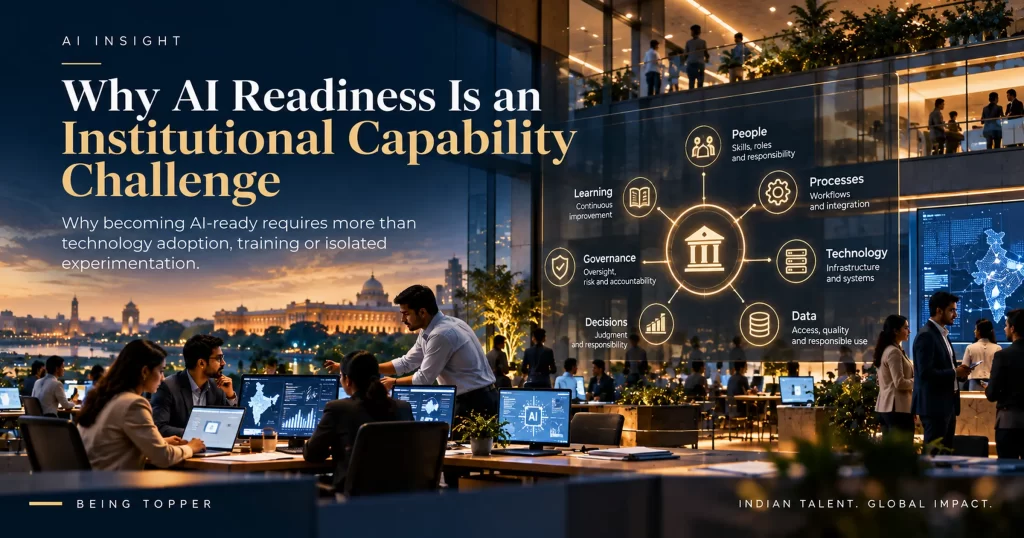
Why becoming AI-ready requires more than technology adoption, training or isolated experimentation.
AI readiness is often mistaken for adoption.
AI adoption is accelerating across organisations. Teams are experimenting with AI assistants. Professionals are incorporating AI into everyday work. Organisations are testing automation, analytics and generative systems.
These developments matter. But adoption alone does not establish institutional readiness.
An institution can have access to AI technology without having the capability to determine where AI should be used, where human judgment must remain central, how workflows should change, who is accountable for decisions, how risks should be managed, or how capability should continue developing.
AI adoption describes what an institution is using. AI readiness describes what the institution is capable of doing with it.
Adoption Is Not Readiness
An organisation may have AI tools without AI capability; training programmes without demonstrated application; pilot projects without institutional integration; automation without appropriate oversight; data without the capability to use it effectively; policies without sufficient understanding among the people expected to follow them.
These gaps do not necessarily mean that AI adoption has failed. They indicate that adoption and readiness are different questions.
Adoption asks: Have we started using AI?
Readiness asks: Can we use AI effectively, responsibly and repeatedly within the way our institution operates?
That second question is considerably broader.
Institutional Capability Is a System
AI readiness cannot be located in a single department. It emerges from the interaction of multiple institutional capabilities.
These elements are interconnected. Weakness in one can constrain the effectiveness of the others.
People Are Necessary — But Training Alone Is Insufficient
Training is an important part of AI readiness. But institutional capability cannot be created simply by training everyone to use the same tools.
Different roles require different capabilities. A general user may need AI literacy, information evaluation and responsible-use awareness. A professional may need workflow integration and domain-specific application. A manager may need to understand process redesign, team capability and decision implications. A technical specialist may need deeper system and implementation capabilities. A governance or risk function may need to understand accountability, oversight and evaluation. Leadership may need the ability to determine where AI fits within institutional strategy and where it should not be deployed.
The objective is therefore not:
Train everyone on AI.
It is:
Develop the capabilities required by different people performing different responsibilities within an AI-integrated institution.
Governance Is Part of Capability
Governance is sometimes treated as something that follows technology adoption. For institutional readiness, it is part of the capability itself.
When AI contributes to consequential work, institutions need clarity around responsibility, accountability, oversight, decision rights, risk, evaluation, monitoring, human judgment and responsible use.
The question is not simply whether a system produces an output. It is also:
Who is responsible for what happens because of that output?
This becomes increasingly important as AI moves from experimentation into operational environments.
From Individual Capability to Institutional Capability
AI readiness becomes an institutional question when individual capability has to operate within systems, workflows and governance structures.
Knowing how to use AI is important. But an institution must also determine how that capability connects with its processes, technology, data, decisions, governance and continuous learning.
A capable professional may know how to use AI. But institutional readiness requires the organisation to create an environment in which that capability can be applied, coordinated, evaluated, governed, improved and scaled appropriately.
This is the difference between having capable people and being a capable institution.
Institutional Readiness Is Distributed
There is no single person who can make an entire institution AI-ready. Capability is distributed across the organisation.
- Employees using AI within their responsibilities.
- Managers integrating AI into team workflows.
- Decision-makers determining where AI should influence decisions.
- Technical teams implementing and maintaining systems.
- Specialists developing deeper AI capabilities.
- Governance and risk functions establishing oversight and accountability.
- Leadership providing strategic direction.
Institutional readiness emerges when these capabilities connect.
The Importance of Institutional Learning
AI technology will continue to change. New models will emerge. Workflows will evolve. Regulatory and governance expectations may change. Organisations will discover both useful applications and inappropriate ones.
This means institutional readiness cannot be achieved once and then considered complete. An AI-ready institution must be capable of learning.
This creates a continuous capability cycle. Readiness is therefore not a static status. It is an institutional capacity for adaptation.
From Experimentation to Integration
Experimentation has an important role. Pilots can reveal opportunities. Small-scale deployments can generate evidence. Teams can identify where AI creates value and where limitations appear.
But experimentation alone does not create institutional capability. The progression must eventually move toward:
At each stage, the institution needs greater clarity about purpose, capability, responsibility, governance, measurement and adaptation.
What an AI-Ready Institution Can Do
An AI-ready institution is not defined simply by the number of systems it has deployed. It should increasingly be capable of answering questions such as:
- Where does AI create meaningful value?
- Where should AI not be used?
- What decisions require human judgment?
- What capabilities do different roles require?
- How should workflows change?
- How should AI outputs be evaluated?
- Who remains accountable?
- How should risks be managed?
- How will the institution learn from implementation?
- How will capability evolve as technology changes?
These questions move AI readiness from technology acquisition toward institutional capability.
Institutional Readiness Is Continuous
There is no permanent endpoint at which an institution can declare itself finished with AI readiness. The technology environment changes. The workforce changes. The nature of work changes. Institutional experience changes. New risks and opportunities emerge.
Readiness therefore requires continuous development. The institution must remain capable of understanding change, developing capability, applying it, evaluating its effects and adapting accordingly.
From Capability to Responsible Scale
The institutional progression can therefore be expressed as:
Capability — people and institutions develop the knowledge, skills, judgment and responsibility required to work with AI.
Integration — capability becomes connected to real workflows, systems and institutional practices.
Readiness — the institution can use, evaluate and govern AI within its operating environment.
Responsible Scale — the institution can expand appropriate AI use while maintaining accountability, adaptability and human judgment.
This is fundamentally different from simply increasing the number of AI deployments.
Why This Matters Beyond Individual Organisations
Institutional capability also affects wider societal readiness. Universities prepare future professionals. Businesses shape employment and production. Public institutions influence services and systems. Educators influence how future generations understand technology. Industry shapes the environments in which capability is applied.
As these institutions develop stronger AI capability, their contribution extends beyond their own internal operations.
Institutional capability is one part of a broader capability ecosystem connecting people, organisations, workforce readiness, education, technology and societal preparedness.
Being Topper’s Perspective
Being Topper approaches AI readiness as an institutional capability challenge rather than solely a technology adoption challenge.
The institution’s role is to connect learning with application, capability with opportunity, and technological change with human preparedness.
Its broader capability architecture recognises that AI readiness requires more than technical familiarity. It requires people who can understand change, exercise judgment, apply technology meaningfully, adapt continuously and act responsibly. And it requires institutions capable of turning those individual capabilities into systems, pathways, frameworks and environments where capability can operate.
Have We Adopted AI, or Have We Developed the Capability to Use It Responsibly?
An AI-ready institution is not simply one that has adopted AI. It is one that has developed the capability to decide where AI belongs, integrate it into its operating environment, evaluate its effects and remain accountable for its use.
Technology creates capacity. Institutional capability determines whether that capacity can be used responsibly and sustained over time.