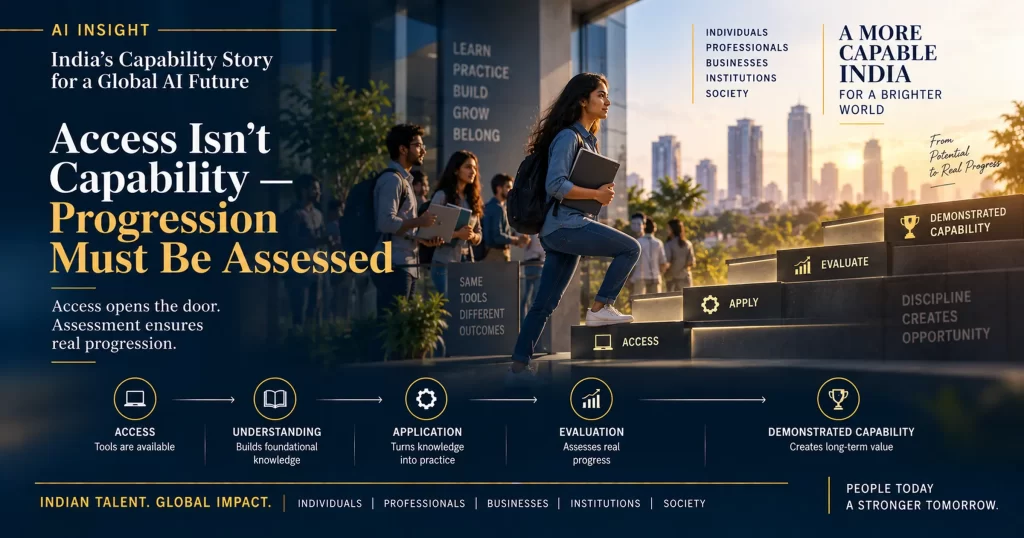
Access to tools does not demonstrate capability. As AI becomes part of everyday work, meaningful progression requires evidence that people can understand, apply, evaluate and execute with increasing levels of responsibility.
Access Is the Starting Point, Not Capability
The expansion of access to AI has changed the entry point for learning and work.
People can experiment with powerful systems almost immediately. Organizations can introduce AI into workflows without building everything from the ground up. Information, assistance and experimentation are becoming increasingly accessible.
But access creates possibility, not demonstrated capability.
A person may have access to an AI system without understanding when to use it, what information to provide, how to evaluate its output or what responsibility remains with them after the system produces an answer.
The same distinction applies at an organizational level.
Deploying AI does not necessarily mean an organization is capable of operating effectively with AI.
The important question therefore moves beyond access:
What can the person or institution actually do with that access?
Exposure Does Not Equal Competence
One of the challenges created by rapidly changing technology is that exposure can easily be mistaken for competence.
Someone who has experimented with an AI tool has gained exposure to it.
That does not necessarily mean they can apply it reliably in a professional environment.
Similarly, someone who understands a concept theoretically may not be able to apply that understanding to a complex situation.
Capability becomes visible through application.
It appears when a person can interpret a situation, select an appropriate approach, make decisions, execute the work and evaluate the result.
This distinction becomes particularly important as AI reduces the technical barriers to experimentation.
When powerful capabilities become easier to access, the differentiating factor increasingly becomes what people can do with them.
Capability Develops Progressively
Capability is rarely acquired in a single step.
A person may begin by understanding basic concepts and gradually progress toward applying them independently, integrating them into workflows and eventually making decisions within more complex environments.
Each stage involves a different level of responsibility.
This means that progression should not simply be described as completing more content.
It should reflect an increasing ability to handle complexity and responsibility.
Different Levels Require Different Expectations
A beginner and an experienced professional should not be evaluated against exactly the same expectations.
At higher levels, the question is no longer simply whether someone can perform a task.
It becomes whether they can determine which task should be performed, why it should be performed, how it should be integrated into the wider system and what consequences may follow.
Progression therefore requires a corresponding progression in assessment.
Assessment Makes Progression Visible
Without assessment, progression can become difficult to distinguish from participation.
Attendance can demonstrate that someone was present. Completion can demonstrate that someone reached the end of a defined learning experience. A certificate can document that a program was completed.
None of these, by themselves, establish what a person can reliably do.
Assessment provides another layer. It creates an opportunity to examine whether capability has actually developed.
The purpose is not simply to assign a score.
It is to establish evidence.
What can this person now understand, apply, evaluate and execute that they could not reliably do before?
That is a more meaningful question about progression.
Assessment Should Measure Application
Capability-oriented assessment should move beyond simple recall.
Knowing a definition is different from applying a principle.
Knowing how a tool works is different from selecting the right tool for a real situation.
Generating an output is different from evaluating whether that output is appropriate.
The assessment therefore needs to reflect the nature of the capability being developed.
Depending on the domain, this may involve practical application, structured problem-solving, decision scenarios, project work, analysis, evaluation or demonstrated execution.
The central principle remains consistent:
Assess what the person can do, not merely what the person has encountered.
AI Makes This More Important
AI changes the relationship between knowledge and execution.
A system can now help generate explanations, drafts, analyses, alternatives and recommendations. This can make certain forms of production significantly easier.
But easier production does not eliminate the need for capability.
In some situations, it increases the importance of judgment.
If AI can generate ten possible answers, someone still needs to determine which answer is appropriate.
If AI can produce an analysis, someone needs to understand the context in which that analysis will be used.
If AI can recommend an action, someone remains responsible for determining whether the recommendation should be followed.
As AI becomes more capable, the ability to evaluate and direct AI-generated work becomes increasingly important.
Progression Should Be Evidence-Based
A meaningful capability framework should make progression observable. Instead of treating development as a simple sequence of lessons, it can establish progressively higher expectations for:
- understanding;
- application;
- consistency;
- judgment;
- systems thinking;
- responsible adoption; and
- execution.
This creates a clearer relationship between learning and demonstrated capability.
It also allows individuals to understand where they currently stand and what higher levels require.
For institutions, it creates a more disciplined way to think about readiness.
Assessment Is Not Merely Evaluation
Assessment is often treated as something that happens after learning.
A more useful perspective is to treat assessment as part of capability development itself.
When expectations are clear, people can understand what they are working toward. When evidence is required, progression becomes more meaningful. When gaps are identified, development can become more targeted.
Assessment therefore performs a governance function.
It helps establish whether the capability being claimed is actually present.
This becomes particularly important when institutions communicate readiness to employers, clients, organizations or other stakeholders.
Capability Requires Increasing Responsibility
Progression should ultimately reflect more than increasing difficulty.
It should reflect increasing responsibility.
A person who can follow a defined process is operating at a different level from someone who can select the process.
Someone who can execute an established workflow is operating at a different level from someone who can design and improve the workflow.
Someone who can use an AI system is operating at a different level from someone who can determine how AI should be integrated into a wider operating environment.
This is why capability progression is closely connected to maturity.
As capability develops, the individual should be able to operate with greater independence, judgment and responsibility.
From Completion to Demonstration
The traditional learning model often emphasizes completion.
A learner attends.
A learner completes modules.
A learner takes an examination.
A learner receives recognition.
A capability-oriented model asks a different question.
What has been demonstrated?
That shift does not make completion irrelevant.
It places completion in its proper context.
Completion can indicate participation in a structured process. Demonstration provides evidence of capability developed through that process.
The distinction becomes increasingly important in an environment where technology changes faster than static curricula can.
The Institutional Implication
Institutions that aim to build capability need more than content.
They need progression architecture.
That architecture should define what capability means at different levels, what evidence is required to progress and what increasing levels of responsibility look like.
This creates a more disciplined relationship between:
It also creates a clearer basis for responsible claims.
Rather than assuming that exposure, attendance or completion automatically produces readiness, this chain can be made visible through a structured model such as the Digital & AI Capability Maturity Model, which establishes evidence for what has actually been demonstrated at each level.
The Question Ahead
AI is making access easier.
That is valuable.
But as access becomes increasingly widespread, access itself becomes a weaker indicator of differentiation.
The more important question becomes whether people can use that access effectively.
And as expectations increase, another question follows:
How do we know?
That is where assessment becomes important.
Capability cannot be established simply because someone has encountered information, completed a program or used a tool.
It must become visible through application, judgment and execution.
Progression should therefore reflect demonstrated capability rather than assumed capability.
Access opens the door. Assessment shows whether capability has developed.
This is the same principle behind the AI Readiness Index — a diagnostic built to measure demonstrated capability across all five readiness areas, rather than simply recording access or completion.
Capability Should Not Be Assumed From Access.
It should be demonstrated through progression.
Not attendance. Not completion. Not exposure to a tool.
Evidence that a person can understand, apply, evaluate and execute — with increasing levels of responsibility.
Capability should not be assumed from access. It should be demonstrated through progression.