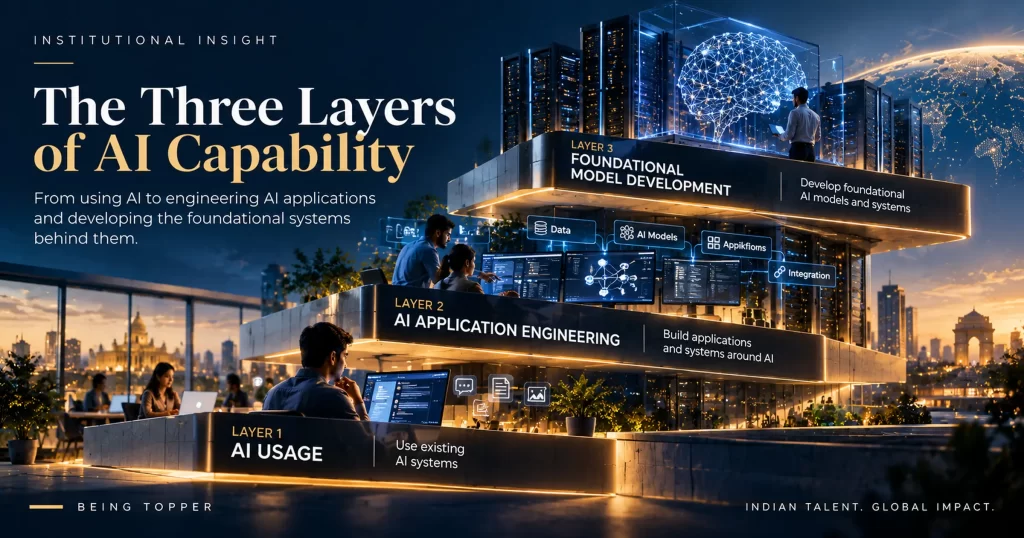
From using AI to engineering AI applications and developing the foundational systems behind them.
AI is not one activity.
The word “AI” is increasingly used as though it describes a single capability. It does not.
Using an existing AI system, engineering an application around AI models, and developing foundational models are fundamentally different activities. They require different levels of technical depth, different infrastructure, different expertise and different forms of capability.
This distinction matters because much of the public conversation about AI readiness collapses these activities into one category. The result is confusion about what it actually means to use AI, build with AI and develop AI itself.
Using AI is not the same as building AI.
The Problem With Treating AI Capability as One Layer
Most conversations about AI skills collapse everything into a single spectrum — “beginner” to “advanced” — as if writing a better prompt and architecting a retrieval-augmented pipeline were points on the same line.
They aren’t.
A marketer who has mastered prompting is not partway to being an AI engineer. A developer who has shipped an LLM-powered feature is not partway to training a foundation model. These are different disciplines, with different depth requirements, different risks and different institutional needs.
Collapsing them into one ladder produces bad guidance: people are told to “go deeper” into AI without being told in which direction.
The Three Layers of AI Capability
Being Topper’s AI Impact Architecture resolves this with three distinct layers:
This is the AI Impact Architecture’s technical-depth axis — distinct from Being Topper’s Institutional Collaboration structure (Institutional Capability Architecture, Career & Workforce Architecture, Social Capability Integration), which segments by audience and stakeholder, not by technical depth. The two frameworks use similar vocabulary but answer different questions and should not be read as the same model.
Three Different Activities
These are connected, but they are not interchangeable. A person can be highly capable at Layer 1 without being an AI application engineer. An application engineer can build sophisticated AI systems without developing foundational models. A foundational-model researcher operates at a different technical and infrastructure level again.
Why the Distinction Matters
Without this distinction, the phrase “AI skills” becomes too broad to be useful. Someone learning to use an AI assistant is developing a different capability from someone engineering a retrieval-augmented application. And both are developing something different from a researcher working on foundational model architecture.
This does not mean that one layer makes the others irrelevant. It means that capability should be described accurately. Different roles require different layers. Different institutions operate across different layers. Different national capabilities require participation across different parts of the AI architecture.
When we do not define the layer, we dilute the competence.
Layer 1 Is Not Insignificant
The existence of deeper technical layers does not make AI Usage unimportant. For most professionals and many organisations, the immediate challenge is effective use of existing AI capability.
- Can people use AI appropriately?
- Can they evaluate its outputs?
- Can they integrate it into professional workflows?
- Can they retain human judgment?
- Can organisations establish responsible usage practices?
The value at this layer comes from effective application in context. The framework does not describe Layer 1 as merely a beginner level — it describes a distinct form of AI capability.
How the Layers Connect
The layers are not a hierarchy of status. Layer 3 is not “better” than Layer 1 — it is a different, narrower specialisation that almost no institution needs at scale.
They are, however, dependent on each other in one direction:
Foundational Model Development produces the models that AI Application Engineering turns into usable systems, which AI Usage then applies to real work.
Most individuals and most institutions will live permanently at Layer 1, with a smaller group operating at Layer 2. That is not a deficiency — it’s the correct distribution. The mistake is not knowing which layer you’re building for.
The Institutional Question
For an institution, this architecture answers a planning question that generic “AI training” cannot:
- Does your workforce need Layer 1 capability — AI-literate employees applying tools responsibly across existing roles?
- Does your workforce need Layer 2 capability — a team that can build and maintain AI-powered products and workflows?
- Or does your work genuinely require Layer 3 — in which case you are likely better served partnering with model providers than building internally?
Which layer are we actually trying to build capability in — and have we matured within it?
Most institutional AI strategies fail not because they chose the wrong layer, but because they never named one.
Being Topper’s Perspective
This architecture — AI Usage, AI Application Engineering and Foundational Model Development — was presented as the AI Impact Architecture framework by Vipin Khuttel at the India AI Impact Summit & Expo 2026, Hall 6, Bharat Mandapam, New Delhi, on 20 February 2026, built around one governing thesis:
Using AI ≠ Building AI.
Capability develops within each layer, as described in the Digital & AI Capability Maturity Model. But progression within a layer should not be mistaken for movement between layers. They are different journeys.
Presented at the India AI Impact Summit & Expo 2026, Bharat Mandapam, New Delhi (20 February 2026).The AI Economy Does Not Have One Capability Layer.
There is a meaningful difference between using AI, engineering applications around AI, and developing the foundational systems that power AI. Understanding that difference helps individuals, institutions and policymakers describe capability more accurately.
The important question is not simply whether someone is “working with AI.” It is what layer of AI capability they are actually operating in.