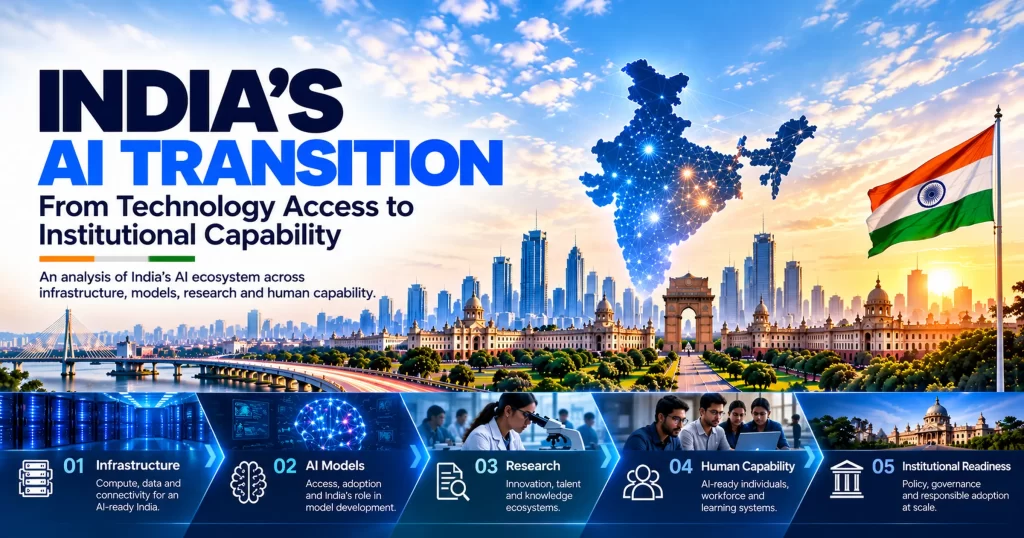
India’s AI Transition: Moving from Technology Access to Institutional Capability
A four-layer framework maps the infrastructure, models, research and human capability required for the next phase of AI adoption.
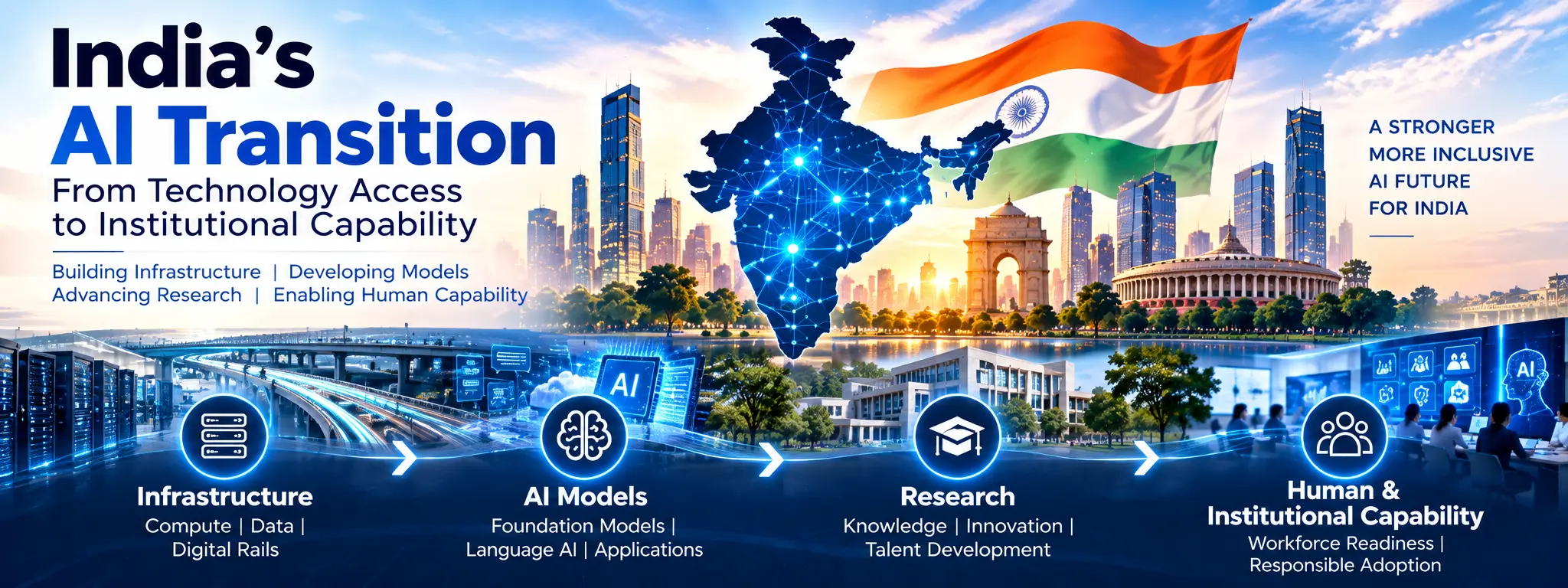
New Delhi: India’s artificial intelligence ecosystem is developing across multiple layers at once, from national compute and digital public infrastructure to foundation models, academic research and enterprise deployment.
But as AI moves from experimentation into everyday institutional and professional environments, another question is becoming increasingly important:
The question
What capabilities must exist around the technology for AI adoption to create sustained value?
A four-layer view of India’s AI landscape helps answer that question.
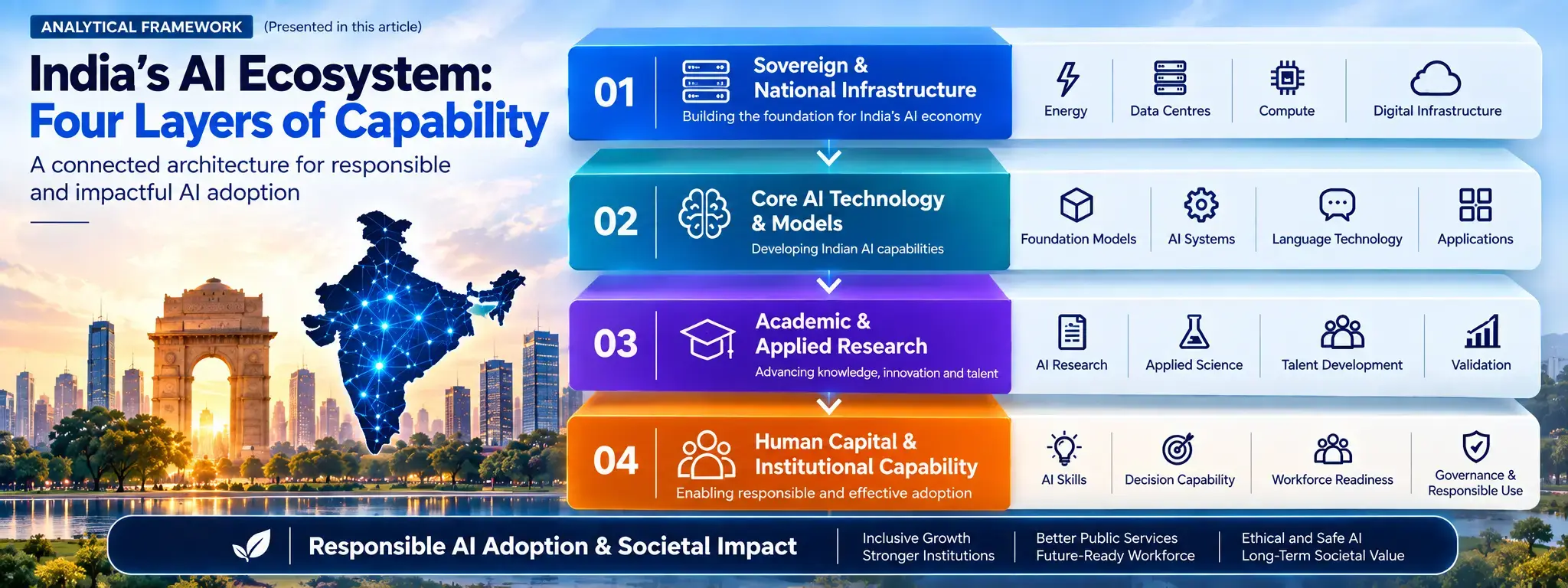
The framework separates the ecosystem into four distinct domains. The distinction matters because these layers solve different problems and require different forms of expertise.
1. Sovereign & National Infrastructure
At the national level, India is building shared infrastructure for AI compute, datasets, models and applications.
The IndiaAI ecosystem now includes AIKosh, a national platform for datasets, models, toolkits and AI resources, alongside an IndiaAI Compute platform designed to make AI compute available to academia, researchers, startups, MSMEs and government entities. The IndiaAI Mission has described its objective as developing capabilities across the AI value chain.
In January 2026, IndiaAI CEO and MeitY Additional Secretary Abhishek Singh emphasized that India needs capability across the entire AI stack, including energy, data centres, compute, models and applications, rather than remaining primarily a consumer of global AI services.
This represents the infrastructure and ecosystem layer on which other AI capabilities can be built.
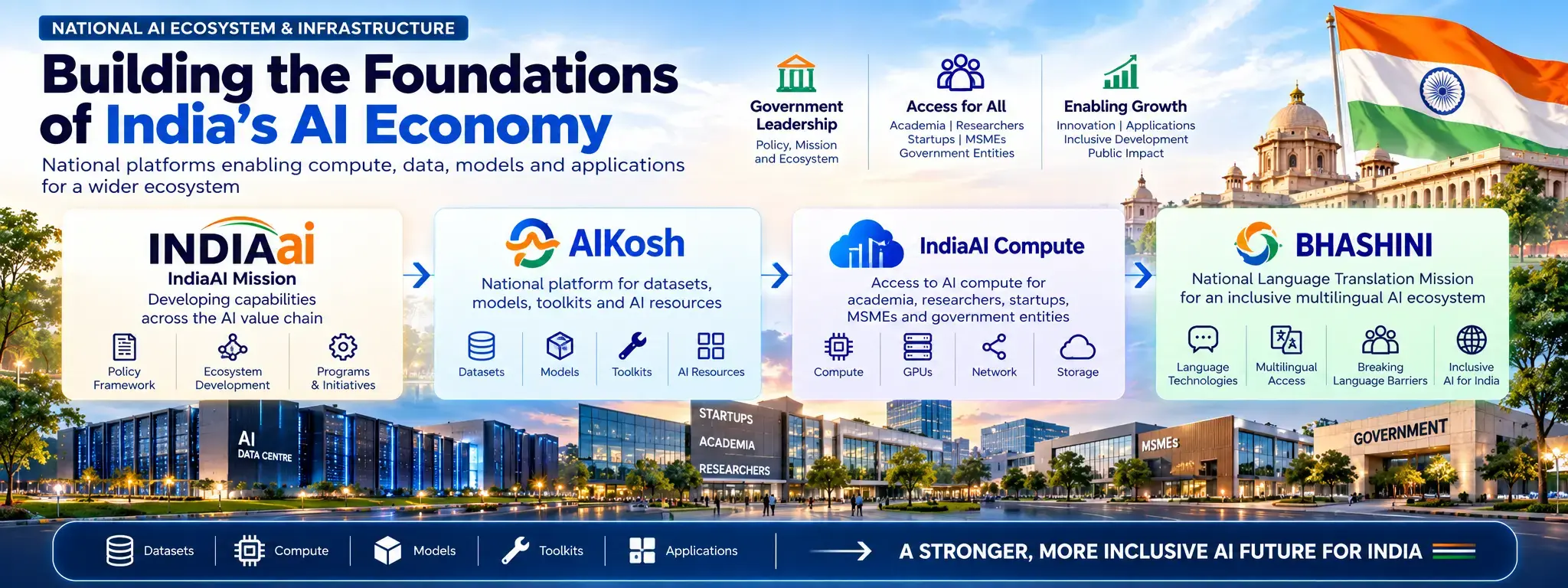
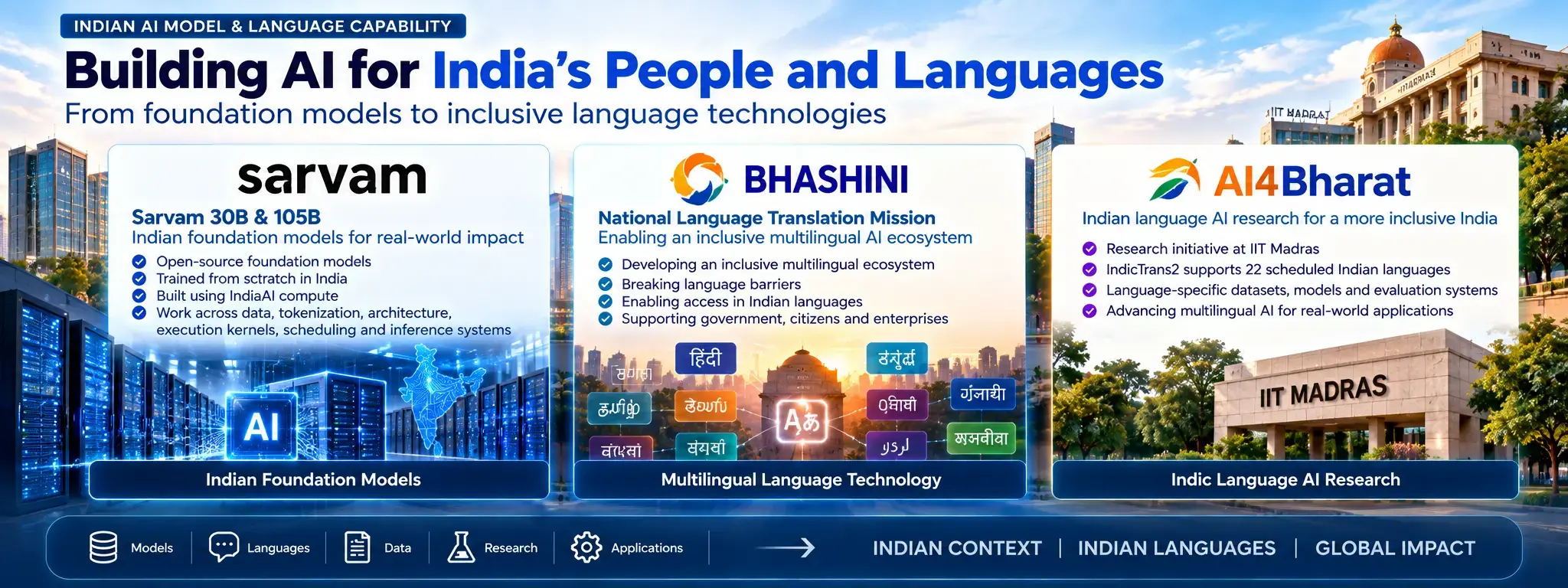
A related example is BHASHINI, led by CEO Amitabh Nag. The Digital India BHASHINI Division is responsible for implementing the National Language Translation Mission and developing an inclusive multilingual AI ecosystem.
2. Core AI Technology & Model Development
The second layer consists of organisations and researchers actually developing AI models, language technologies, software systems and deployment infrastructure.
Sarvam AI provides a concrete example. The company, co-founded by Dr. Vivek Raghavan and Dr. Pratyush Kumar, has released Sarvam 30B and Sarvam 105B as open-source models. Sarvam says the models were trained from scratch in India and that its engineering work spans data, tokenization, architecture, execution kernels, scheduling and inference systems.
Similarly, Dr. Mitesh M. Khapra at IIT Madras and AI4Bharat has worked on multilingual AI for Indian languages. AI4Bharat’s IndicTrans2 work supports translation among India’s 22 scheduled languages, illustrating the importance of language-specific datasets, models and evaluation systems in India’s AI ecosystem.
India’s linguistic diversity is a defining requirement here, not a side detail. Alongside AI4Bharat, the BHASHINI initiative’s National Language Translation Mission works to make digital services and information more accessible across India’s languages. Together they illustrate a broader principle: AI capability in India is not only about building more powerful models, but about building systems that work within the social, linguistic and institutional context in which they will actually be used.
This is the engine-building layer: models, datasets, algorithms, infrastructure software and technical systems.
3. Academic & Applied Research
A third layer sits within universities and research institutions.
At IIT Madras, Prof. Balaraman Ravindran heads the Department of Data Science and AI and has led institutional work spanning reinforcement learning, responsible AI and deep learning. His public profile also documents participation in national AI governance initiatives.
At IIT Delhi, Prof. Mausam is a professor whose research areas include Artificial Intelligence and Natural Language Processing.
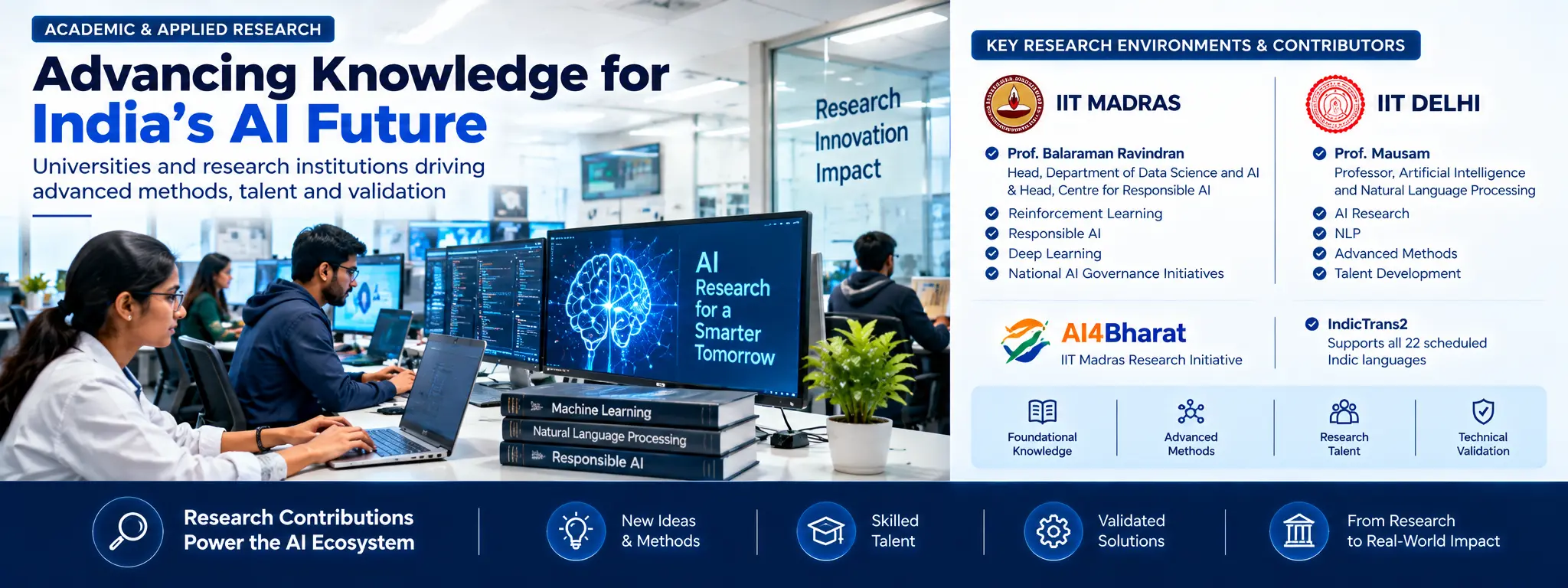
These research environments contribute foundational knowledge, advanced methods, talent development and validation that can subsequently move into public and commercial systems.
The research layer is therefore not simply another form of enterprise implementation. Its role includes extending the technical frontier and developing the knowledge base on which future systems depend.
4. Human Capital & Institutional Capability
The fourth layer concerns what happens after technology becomes available.
An institution may have access to models, compute and software while still facing questions around workforce adoption, workflow redesign, decision-making, evaluation, accountability and responsible use.
This is the layer on which Vipin Khuttel, Institutional Digital & AI Capability Architect and Founder of Being Topper, has positioned his current work.
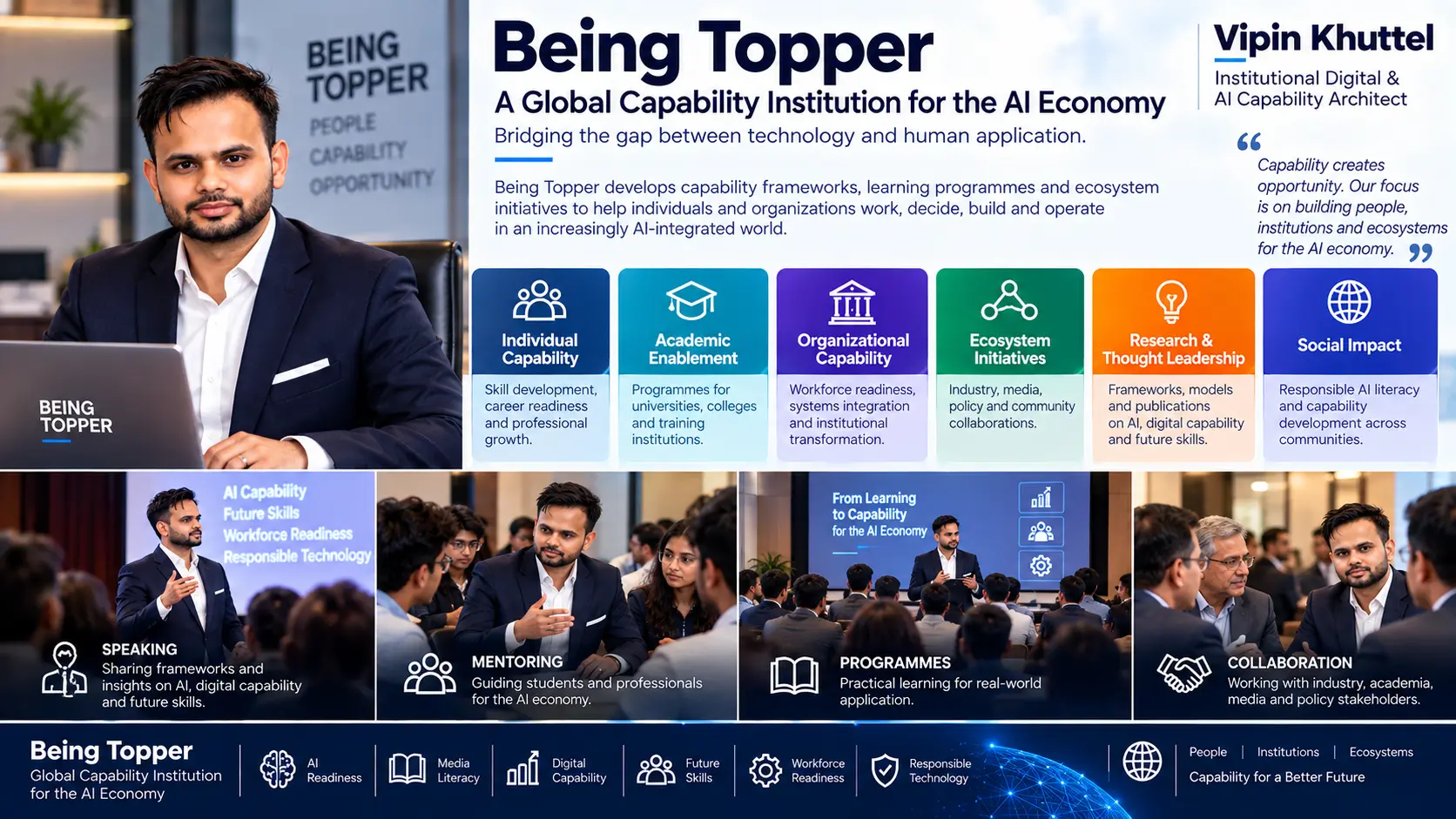
His public work focuses on the distinction between AI access, AI usage and deeper AI capability, with an emphasis on decision capability, systems thinking, execution maturity and institutional readiness.
Being Topper® describes its role as operating between AI infrastructure and human application: the capability layer concerned with whether people and institutions can actually convert increasingly capable technology into responsible and useful outcomes.
A central framework presented through Khuttel’s work is the Digital & AI Capability Maturity Model™, which is intended to distinguish basic AI tool usage from broader professional and institutional capability.
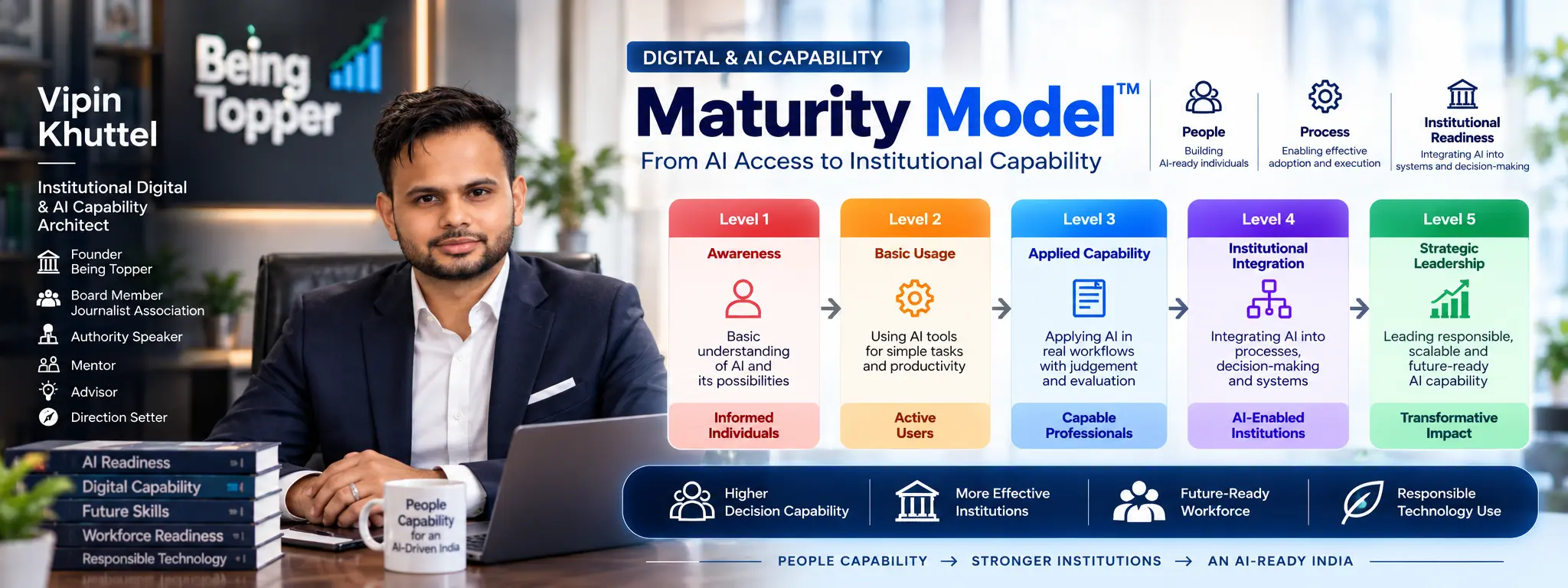
At the 2026 India AI Impact Summit, his public work also introduced the formulation:
Using AI ≠ Building AI.
The distinction separates using available AI systems from engineering applications and, at a deeper level, developing foundational AI systems. A complementary framework from Khuttel’s own work sets this out as three distinct layers of AI capability:
Layer 1
AI Usage
Using existing AI systems and tools.
Layer 2
AI Application Engineering
Building applications, workflows and integrations around AI.
Layer 3
Foundational Model Development
Developing the underlying AI models and foundational technology.
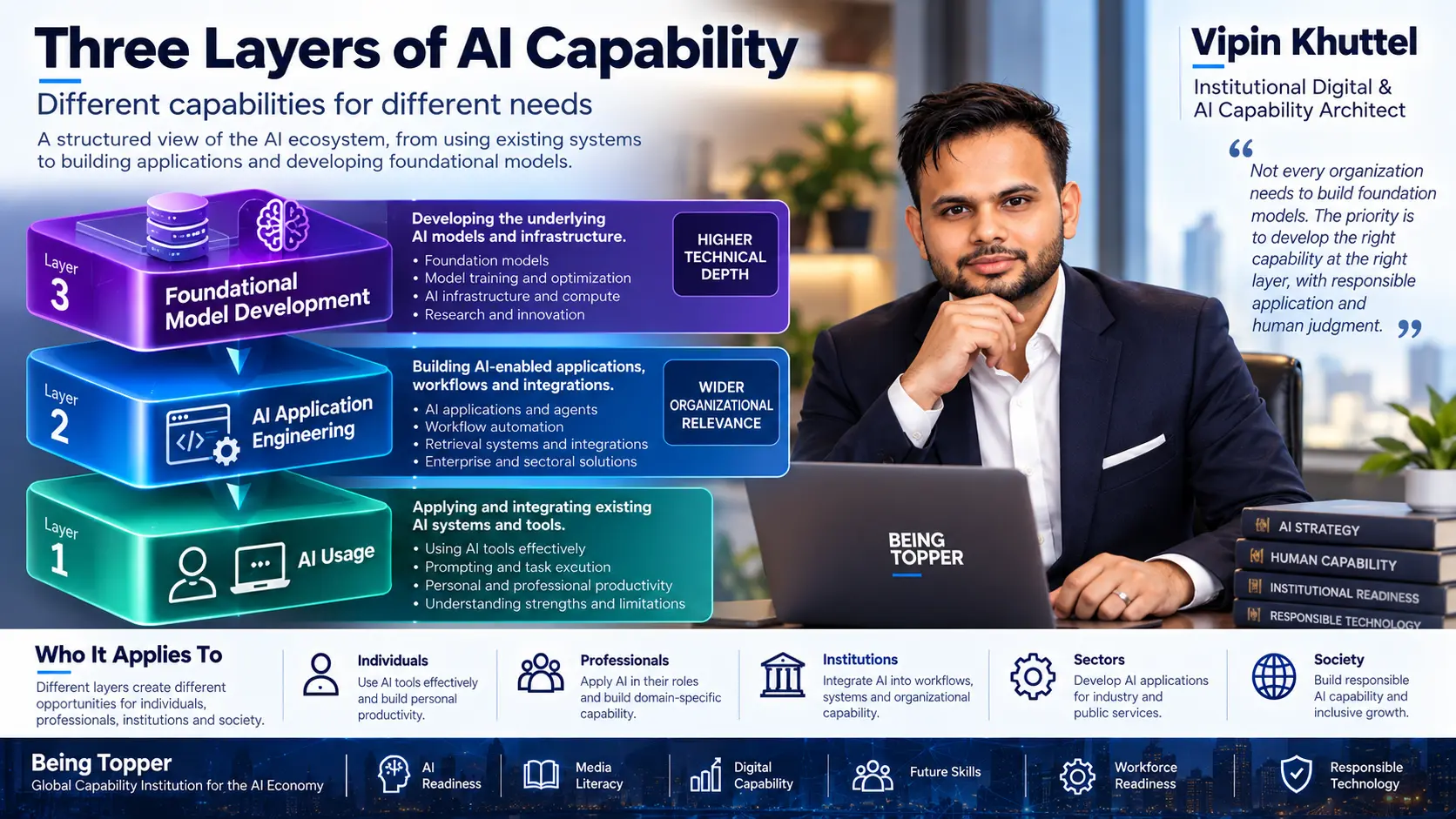
AI capability, in this view, should not be measured simply by asking whether an individual or institution is “using AI.” The more useful question is what level of capability a given task, organisation or national objective actually requires.
The significance of this distinction is organisational. The question is no longer only whether employees have access to AI tools. It is whether they can:
- understand where AI is appropriate;
- evaluate AI-generated outputs;
- redesign workflows around AI;
- retain appropriate human judgment;
- understand limitations and risks;
- make responsible decisions; and
- operate effectively as AI changes professional roles.
From AI Adoption to AI Capability
The four layers should not be understood as competing alternatives. They are complementary, and together they form a progression:
- National Infrastructure
- AI Technology & Models
- Research & Knowledge
- Human Capability
- Institutional Readiness
- Responsible AI Adoption & Impact
Each layer depends on the others. Infrastructure provides the foundation, models provide technical capability, research expands knowledge, people translate technology into action, and institutions build the systems, processes and governance around it. Responsible adoption is what determines whether all of this creates sustainable value.
This distinction is becoming increasingly relevant as India moves from AI experimentation toward wider deployment.
The challenge is therefore not simply to acquire more technology. It is to develop the capability required to use that technology well.
From Technology Adoption to Institutional Readiness
Institutional readiness involves multiple dimensions. For institutions, this means asking a broader set of questions than “which AI tool should we use”:
People
Do employees and leaders understand the technology and its implications?
Processes
Have workflows been redesigned where AI can create meaningful value?
Systems
Can AI tools integrate into existing digital and operational environments?
Decision-Making
Can people evaluate AI-generated information and recommendations?
Governance
Who is accountable for AI-assisted decisions?
Workforce
What new skills and professional roles are required?
Responsibility
How should institutions address trust, risk, transparency and public value?
These questions demonstrate why AI readiness is broader than technology procurement. The technology layer is necessary. It is not sufficient.
A Different Kind of AI Readiness
Vipin Khuttel’s positioning within this ecosystem is therefore not as a replacement for the engineers, researchers or public infrastructure architects building India’s AI stack. It is complementary. His focus is the human and institutional capability surrounding AI adoption.
That distinction is consistent with his broader work across AI readiness, digital capability, workforce readiness, media literacy, future skills and responsible technology adoption.
As AI becomes embedded in organisations, the strategic question increasingly shifts. The transition can be understood as a five-stage progression, moving beyond technology access:
1. Access
Can people and institutions access AI?
2. Usage
Can they use AI effectively?
3. Capability
Can they integrate AI into meaningful work and decisions?
4. Institutional Readiness
Can organisations redesign systems, workforce and governance around AI?
5. Responsible Impact
Can these capabilities create sustainable public and economic value?
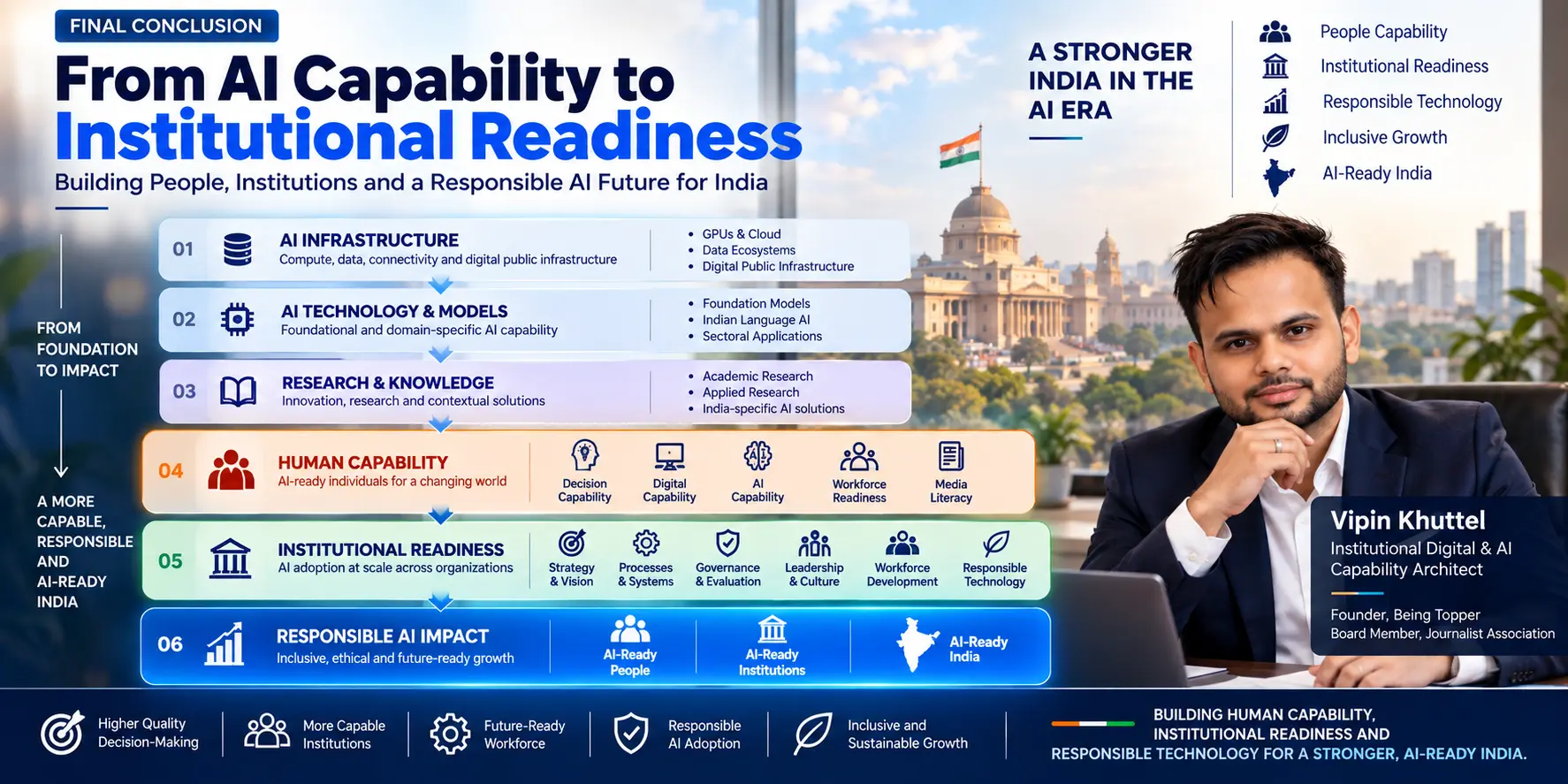
That is the emerging capability question at the heart of India’s next phase of AI adoption.
India’s Next AI Capability Challenge
India has made significant investments in the foundations of an AI ecosystem. The next phase will increasingly require attention to what happens between technology availability and meaningful institutional adoption. That means developing:
- AI-ready professionals
- capable institutions
- responsible AI governance
- workforce adaptability
- stronger decision capability
- context-aware AI systems
- public trust
This is particularly important because AI is not confined to the technology sector. It is increasingly affecting education, media, employment, business, government, healthcare, finance, manufacturing and public services. The capability question therefore extends across the economy, not just the technology industry.
The next competitive advantage will not simply be access to AI. It will increasingly be the institutional capability to use AI responsibly and effectively.
Frequently Asked Questions
What is the IndiaAI Mission?
The IndiaAI Mission is the Government of India's national programme, led by MeitY, to build AI capability across compute, datasets, models and applications. It has an approved outlay reported at roughly ₹10,300 crore and a compute-scaling target of tens of thousands of GPUs, and is headed by IndiaAI CEO Abhishek Singh.
What is AIKosh?
AIKosh is the IndiaAI Mission's national platform for AI-ready datasets, pre-trained models, toolkits and other resources, intended to give researchers, academia, startups, MSMEs and government entities shared access to AI-building blocks.
What is BHASHINI?
BHASHINI (the Digital India BHASHINI Division, formerly the National Language Translation Mission) is a national initiative building a multilingual AI ecosystem so that digital services and information are accessible in India's own languages rather than requiring English proficiency. It is led by CEO Amitabh Nag.
What is Sarvam AI and what models has it released?
Sarvam AI is an Indian AI lab, co-founded by Dr. Vivek Raghavan and Dr. Pratyush Kumar, that has released Sarvam 30B and Sarvam 105B as open-source models trained from scratch in India, covering engineering work from data and tokenization through architecture, kernels, scheduling and inference.
What is AI4Bharat and IndicTrans2?
AI4Bharat is a research initiative at IIT Madras, co-founded by Dr. Mitesh M. Khapra, working on multilingual AI for Indian languages. Its IndicTrans2 system supports translation across India's 22 scheduled languages.
What are the four layers of India's AI ecosystem?
This framework separates India's AI ecosystem into four layers: Sovereign & National Infrastructure (compute, datasets, digital public infrastructure), Core AI Technology & Models (models, language technology, systems software), Academic & Applied Research (foundational knowledge, methods, talent), and Human Capital & Institutional Capability (adoption, judgment, governance, readiness).
What is the difference between AI infrastructure and AI capability?
AI infrastructure is access — compute, data, digital rails and available models. AI capability is whether people and institutions can actually use that access well: evaluating outputs, redesigning workflows, retaining human judgment and governing outcomes responsibly. Infrastructure enables; capability determines what gets built on top of it.
What is institutional AI capability?
Institutional AI capability is an organisation's ability to adopt AI responsibly and effectively across people, processes, systems, decision-making, governance, workforce and accountability, rather than simply having access to AI tools or models.
What is the difference between AI adoption and AI capability?
AI adoption is acquiring or deploying AI tools. AI capability is the deeper, harder-to-build layer: whether an institution's people, workflows and governance are mature enough to use those tools to create sustained, responsible value.
What are the three layers of AI capability (AI Usage, AI Application Engineering, Foundational Model Development)?
This is a complementary framework from Vipin Khuttel's work: Layer 1, AI Usage, is using existing AI systems and tools; Layer 2, AI Application Engineering, is building applications, workflows and integrations around AI; Layer 3, Foundational Model Development, is developing the underlying AI models and technology itself. See the full breakdown in <a href='https://beingtopper.net/news/vipin-khuttel-institutional-digital-ai-capability-architect/'>Vipin Khuttel: Institutional Digital & AI Capability Architect</a>.
What is the Digital & AI Capability Maturity Model?
The Digital & AI Capability Maturity Model is a six-level framework, from L0 Unaware to L5 Steward, describing how individuals, professionals and institutions progress from unawareness of AI capability to responsible stewardship of it.
Why is India's AI transition described as more than a technology story?
Because infrastructure, models and research are necessary but not sufficient on their own. AI is affecting education, media, employment, business, government, healthcare, finance, manufacturing and public services — sectors where the deciding factor is whether people and institutions have the capability to use AI responsibly, not just whether the technology exists.
Who is building institutional AI capability in India?
India's AI capability is being built across several layers at once: government and sovereign infrastructure through the IndiaAI Mission, academic research through institutions such as IIT Madras and IIT Delhi, model and language technology through organisations such as Sarvam AI and AI4Bharat, and human and institutional capability through work such as Vipin Khuttel's at Being Topper. These layers are complementary rather than competing.
Disclaimer: All trademarks, logos, brand names and institutional emblems referenced or depicted in this article, including those of IndiaAI, AIKosh, BHASHINI, Sarvam AI, AI4Bharat, IIT Madras and IIT Delhi, are the property of their respective owners. They are used solely for informational and educational purposes to illustrate India’s AI ecosystem. Their use does not imply any endorsement, sponsorship, affiliation, association or partnership with, or promotion by, Being Topper or Vipin Khuttel, and no claim of ownership or copyright over such marks is made.