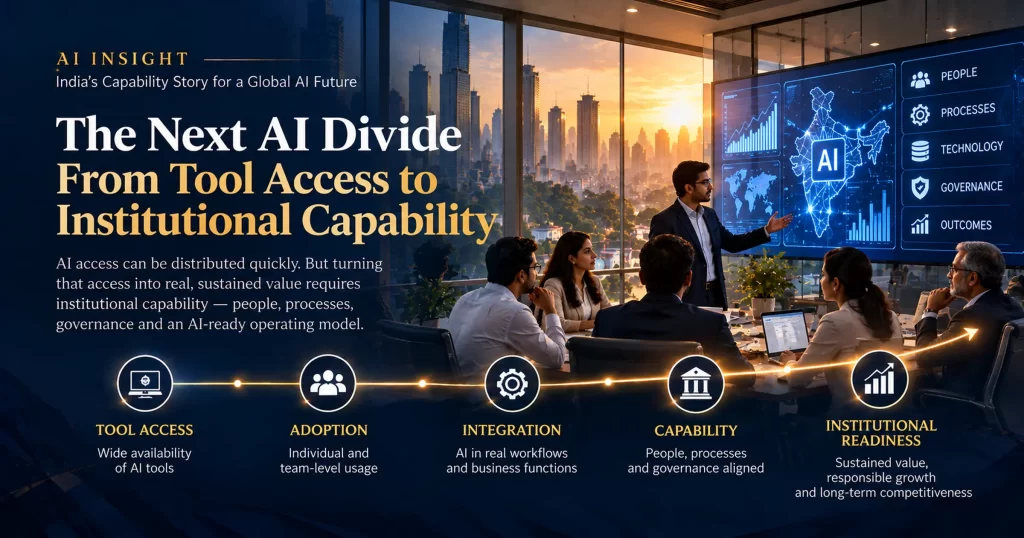
Why organizations need more than AI access to become genuinely AI-ready.
AI adoption is increasingly moving from experimentation into everyday organizational environments.
Organizations are acquiring AI tools, integrating AI into software platforms, experimenting with automation and encouraging employees to use generative AI in their work.
But access creates a different question from capability.
An organization can provide AI tools without necessarily developing the ability to use them effectively.
It can automate a workflow without understanding how that workflow should change.
It can generate large volumes of content without improving the quality of decisions.
It can introduce AI into an existing process without establishing who remains responsible for the outcome.
This creates a deeper organizational question:
What separates an organization that has access to AI from one that is actually capable of operating with AI?
The answer is not simply more tools.
It is institutional capability.
AI Access Is Not the Same as AI Readiness
The first stage of organizational AI adoption is often access.
People receive:
- AI subscriptions
- enterprise software with embedded AI
- generative AI tools
- automation platforms
- coding assistants
- analytics systems
- AI-enabled productivity applications.
Access matters.
Without access, meaningful experimentation cannot occur.
But access does not demonstrate readiness.
A person can have access to an AI system without knowing when to use it.
An organization can have hundreds of employees using AI without having a shared understanding of appropriate use.
A company can automate processes without knowing whether the redesigned workflow actually improves the system.
This is why the progression should not stop at access.
Each stage introduces a different requirement.
Adoption Changes More Than Individual Productivity
AI is often introduced through a productivity lens.
- Can employees complete tasks faster?
- Can teams reduce repetitive work?
- Can organizations generate content more quickly?
- Can research be accelerated?
- Can customer interactions be supported?
These are legitimate questions.
But AI can affect more than individual task efficiency.
It can change:
- how information moves;
- who performs a task;
- how decisions are prepared;
- how work is reviewed;
- where errors can enter;
- how responsibilities are distributed;
- how teams coordinate;
- how customers interact with an organization;
- and how institutional knowledge is created and retained.
This means AI adoption can become a systems question.
A local improvement can create a wider consequence.
A faster process is not necessarily a better process if it introduces new dependencies, weakens oversight or produces unreliable decisions at greater scale.
The relevant question therefore becomes:
How does AI change the system in which the task exists?
The Organization Can Have AI Without Becoming AI-Capable
Consider two organizations.
Both have access to similar AI tools.
Both provide employees with AI subscriptions.
Both encourage experimentation.
Yet their results can differ significantly.
One organization may treat AI as an additional tool employees can use individually.
Another may examine where AI fits into workflows, how decisions should be reviewed, what responsibilities remain human, how employees need to develop, what information can be used, and how outcomes should be evaluated.
The difference is not necessarily the technology.
It is the surrounding capability.
Institutional AI capability exists in the interaction between:
- People
- Processes
- Technology
- Decisions
- Governance
- Learning
AI becomes organizational capability when these elements begin working together.
What Institutional AI Capability Requires
Institutional capability is not a single skill.
It is a collection of connected capabilities.
1. AI Understanding
People need enough understanding to recognize where AI can contribute and where it may be inappropriate.
This does not mean every employee needs to become an AI engineer.
It means relevant people need enough understanding to make informed choices about AI use.
2. Problem Framing
AI cannot compensate for an unclear problem.
Before selecting a tool or designing an automation, organizations need to understand:
- What problem are we solving?
- For whom?
- Why does it matter?
- What constraints exist?
- What would a useful result look like?
Problem framing becomes especially important when AI makes experimentation easier.
The easier it becomes to generate solutions, the more important it becomes to define the right problem.
3. Workflow Integration
AI should not automatically be added to an existing workflow simply because it can perform one of its tasks.
Organizations need to understand:
- where AI enters the workflow;
- what information it receives;
- what it produces;
- who reviews the output;
- what happens when it fails;
- and how the human and technological components interact.
This is where AI adoption becomes systems thinking.
4. Decision Capability
AI can increasingly support analysis and recommendations.
But organizations still need people who can determine:
- which recommendation is relevant;
- what evidence supports it;
- what assumptions it contains;
- what risks it introduces;
- what alternatives exist;
- and whether action should follow.
Decision capability becomes more important as AI-generated recommendations become more sophisticated.
5. Human Oversight
Not every AI-assisted process requires the same level of human intervention.
Some applications may require routine review.
Others may require expert validation.
High-impact decisions may require stronger controls and explicit accountability.
Institutional readiness therefore requires organizations to understand where human oversight belongs rather than assuming that automation automatically means removing human involvement.
6. Governance
AI adoption creates questions around:
- accountability;
- data;
- security;
- transparency;
- risk;
- appropriate use;
- oversight;
- and organizational responsibility.
Governance is therefore not an administrative layer added after implementation.
It becomes part of the capability required to operate AI responsibly.
AI Capability Has an Organizational Dimension
One of the major shifts in the AI era is that capability can no longer be understood only at the individual level.
An employee may be highly capable with AI.
But if the organization has:
- unclear processes;
- poor information flows;
- incompatible systems;
- weak governance;
- limited decision authority;
- insufficient training;
- or no mechanism for learning from implementation,
individual capability may not translate effectively into organizational capability.
The reverse can also occur.
An organization may establish strong systems and governance but fail to develop the people needed to operate them.
Institutional capability therefore depends on the relationship between individual capability and organizational architecture.
From Employees Using AI to Organizations Operating With AI
This distinction can be expressed through a simple progression.
This final stage is fundamentally different from simply deploying another technology.
The Importance of Organizational Learning
AI systems and tools will continue to change.
That makes static implementation models increasingly difficult to sustain.
An organization may adopt one model, platform or workflow today and encounter a substantially different technology environment later.
Institutional capability therefore needs a learning mechanism.
Organizations need to be able to ask:
- What worked?
- What failed?
- What changed?
- What risks emerged?
- What assumptions were wrong?
- Which workflows should be redesigned?
- What new capabilities do people need?
- What should remain human-led?
This turns AI adoption from a one-time technology project into an ongoing capability-development process.
Responsible Adoption Is Part of Capability
Institutional AI readiness also requires understanding that capability is not simply the ability to make AI do more.
It is the ability to use AI appropriately.
A technically possible application may not be an appropriate application.
A highly efficient workflow may introduce unacceptable risk.
An accurate-looking output may still require verification.
A recommendation may be useful without being sufficient for a consequential decision.
This is why responsible technology use belongs inside institutional capability rather than outside it.
The relevant question is not only:
Can we use AI for this?
It is also:
Should we use AI for this, under what conditions, with what oversight, and with whom accountable?
India’s AI Ecosystem Is Moving Toward Institutional Scale
India’s AI development is increasingly extending beyond individual experimentation into institutional and public-system applications.
In July 2026, the Ministry of Electronics and Information Technology reported 762 AI use cases across 62 ministries, alongside 58 AI Centres of Excellence and 543 Data & AI Labs under the IndiaAI Mission ecosystem.
The government’s AI governance work has also increasingly focused on institutional questions around accountability, human agency, responsible development and deployment, and trustworthy AI.
These developments illustrate why institutional capability is becoming a broader question.
As AI moves into organizations and public systems, the requirement is no longer simply to make AI available.
It is to develop the capability to deploy, govern, evaluate and continuously improve its use.
The Institutional AI Capability Stack
A useful way to understand this transition is as a stack:
The layers are connected.
- Strong infrastructure without capable people creates unused capacity.
- AI access without integration creates fragmented experimentation.
- Integration without judgment creates new operational risks.
- Capability without governance can create inconsistent use.
- Governance without learning can become static.
Institutional readiness requires the layers to work together.
Why the Next Divide May Be Institutional
The emerging difference between organizations may therefore not simply be:
AI users vs non-AI users.
It may increasingly be between organizations that use AI as an additional tool and organizations that develop the capability to redesign how they work with AI.
That distinction changes the strategic question.
The issue is no longer only:
Which AI tools should the organization adopt?
It becomes:
What capabilities, systems and responsibilities must change because AI has entered the organization?
From Tool Training to Capability Development
This also changes what organizations should expect from training.
Tool training can answer:
How does this platform work?
Capability development must go further:
- When should this technology be used?
- How should the output be evaluated?
- How does it change the workflow?
- What decisions remain human?
- What risks need to be managed?
- How should the organization learn from its use?
The distinction is important because platforms will continue to change.
A capability framework can remain relevant even as the specific tools change.
Institutional Readiness Is Not a Technology Department’s Responsibility Alone
AI capability can involve technology teams.
But it does not belong exclusively to them.
- Leadership needs decision capability.
- Managers need workflow and people capability.
- Professionals need AI and judgment capability.
- Operations teams need integration capability.
- Risk and governance functions need responsible-use frameworks.
- Educators and learning teams need capability-development systems.
Different functions therefore require different forms of AI readiness.
This makes institutional capability an organizational responsibility, not merely a technical implementation project.
What an AI-Capable Institution Looks Like
An AI-capable institution does not necessarily mean an institution that uses AI everywhere.
It means an institution that can make informed decisions about:
- where AI creates value;
- where AI should not be used;
- how people should work with it;
- how workflows should change;
- how decisions should be reviewed;
- how risks should be managed;
- how capability should be developed;
- and how the organization should learn as the technology evolves.
That is a more useful definition of readiness than the number of AI tools an organization has deployed.
The Shift From Adoption to Capability
The evolution can therefore be summarized as:
Access — AI is available.
Adoption — People begin using it.
Integration — AI enters workflows.
Capability — People can use, evaluate and adapt AI effectively.
Institutional readiness — The organization can learn, decide, operate and improve with AI responsibly.
This is the transition from having AI to being capable with AI.
The Institutional Question
AI is becoming easier to access.
That is important.
But as access expands, the differentiating question changes.
The future challenge is not simply whether organizations can obtain increasingly capable AI systems.
It is whether they can develop the people, processes, decisions, governance and learning systems required to use those systems effectively.
Technology creates capacity.
Institutional capability determines what an organization can responsibly do with that capacity.
And as AI becomes embedded across the economy, the ability to build that capability may become as important as the ability to acquire the technology itself.
An organization does not become AI-ready because it has AI. It becomes AI-ready when it develops the capability to learn, decide, operate and improve with AI.
Institutional Capability Determines What an Organization Can Do With AI.
Being Topper approaches this transition through its broader Digital & AI Capability framework, which places capability beyond individual tool use and connects it with decision capability, systems thinking, responsible technology adoption and execution maturity.
The institutional question is therefore not simply how quickly people can adopt the next AI tool.
It is whether individuals, teams and institutions can develop the capability required to work, decide, build and operate effectively in an increasingly AI-integrated economy.
The next stage of AI adoption is not simply more access. It is greater capability.