As technology changes the nature of work, capability must evolve beyond digital tool proficiency.
Technology does not only introduce new tools. Over time, it changes the capabilities people need to work effectively.
The shift from desktop software to cloud platforms, from websites to digital ecosystems, and now from conventional digital workflows to increasingly capable AI systems has changed what it means to be professionally capable.
This creates an important distinction.
Knowing how to use technology is not the same as knowing how to operate effectively in an environment shaped by technology.
As AI becomes embedded in everyday work, that distinction is becoming more significant.
The question is no longer simply whether people can use digital or AI tools.
It is whether they can understand, decide, adapt, apply, evaluate and execute when those technologies become part of the work itself.
The Capability Requirement Is Changing
For much of the digital era, workforce capability was often discussed in terms of digital proficiency.
- Can someone use productivity software?
- Can they work with digital platforms?
- Can they communicate through digital channels?
- Can they manage online information?
- Can they use the tools required by their profession?
These capabilities remain important.
But AI introduces another layer.
An AI-integrated workplace can assist with analysis, drafting, research, coding, communication, content creation, workflow execution and increasingly complex forms of decision support.
That changes the nature of the capability requirement.
A professional may now need to understand:
- what should be delegated to AI;
- what should remain under human judgment;
- how to frame a problem before asking a system to solve it;
- how to evaluate an AI-generated output;
- how to identify limitations or risks;
- how to integrate AI into an existing workflow;
- how to improve a process rather than simply automate it;
- and how to remain accountable for the result.
This is a different layer of capability from basic tool proficiency.
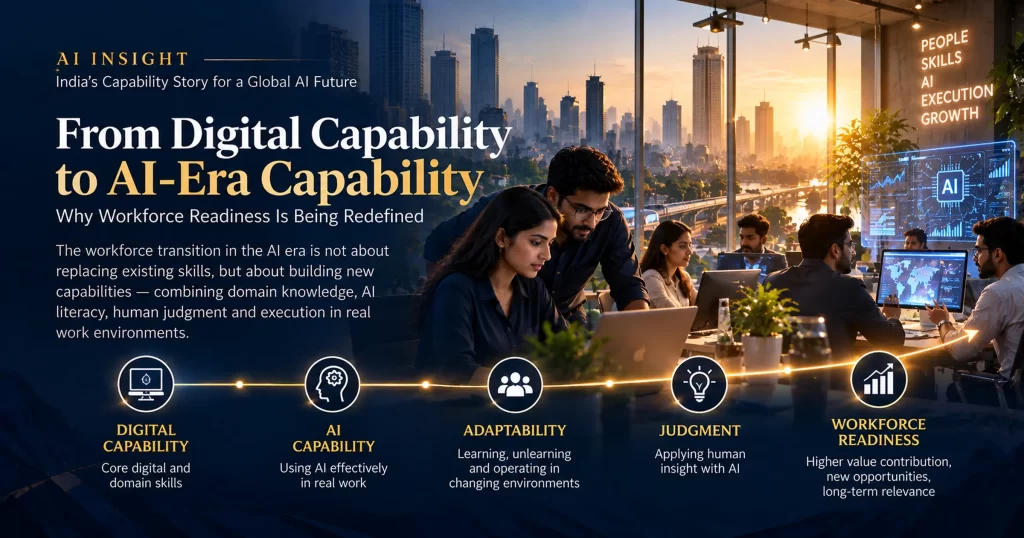
From Digital Capability to AI-Era Capability
The evolution can be understood as a progression:
Digital capability established the foundation for working effectively with digital systems.
AI capability adds the ability to work effectively alongside increasingly capable AI systems.
Future skills extend beyond technology itself to include capabilities such as analytical thinking, creative thinking, adaptability, technological literacy, systems thinking and continuous learning.
Workforce readiness then asks a broader question:
Can people apply these capabilities effectively as the nature of work changes?
And institutional capability takes the question beyond individuals:
Can organizations create the conditions in which people, technology, processes and decisions work together effectively?
This progression matters because technological change does not stop at the introduction of a new tool.
It changes the environment in which capability is exercised.
Digital Proficiency Is Still Important — But It Is No Longer the Whole Requirement
The answer is not to discard digital capability.
Digital capability remains foundational.
People still need to understand digital systems, information, platforms, communication, data and technology.
The change is that these capabilities increasingly operate alongside AI.
The World Economic Forum’s Future of Jobs Report 2025 identifies AI and big data, networks and cybersecurity, and technological literacy among the fastest-growing skill areas through 2030. At the same time, it identifies analytical thinking, creative thinking, resilience, flexibility and agility, curiosity and lifelong learning, and systems thinking as important capabilities in the changing workforce. (World Economic Forum)
This combination is significant.
The emerging capability requirement is not simply:
technology instead of human capability.
It is increasingly:
technology capability + human judgment + adaptability + application.
AI Is Changing the Work Around the Skill
One reason this transition matters is that AI does not affect only the technical specialist.
It increasingly changes the environment in which many different professionals operate.
- A marketer may use AI for research, analysis and content development.
- A manager may use AI to synthesize information and support decisions.
- An entrepreneur may use AI to accelerate research, operations and customer work.
- A designer may use AI within creative workflows.
- An educator may use AI for preparation, personalization and learning support.
- A technical professional may work with AI throughout development and problem-solving.
The tool differs.
The underlying capability question is similar:
Can the person use the technology while still understanding the work?
That distinction becomes increasingly important as AI systems become capable of producing more of the immediate output.
The professional value shifts toward understanding the problem, setting the direction, evaluating the result and integrating the output into meaningful work.
The Workforce Question Is Becoming More Complex
The public conversation about AI and employment often focuses on one question:
Will AI replace jobs?
But workforce readiness requires a broader question.
How will AI change the capability required to perform those jobs?
The difference is important.
A job is rarely one indivisible activity.
It consists of tasks, decisions, interactions, processes and responsibilities.
AI may change some of those components without eliminating the entire role.
The World Economic Forum’s 2025 analysis similarly describes technological change as a major driver of labour-market transformation and identifies a combination of technological and human capabilities as increasingly important. (World Economic Forum)
That means workforce preparation cannot depend only on predicting which job titles will grow or decline.
It must also develop people’s ability to adapt as the work inside those roles changes.
What Becomes More Important?
As AI takes on more routine cognitive work, several human capabilities become increasingly relevant.
India Is Already Moving From Digital Skilling Toward AI Readiness
This transition is not merely theoretical.
India’s skilling ecosystem is increasingly incorporating AI alongside broader digital and emerging-technology capabilities.
In August 2026, the Ministry of Skill Development and Entrepreneurship reported that the national Skilling for AI Readiness (SOAR) programme had expanded from its initial foundational courses to 50 AI and AI-application-oriented qualifications, covering areas including AI for jobs, workplace productivity and sector-specific applications. The ministry reported 5,17,477 enrolments and 1,00,664 successful completions and certifications as of 6 August 2026. (Press Information Bureau)
The government has also described FutureSkills PRIME as supporting emerging-technology capabilities across areas including AI, big data analytics, cybersecurity, IoT, semiconductors and cloud computing. (Press Information Bureau)
More recently, NIELIT and Intel India convened a national dialogue in September 2026 specifically around preparing India’s future workforce for the agentic AI era, bringing government, academia, industry and the skilling ecosystem into the discussion. (Press Information Bureau)
These developments indicate that the workforce conversation is already moving beyond conventional digital literacy toward broader AI readiness.
The next question is what readiness should actually mean.
AI Readiness Is More Than Knowing AI Tools
A person can know how to operate an AI platform and still struggle to use AI effectively in real work.
- They may know how to generate content but not how to evaluate it.
- They may know how to prompt a system but not how to frame the underlying problem.
- They may automate a task without understanding the process around it.
- They may accept an AI recommendation without examining its assumptions.
- They may produce more output without improving the quality of the decision.
This is why AI-era capability should not be reduced to a list of tools.
Tools change.
Platforms change.
Interfaces change.
Models change.
The underlying capability must be durable enough to operate through those changes.
The Post-Tool Capability Layer
This creates a layer beyond technology access.
It can be thought of as the post-tool capability layer.
The progression therefore moves from tool use toward operating capability.
That distinction is increasingly important as AI becomes less of a separate application and more of an embedded component of work.
From Individual Skills to Workforce Capability
This also changes how workforce development should be understood.
Traditional skills programmes can often focus on teaching a defined competency.
AI-era capability requires a broader progression:
Someone may understand AI without being able to apply it.
They may apply it without being able to evaluate its output.
They may evaluate individual outputs without understanding how AI should be integrated into a wider workflow.
And they may understand all of these concepts without being able to execute effectively in a real environment.
Capability therefore develops through application and increasing responsibility.
What This Means for Institutions
The transition also has implications beyond individual workers.
Organizations cannot build AI readiness simply by purchasing tools or providing isolated training.
They need people who can use those tools.
They also need people who can:
- redesign workflows;
- identify appropriate applications;
- evaluate outputs;
- manage dependencies;
- understand risks;
- coordinate human and AI work;
- establish appropriate oversight;
- learn from implementation;
- and continuously adapt.
This makes workforce capability an institutional question.
An organization with advanced technology but insufficient capability may have access without effective integration.
An organization with capable people but poor systems may struggle to translate individual ability into organizational performance.
AI readiness therefore increasingly sits at the intersection of people, technology, processes and decisions.
Capability Must Outlast the Tool
The defining characteristic of an AI-era capability framework should therefore be durability.
A person trained only on a particular interface may need to start again when the interface changes.
A person who understands how to frame problems, evaluate outputs, make decisions, adapt workflows and learn new systems has a more transferable foundation.
This does not make specific tools irrelevant.
It puts them in their proper place.
Tools are instruments of capability. They are not the complete definition of capability.
That distinction becomes more important as the technology itself accelerates.
From Digital Capability to a Broader Capability Architecture
Being Topper’s own institutional evolution reflects this broader transition.
The institution’s journey began with early digital capability programmes in 2013 and has evolved through professional capability pathways, AI integration frameworks and broader capability architecture into its current AI-era positioning.
Its current institutional position is explicitly capability-first: developing decision capability, systems thinking and execution maturity as a layer between AI infrastructure and human application.
That evolution reflects a broader change in the environment.
When technology was primarily something people had to learn to operate, digital proficiency could be the central question.
When technology becomes embedded in how people work, decide, create and operate, the question becomes broader:
What capabilities do people need to work effectively with increasingly capable technology?
And when those technologies become embedded across organizations, the question expands again:
What capabilities must institutions develop to operate responsibly and effectively in an AI-integrated environment?
The Next Workforce Advantage Is Not Simply Technical
The emerging workforce will still need technical capability.
But technical capability alone does not describe the full requirement.
The stronger foundation is the combination of:
This is not a rejection of technology.
It is a recognition that technology becomes more powerful when the human capability around it becomes more mature.
The Shift Ahead
The transition from the digital era into the AI era should therefore not be understood simply as:
Old tools → New tools.
It is a transition in the capability environment itself.
The requirement is moving:
- from operating software → to operating with intelligent systems
- from consuming information → to evaluating and directing information
- from performing tasks → to designing and improving workflows
- from tool proficiency → to decision capability
- from individual digital skills → to workforce readiness
- from technology adoption → to responsible integration
The people best prepared for this transition will not necessarily be those who know the greatest number of AI tools.
They will be those who can continue to learn, decide, adapt, integrate and execute as the tools change.
From Digital Capability to AI-Era Capability
The evolution of capability does not make the previous layer obsolete.
It builds upon it.
Digital capability created the foundation.
AI capability extends it.
Workforce readiness connects it to changing work.
Institutional capability connects individual capability to organizational systems.
And responsible technology use ensures that increasing technological capacity remains connected to judgment and accountability.
The central challenge is therefore not simply teaching people to use the next generation of technology.
It is developing the capability to work, decide, build and operate effectively as technology becomes increasingly intelligent and integrated into the environment around us.
That is the deeper shift from digital capability to AI-era capability.
The tools will continue to change. The enduring advantage will be the capability to understand them, adapt to them, decide with them and use them responsibly.
The Question Is No Longer Only What Technology Can Do.
Being Topper approaches this transition through a capability-first model for the digital and AI economy, developing the capabilities people and institutions need to work, decide, build and operate effectively in an increasingly AI-integrated economy.
The objective is not to make technology the centre of capability.
It is to develop the human and institutional capability required to use technology effectively, responsibly and with context.
From digital capability to AI-era capability, the question is no longer only what technology can do. It is what people and institutions are capable of doing with it.